

Bu içerik Türkçe olarak yazılmış olup yapay zeka ile otomatik olarak İngilizceye çevrilmiştir.
+1 Daha
The Intrigue is a painting executed in oil on canvas by Belgian artist James Ensor in 1890. The dimensions of the work are 89.5 × 149 cm. It is part of the collection of the Royal Museum of Fine Arts Antwerp in Antwerp, Belgium. The painting belongs to the period in Ensor’s career during which he extensively employed masked figures and consciously transformed figurative representation.
From the late 1880s onward, James Ensor moved away from academic conventions in figurative painting and developed a visual language centered on masks grotesque faces and theatrical scenes. The Intrigue is among the works from this period in which Ensor transformed the figure from an individual portrait into a social type. The painting is situated within Ensor’s output associated with Symbolist tendencies and clearly demonstrates his use of the mask as a fundamental narrative device.
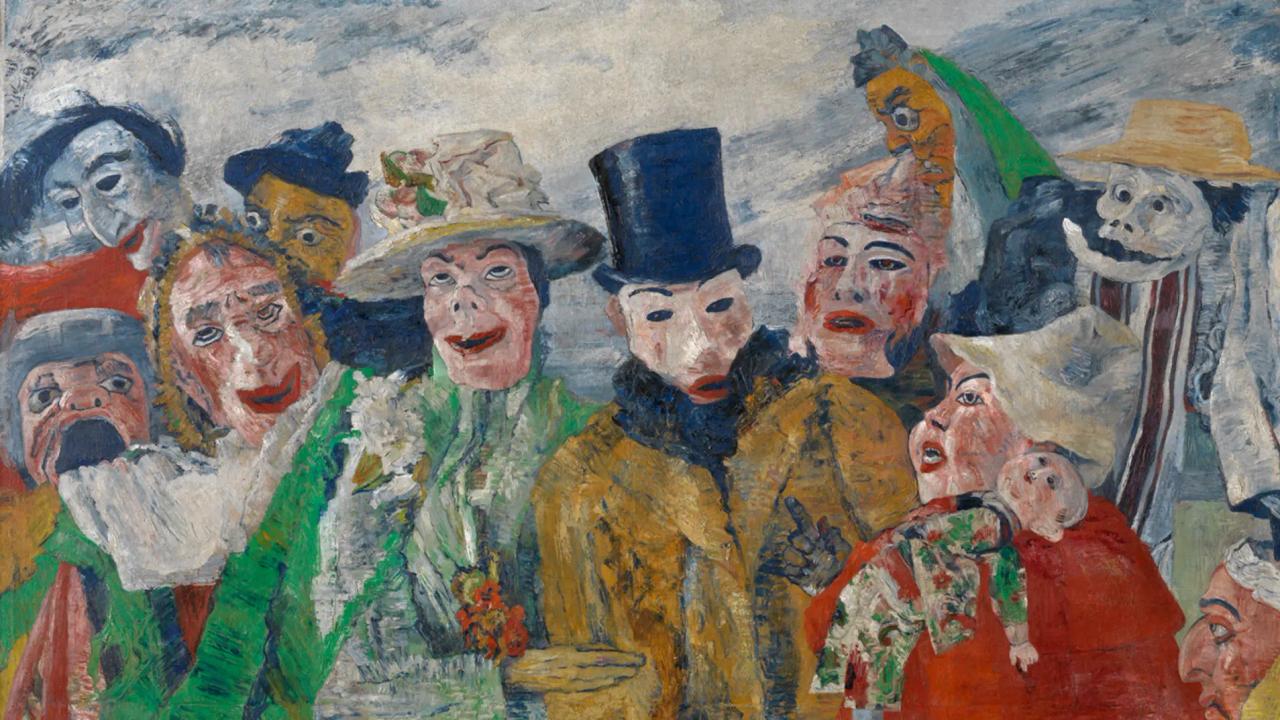
The work features a horizontal composition that creates the impression of a narrow enclosed space. The figures are densely piled toward the foreground, with spatial depth deliberately restricted. At the center is a female figure depicted with a man entering her arm. The bouquet of flowers she holds suggests a reference to marriage or a similar social bond. The surrounding figures compress this central arrangement, reinforcing the closed and tense character of the scene.
The painting contains eleven figures, all of whom wear masks. These masks feature exaggerated and often grotesque facial expressions that sharply diverge from natural human features. Individual facial identities have been entirely erased, replaced by an anonymous typological appearance. The formal variety of the masks serves to emphasize social roles and superficial representations rather than personal characteristics.
James Ensor, The Intrigue (Smarthistory)
The Intrigue assigns each mask a distinct visual function based on its position within the composition and its formal qualities. The mask of the central female figure presents a relatively smooth and controlled expression, embodying the scene’s ostensibly orderly and ceremonial character. The fixed smile on her face creates an effect of stiffness and artificiality rather than natural emotion.
The mask of the man entering her arm has sharper contours and more pronounced facial lines. While it underscores the connection between the central pair, it suggests a formal proximity rather than emotional interaction. The man’s mask presents a surface stripped of individual expression, highlighting instead his social role.
The masks surrounding the central figures draw attention through grotesque and exaggerated facial expressions. Some masks feature disproportionately enlarged mouths, prominent teeth and caricatured features. These masks reinforce the impression that the crowd is composed not of individual persons but of anonymous surfaces.
Some masks positioned at the edges of the composition are painted in darker tones and exhibit more rigid facial contours. These masks generate a visual effect that emphasizes the tense and closed nature of the relationships between the figures. The direct gaze of the masks toward the viewer transforms the scene into an inward-looking social space.
Taken together, all the masks reveal a visual structure in which individual identities have been completely erased and replaced by social representations. In this context the mask functions not as a tool of concealment but as a primary narrative element that exposes the artificiality and superficiality of social relations.
The painting does not present a clear linear narrative. Instead it establishes a closed multilayered and theatrical staging. The crowded arrangement of figures and their direct gaze toward the viewer cause the scene to be perceived as a self-contained social space. This approach to staging leaves the viewer not as a participant in the narrative but confronted with a superficial social arrangement.
The painting employs saturated and high-contrast colors. The surfaces of the masks are emphasized through sharp chromatic oppositions and visible brushstrokes that are sometimes left deliberately loose. This technical approach creates a rough and vibrating texture on the picture surface intensifying the visual tension of the scene. Ensor’s method reflects a deliberate departure from the idealized surfaces of academic painting tradition.
The Intrigue presents a visual structure that comments on the formality of social relations and the marginalization of individual identity in late 19th century Belgian society. The masks make visible on a symbolic level the determining influence of social roles on individuals. The scene depicted does not illustrate a specific event but rather addresses the social relationship structures of the era as a generalized condition.
The Intrigue is among the works in which James Ensor elevated the mask to the conceptual and structural foundation of painting. The work is associated with Symbolist tendencies and is also linked to early Expressionist approaches due to the formal exaggeration and intensity of expression of the figures. In this regard the painting holds a significant position in the development of late 19th century Belgian art and European modernism.
The Intrigue is part of the permanent collection of the Royal Museum of Fine Arts Antwerp. The work is preserved and exhibited within the museum’s dedicated collection section for James Ensor.

Henüz Tartışma Girilmemiştir
"The Intrigue (Painting)" maddesi için tartışma başlatın
Place Within the Artist’s Creative Period
Overall Composition
Figures and Masks
Function of the Masks
Narrative and Staging
Color and Technical Features
Social and Cultural Context
Position in Art History
Collection and Conservation Status