


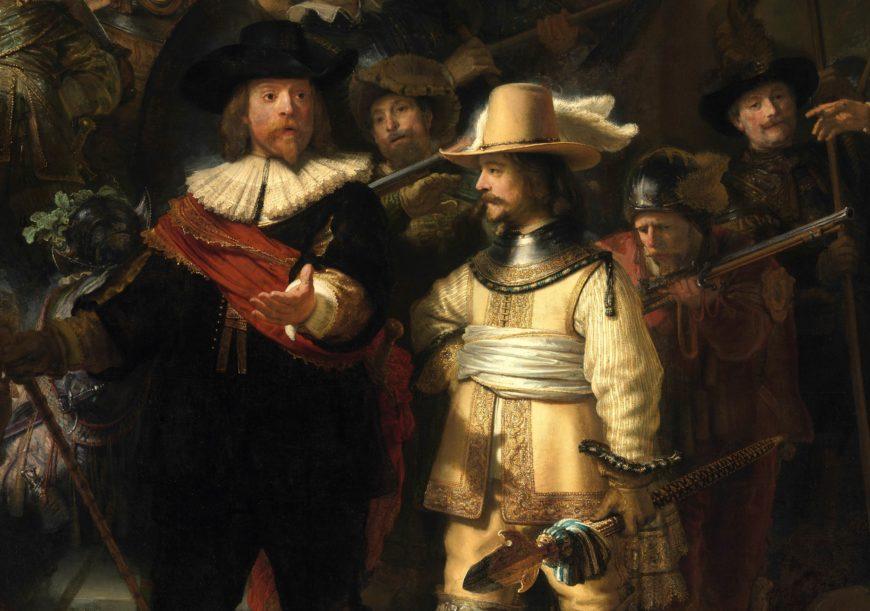
Original Title | Militia Company of District II under the Command of Captain Frans Banning Cocq | ||||||||
|---|---|---|---|---|---|---|---|---|---|
Artist | Rembrandt van Rijn | ||||||||
Location | Rijksmuseum / Amsterdam | ||||||||
Year of Creation | 1642 | ||||||||
Technique | Oil on Canvas | ||||||||
Size(s) | 379.5 x 453.5 cm | ||||||||
Subject(s) | Group portrait of the Amsterdam city militia | ||||||||
Key Figures | Captain Frans Banning Cocq and Lieutenant Willem van Ruytenburgh | ||||||||
Distinguishing Feature | A composition that adds movement, light, and depth to the traditional group portrait | ||||||||
The Night Watch (De Nachtwacht), officially titled The Militia Company of District II under the Command of Captain Frans Banninck Cocq, is an oil painting on canvas created by Dutch Baroque painter Rembrandt van Rijn in 1642. The painting is exhibited at the Rijksmuseum in Amsterdam and is regarded as one of the iconic works of the Dutch Golden Age. Measuring 3.63 x 4.37 meters, it depicts one of the city’s militia companies in a lively, dynamic, and theatrical composition.
Members of Amsterdam’s militia commissioned the painting as a group portrait glorifying their role in protecting the city and maintaining order. However, Rembrandt offers an unconventional interpretation of this genre: instead of arranging the figures in a static row, he creates a dynamic scene supported by dramatic contrasts of light and shadow. The figures appear to be in a grand parade, almost as if on a theater stage.
Due to the darkened varnish and physical degradation over time, the scene was mistakenly believed to depict a nighttime event, hence the title The Night Watch. In reality, however, the scene takes place in daylight.

The Night Watch (Rijksmuseum)
Although The Night Watch is technically a commissioned militia portrait, it avoids static representation thanks to Rembrandt’s unique compositional approach. Captain Frans Banninck Cocq and his lieutenant, Willem van Ruytenburch, occupy the foreground, highlighting the hierarchy among the figures. The selective use of light directs the narrative flow.
The arrangement of the large group deviates from classical norms: some figures remain in shadow while others are abruptly illuminated. Even details like the dog in the background contribute to the narrative. Rather than compressing all the figures into a uniform structure, Rembrandt establishes a visual rhythm that guides the viewer’s eye.
The painting was commissioned by the Kloveniersdoelen, the headquarters of a civic militia in Amsterdam. Such group portraits were common in the Dutch Republic, particularly in Amsterdam, and adorned the halls of militia guilds to emphasize their power, solidarity, and individual identities. These militias were responsible for guarding city gates, maintaining street security, extinguishing fires, and participating in ceremonies.
Each militia company had its own specific weaponry (longbows, crossbows, muskets) and emblems. The company portrayed here consists of kloveniers, or musketeers. Each member paid according to the visibility of their portrait in the composition.
Unlike typical portraits of the time, where figures are arranged statically, Rembrandt opted for a dynamic moment of action. It appears as if the scene captures a specific event. In the foreground are Captain Frans Banninck Cocq in a black outfit with a red sash, and Lieutenant Willem van Ruytenburch in a bright yellow suit with a steel gorget and ceremonial spear. The names of the sixteen other militia members are inscribed on a plaque beneath the painting’s arch.
Rembrandt also included non-paying figures to enliven the scene: a boy carrying gunpowder, a drummer setting the rhythm, a barking dog, a flag bearer high above, and even a possible self-portrait visible through a single eye in the background.
Three figures near the center of the painting demonstrate sequential steps in using a musket, forming a visual narrative chain. From left to right: one pours gunpowder, another fires the musket, and a third blows out the residual powder to clean the barrel. This sequence is thought to be inspired by 1607 military drill manuals.
One of the most mysterious figures is the young girl in golden-yellow attire appearing behind the red-clad musketeer. The white chicken hanging from her waist, particularly its claws, alludes to the golden claw emblem of the Kloveniers company. This figure is believed to be an allegorical representation of the company’s spirit rather than a real person.
Rembrandt Harmenszoon van Rijn was one of the most prolific and influential artists of 17th-century Holland. Born in Leiden in 1606, he studied at a Latin school and Leiden University before continuing his art career in Amsterdam. His work reflects not only technical mastery but also a deep understanding of human nature. His portraits and historical scenes are marked by spiritual depth, emotional realism, and dramatic use of light.
Renowned for his portraits, self-portraits, and biblical/mythological scenes, Rembrandt is particularly known for his use of chiaroscuro (light-dark contrast). The Night Watch is considered a pinnacle of his artistic daring and innovation. He also employed tenebrism (sharp light contrasts on dark backgrounds) and impasto (thick layers of paint). Rather than idealizing beauty, Rembrandt emphasized lived experience and psychological depth in his subjects, adding both humanism and intensity to his work.
Scientific analyses have revealed details about Rembrandt’s material choices, for example:

Van Ruytenburch’s Bright Yellow Pigments. (Rijksmuseum)
In 2019, the Rijksmuseum launched “Operation Night Watch,” a multi-disciplinary research project that lasted 2.5 years. Using various spectroscopic and imaging techniques, researchers documented the painting’s original creation process and its subsequent transformations in great detail.
High-resolution scans have made visible the initial sketches Rembrandt used while composing the work. These drafts include additional spears that were ultimately omitted and a sword placed between the captain and his lieutenant. Elements like Claes van Cruijsbergen’s helmet feathers appeared in the preliminary drawing but were not included in the final version.

The Final Version (Left) and the Revealed Underpainting (Right) of The Night Watch. (Rijksmuseum)
Over centuries, restorations, transport, and environmental effects caused various deformations:

Deformation in the Top Left Corner of the Painting. (Rijksmuseum)

Discoloration on the Dog in The Night Watch. (
Rembrandt redefines the genre of militia group portraits with revolutionary flair. Instead of static poses, he creates scenes that pull the viewer in. His use of light reflects both character hierarchy and emotional intensity. Expressions, costumes, and gestures enrich the visual story.
Not only do the two main figures stand out, but background characters and even the dog contribute actively to the composition. This reveals Rembrandt’s ability to preserve individuality within a group scene.
The Night Watch is a cultural artifact rediscovered through modern scientific tools. From an art historical perspective, it redefines classical genre painting. Simultaneously, through the lenses of material science, chemistry, and visual technology, it allows for multilayered readings.
The work also functions as a symbolic document reflecting art, society, and power dynamics. Rembrandt’s capacity for theatrical staging, his use of light as a narrative device, and his creation of scenes that feel historical without being literal elevate his art beyond the conventions of his time.
Gabrieli, Francesca, John K. Delaney, Robert G. Erdmann, Victor Gonzalez, Annelies van Loon, Patrick Smulders, Roy Berkeveld, Robert van Langh, and Katrien Keune. “Reflectance Imaging Spectroscopy (RIS) for Operation Night Watch: Challenges and Achievements of Imaging Rembrandt’s Masterpiece in the Glass Chamber at the Rijksmuseum.” Sensors 21, no. 20 (2021): 6855. Accessed August 1, 2025. https://www.mdpi.com/1424-8220/21/20/6855.
Rijksmuseum. “Operation Night Watch – Results of the Research.” Rijksmuseum.nl. Accessed August 1, 2025. https://www.rijksmuseum.nl/en/whats-on/exhibitions/operation-night-watch/story/results-of-the-research.
Rijksmuseum. “Operation Night Watch.” Rijksmuseum.nl. Accessed August 1, 2025. https://www.rijksmuseum.nl/en/whats-on/exhibitions/operation-night-watch.
Rijksmuseum. “The Night Watch: Militia Company of District II under the Command of Captain Frans Banninck Cocq.” Rijksmuseum.nl. Accessed August 1, 2025. https://www.rijksmuseum.nl/en/collection/object/The-Night-Watch-Militia-Company-of-District-II-under-the-Command-of-Captain-Frans-Banninck-Cocq--3137deb45cd7765f9a76084a16c99544.
Schaller, Wendy. “Rembrandt, The Night Watch.” Smarthistory. Accessed August 1, 2025. https://smarthistory.org/rembrandt-the-night-watch/.


Original Title | Militia Company of District II under the Command of Captain Frans Banning Cocq | ||||||||
|---|---|---|---|---|---|---|---|---|---|
Artist | Rembrandt van Rijn | ||||||||
Location | Rijksmuseum / Amsterdam | ||||||||
Year of Creation | 1642 | ||||||||
Technique | Oil on Canvas | ||||||||
Size(s) | 379.5 x 453.5 cm | ||||||||
Subject(s) | Group portrait of the Amsterdam city militia | ||||||||
Key Figures | Captain Frans Banning Cocq and Lieutenant Willem van Ruytenburgh | ||||||||
Distinguishing Feature | A composition that adds movement, light, and depth to the traditional group portrait | ||||||||
Henüz Tartışma Girilmemiştir
"The Night Watch (Painting)" maddesi için tartışma başlatın
Historical Context and Background
Artistic Innovation
The Civic Guard and Social Background
Composition and Figures
Weapons and Narrative Motion
Symbolic Elements: “The Golden Girl”
The Artist: Rembrandt van Rijn (1606–1669)
Technical Features and Materials
Creative Process and Early Drafts
Age-Related Damages
Artistic Meaning and Innovation
Artistic Legacy
Bu madde yapay zeka desteği ile üretilmiştir.

