


Bu içerik Türkçe olarak yazılmış olup yapay zeka ile otomatik olarak İngilizceye çevrilmiştir.
+1 Daha
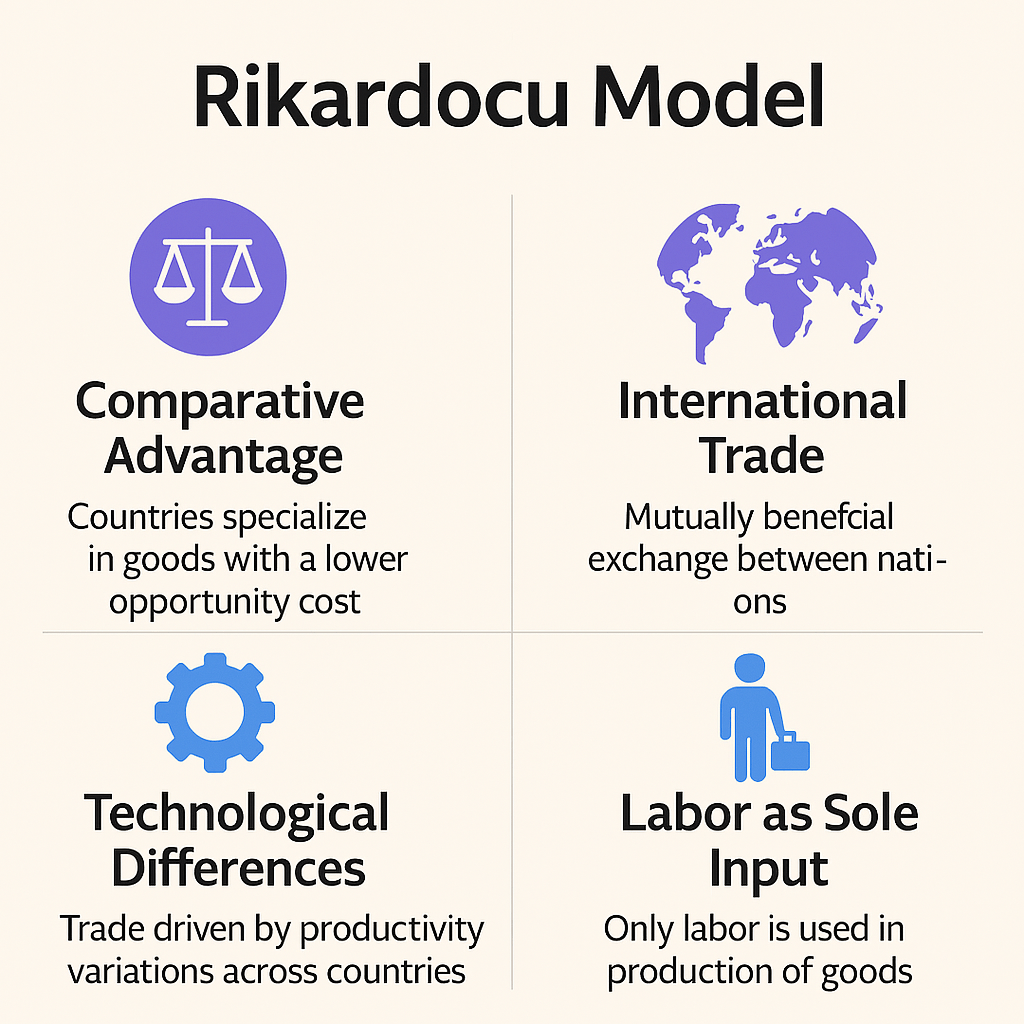
The Ricardian Model is a theory developed by David Ricardo in 1817 that identifies comparative advantage as the fundamental reason for international trade classical. The model argues that countries can achieve mutual benefits gain from trade by specializing in goods where they have a relative efficiency advantage independent based on their absolute strengths. This approach treats labor as the sole production factor production and asserts that technological differences determine trade patterns Only. Despite its simple assumptions, the Ricardian Model is one of the most effective theories explaining the growth-enhancing effects of free trade prosperity and has formed the foundation of modern trade theories.
The Ricardian Model is one of the foundational pillars of international trade theory and was first presented by David Ricardo in his 1817 work Principles of Political Economy and Taxation. The model contends that the primary determinant of international trade is comparative advantage and demonstrates that countries can gain from trade by specializing in goods they produce relatively more efficiently, regardless of absolute advantage.

Example table for the Ricardian Model (generated with artificial intelligence assistance)
Ricardo’s model operates within a simple framework involving two countries and two goods, asserting that trade is driven not by differences in factor endowments but by technological differences—in other words, variations in labor productivity. The model’s core assumptions are as follows:
This model is widely regarded as one of the simplest yet most powerful frameworks for explaining why and how trade emerges.
Ricardo’s theory of comparative advantage argues that countries should specialize in producing goods for which they have a lower opportunity cost relative to other goods, not necessarily those in which they have an absolute advantage. For example, suppose Country A produces one unit of textile in 1 hour and one unit of wheat in 2 hours. Country B produces one unit of textile in 3 hours and one unit of wheat in 1 hour. In this case:
Therefore:
The Ricardian Model is one of the most fundamental theories asserting that international trade generates mutual gains and that free trade enhances economic welfare. It continues to be applied today in the following areas:
1. International Trade Policies: The model demonstrates that countries benefit more from specialization and trade than from protectionism. The World Trade Organization (WTO) and free trade agreements are founded on this principle World.
2. Globalization and Production Distribution: Ricardo’s principle of specialization underpins the modern practice of multinational corporations dividing production processes across different countries. For instance, countries with low labor costs specialize in labor-intensive industries, while advanced economies focus on capital-intensive production technology.
3. Labor Productivity and Technological Differences: The Ricardian Model posits that productivity differences between countries are the key determinant of trade. Today, access to technology and innovation capacity are critical factors shaping trade advantages among nations main important.
Although the Ricardian Model provides a crucial foundation for understanding trade, it has several limitations:
To address these shortcomings, more advanced models have been developed, including the Heckscher-Ohlin Model, the New Trade Theory (Krugman, 1980), and the New-New Trade Theory (Melitz, 2003) like.
The Ricardian Model is one of the simplest and most effective theories developed to explain the causes of international trade. The principle of comparative advantage enables countries to specialize in areas where they are most efficient, thereby increasing production and enhancing global welfare. However, the simplicity of its assumptions creates limitations in explaining today’s complex trade relationships. Nevertheless, it remains one of the most important theories underpinning the belief that free trade supports economic growth together.

Henüz Tartışma Girilmemiştir
"The Ricardian Model in International Trade" maddesi için tartışma başlatın
Definition and Theoretical Framework
Comparative Advantage and Model Operation
Applications and Significance of the Ricardian Model
Criticisms of the Model’s Assumptions