


+2 Daha


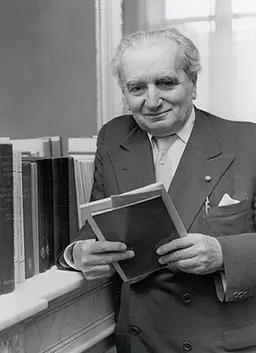
Theodore von Kármán was a pioneering scientist in aerodynamics and applied mathematics whose career spanned from Europe to the United States, significantly contributing to the institutionalization of aerospace engineering. He played a leading role in the founding of the Jet Propulsion Laboratory (JPL) and in the establishment of the Advisory Group for Aeronautical Research and Development (AGARD) within NATO, promoting international scientific collaboration. Numerous fundamental scientific concepts, including the Kármán vortex street, Kármán constant, and the Kármán line, are named in his honor.

Illustrative Image Showing the Kármán Line (Generated by Artificial Intelligence)
Theodore von Kármán was born on May 11, 1881, in Budapest. His father, Moritz von Kármán, was a university professor and an educational reformer in the Hungarian Ministry of Education, and his mother, Helene Konn, came from an intellectually prominent background. Displaying a remarkable aptitude for mathematics at a young age, von Kármán graduated from the Minta Gymnasium and earned his mechanical engineering degree from the Budapest University of Technology and Economics in 1902.
He continued his education at the University of Göttingen, where he worked under Ludwig Prandtl and completed his doctorate in 1908. Between 1909 and 1912, he served as an academic at Göttingen, contributing significantly to solid mechanics, particularly through the development of the Föppl–von Kármán equations explaining large deflections in elastic plates.

"Image from Kármán's Lecture (JPL-NASA)
In 1912, von Kármán was appointed founding director of the Aerodynamics Institute at RWTH Aachen University in Germany. During World War I, he contributed to the Austro-Hungarian Army's research efforts by assisting in the development of tethered helicopters at Fischamend.
After the war, in 1922, he organized an international congress on applied mechanics in Innsbruck, laying the groundwork for the later establishment of the International Union of Theoretical and Applied Mechanics (IUTAM).
In 1926, invited by Robert A. Millikan, von Kármán moved to the United States and began his collaboration with the California Institute of Technology (Caltech). In 1930, he became the director of the Guggenheim Aeronautical Laboratory (GALCIT). Following the rise of the Nazi regime, he left Germany permanently and became a U.S. citizen in 1936.
At Caltech, von Kármán and his students focused on rocket propulsion systems, leading to the founding of the Jet Propulsion Laboratory (JPL) in 1944 and the formation of Aerojet General Corporation. In 1941, he and his team successfully conducted the first restricted solid-fuel JATO (Jet Assisted Take-Off) test at March Field, California.

The First Successful Limited-Combustion Solid Fuel Test in the United States (JPL-NASA)
Recognizing the importance of international cooperation, von Kármán founded AGARD within NATO in 1951 and served as its chairman until his death. He also established the Von Kármán Institute for Fluid Dynamics (VKI) in Belgium in 1956.
Theodore von Kármán made substantial contributions to several fields, including:

Kármán Line (Generated by Artificial Intelligence)
Von Kármán died on May 7, 1963, in Aachen. He is buried at Hollywood Forever Cemetery in Los Angeles. His name has been given to craters on the Moon and Mars, scientific concepts, institutes, and prestigious awards. His famous quote, "Scientists discover the world that exists; engineers create the world that never was," highlights his deep engagement with both theoretical and practical aspects of science and engineering.
BBC Sky at Night Magazine. "Where Does Space Begin?" BBC Sky at Night Magazine. Accessed April 15, 2025. https://www.skyatnightmagazine.com/space-science/where-does-space-begin.
Dryden, Hugh. "Dr. Theodore von Kármán, For.Mem.R.S.." Nature 199 (1963): 20–21. https://doi.org/10.1038/199020a0.
GALCIT - California Institute of Technology. "Theodore von Kármán." GALCIT - California Institute of Technology. Accessed April 15, 2025. https://www.galcit.caltech.edu/about/legends-of-galcit/theodore-von-k%C3%A1rm%C3%A1n.
Greenberg, John L., and Judith R. Goodstein. "Theodore von Kármán and Applied Mathematics in America." Science 222, no. 4630 (1983): 1300–1304. https://doi.org/10.1126/science.222.4630.1300.
NASA Jet Propulsion Laboratory. "Dr. Theodore von Kármán (1881-1963)." NASA Jet Propulsion Laboratory. Accessed April 15, 2025. https://www.jpl.nasa.gov/who-we-are/faces-of-leadership-the-directors-of-jpl/dr-theodore-von-karman-1881-1963/.
NASA Jet Propulsion Laboratory. "Slice of History: Happy Birthday, Dr. von Kármán." NASA Jet Propulsion Laboratory. Accessed April 27, 2025. https://www.jpl.nasa.gov/images/slice-of-history-happy-birthday-dr-von-karman/.
NATO Science and Technology Organization. "Theodore von Kármán." NATO Science and Technology Organization. Accessed April 15, 2025. https://www.sto.nato.int/Pages/theodore-von-karman.aspx.
Royal Society. "Theodore von Kármán (1881–1963)." Biographical Memoirs of Fellows of the Royal Society 12 (1966): 335–351. https://royalsocietypublishing.org/doi/pdf/10.1098/rsbm.1966.0016.
RWTH Aachen - AStA. "Theodore von Kármán." RWTH Aachen - AStA. Accessed April 15, 2025. https://www.asta.rwth-aachen.de/en/theodore-von-karman/.
The American Presidency Project. "Statement by the President on the Death of Dr. Theodore von Kármán." The American Presidency Project. Accessed April 15, 2025. https://www.presidency.ucsb.edu/documents/statement-the-president-the-death-dr-theodore-von-karman.
Von Karman Institute for Fluid Dynamics. "Theodore von Kármán." Von Karman Institute for Fluid Dynamics. Accessed April 15, 2025. https://www.vki.ac.be/index.php/home-v16/about-vki/73-about-vki/about-vki/560-theodore-von-karman.

Henüz Tartışma Girilmemiştir
"Theodore von Kármán" maddesi için tartışma başlatın
Early Life and Education
Scientific Career in Europe and the Aachen Years
Move to the United States and Caltech
International Scientific Collaboration and AGARD
Contributions to Science
Fluid Mechanics and Aerodynamic Theories
Solid Mechanics
Applied Mathematics
Rocket Science and Propulsion Systems
Engineering Consultancy and Public Infrastructure
Environmental Engineering
Major Publications
Honors and Awards
Legacy
Bu madde yapay zeka desteği ile üretilmiştir.