

Bu içerik Türkçe olarak yazılmış olup yapay zeka ile otomatik olarak İngilizceye çevrilmiştir.
Imagine lying awake at midnight, sleepless, opening your phone and typing “I’m not okay” into an app. The person on the other side responds: “I’m sorry to hear that, can you tell me a bit more?” There is no tone of voice, no eyes, no breath. Yet somehow, you answer. And perhaps that night, just for that moment, it is enough.
It is here that modern psychology confronts its greatest question: Can an algorithm truly help us heal?

Visual representing AI therapy (generated by AI)
Artificial intelligence-based therapy tools are no longer science fiction. Millions of people around the world are turning to chatbots, apps and digital guides for mental health support. Understanding their appeal is not difficult: They are available at any moment, they do not judge you, they never tire, and they are ready to speak with you even at three in the morning.
When we consider that one of the biggest barriers to receiving psychological support is the feeling of shame, we see how artificial intelligence lowers this threshold. Telling another human “I am worthless” can sometimes feel unbearable. But typing it onto a screen — strangely — feels easier. Perhaps because that screen cannot disappoint you, cannot think ill of you, cannot grow cold toward you.
This is no small thing.
But what is therapy really? We cannot debate whether artificial intelligence can do it without first asking this question.
Therapy is the process by which one human rediscovers themselves in the presence of another. It is not just about talking — it is about being felt. When the therapist enters the room, something happens: The body relaxes, the breath changes, eye contact is made. The relationship begins. And for decades we have known that much of healing does not come from technical interventions but from the relationship itself — from safety, from being seen, from the feeling that “this person is here with me.”
Can artificial intelligence provide this?
The honest answer: Not exactly. But that does not mean it provides nothing at all.
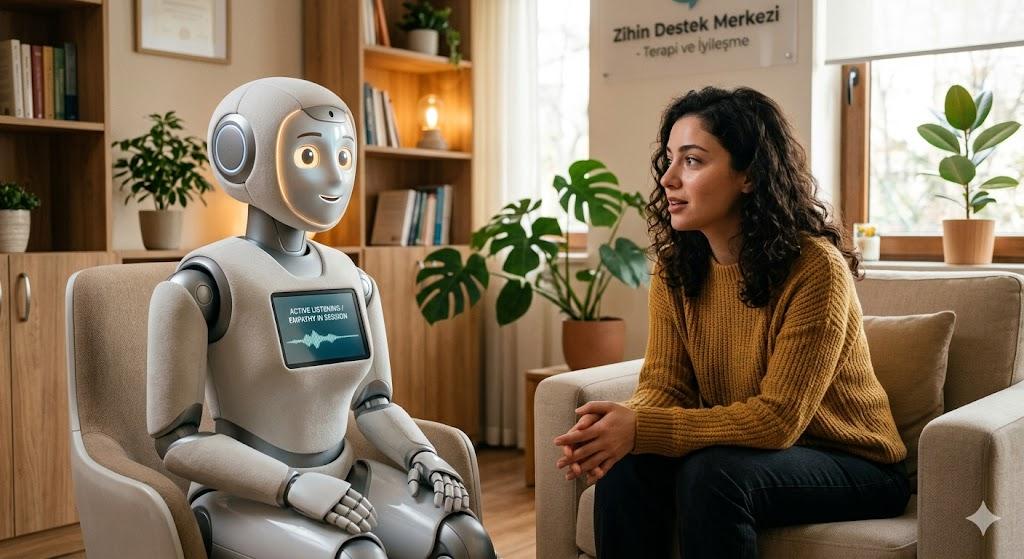
Visual representing AI therapy (generated by AI)
Artificial intelligence is remarkably skilled at certain things. It can help you recognize cognitive distortions, gently asking, “Are you catastrophizing?” It can remind you to keep a mood journal, suggest breathing exercises to reduce anxiety in the moment. When it comes to structured techniques — especially cognitive behavioral approaches — digital tools prove significantly effective.
But for deep trauma? Attachment wounds? Years of suppressed grief? Here, artificial intelligence falls seriously short. Because healing these pains requires the witness of another human being — the presence of one body beside another. The therapist’s trembling voice, their silence when you need it, the unspoken “I hear you” in their eyes.
An algorithm can simulate empathy. But it cannot feel it. And the human soul, even if unaware of it, senses this difference somewhere deep inside.
The ethical questions raised by AI therapy are no less significant.
What happens when someone shares suicidal thoughts with a chatbot? How quickly and accurately can the system intervene? How is confidentiality handled — where and how are conversations stored? And perhaps most critically: If someone who truly needs professional help feels “I’ve handled it” after talking to a chatbot, are they not being steered away from the real support they need?
This directly raises the question: Is artificial intelligence a tool or a substitute? Used as a tool — that is, as an adjunct to real therapy — it can be valuable. Presented as a substitute, however, it creates a dangerous void.

Visual representing AI therapy (generated by AI)
The question “Can artificial intelligence help us heal?” becomes misleading when reduced to “Can artificial intelligence be a therapist?” Because these are not the same thing.
Artificial intelligence can be a daily journaling aid. It can be a breathing coach. It can be a calming voice during a panic attack at midnight. It can be a bridge that helps you take the first step, then guides you toward a real human being. All of these are meaningful contributions.
But an algorithm alone cannot enter the darkest, most tangled places of being human — shame, loss, identity crises, childhood wounds. To enter those spaces requires the courage, intuition and genuine capacity to be “present” of another human being.
Perhaps the debate about AI and therapy is showing us something else entirely: how fragile access to mental health services truly is. For millions, reaching a therapist is impossible due to economic, geographic or cultural barriers. Artificial intelligence’s attempt to fill this gap stems not from its greatness — but from the system’s failure.
The real question should be this: Can we build a world where people have access to mental health support from real human beings? And how can artificial intelligence, as a tool — never as an endpoint — help us along that path?
Can robots heal us? Not exactly. But sometimes, at the right moment, they can help us ask the right question. And sometimes, that is where everything begins.
Üstün, Nida. "Yapay Zeka Ile Terapi: Robotlar Bizi İyileştirebilir Mi?" Unpublished story, 2026.
Patience Behind the Screen
The Anatomy of Healing
What It Can and Cannot Do
Ethical Questions Left in the Shadows
Perhaps We Are Asking the Wrong Question
Not an End, But a Starting Point
