Bu içerik Türkçe olarak yazılmış olup yapay zeka ile otomatik olarak İngilizceye çevrilmiştir.
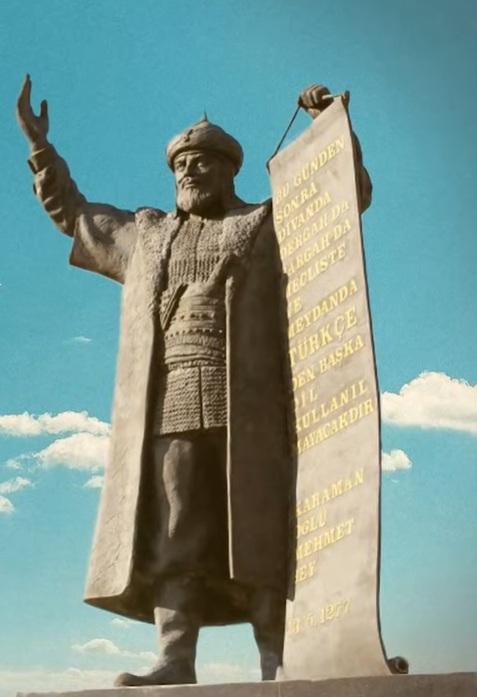
Turkish Language Day is an annual holiday observed on 13 May in commemoration of the linguistic decree dated 13 May 1277, which holds symbolic significance in the historical development of Turkish in Anatolia. According to traditional narratives, this date is associated with the decree issued by Karamanoğlu Mehmed Bey: “From now on, no one shall speak any language other than Turkish in the palace, the divan, assemblies, or public spaces”; it is regarded as a strong declaration of intent to establish Turkish as the language of the court, the divan, councils, and public life.【1】 In this sense, Turkish Language Day is not merely a remembrance of a historical event but also carries meaning in emphasizing Turkish’s place in administrative, cultural, and social life.
The development of Turkish as a written language in Anatolia is the result of a long historical process that began with the settlement of Oghuz tribes in the region from the 11th century onward. The Oghuz groups migrating from Turkistan were initially not entirely distinct from the Karakhanid literary tradition. Consequently, the written language used in the early period exhibited a “mixed Oghuz” character, blending Oghuz elements with features of Eastern Turkish. From the late 13th century, however, as settled life strengthened in Anatolia, beylik centers emerged, and local cultural environments developed, a new written language based on Oghuz Turkish began to take shape. This period marked a transitional phase during which Anatolian Turkish gradually separated from Karakhanid and Eastern Turkish influences and acquired its own regional characteristics.
Video Introducing Turkish Language Day (Presidency of Communication of the Republic of Türkiye)
In the Great Seljuk and Anatolian Seljuk states, the use of Turkish in official domains remained limited. In the Great Seljuk sphere, Arabic dominated as the language of religious sciences and madrasas, while Persian was prominent as the language of literature and administration; this tradition continued largely in the Anatolian Seljuks. The strong position of Persian in 13th-century Anatolia within madrasas, Sufi circles, literary production, and state correspondence, despite Turkish’s widespread use as a vernacular language, caused Turkish to remain in the background in high culture and administration. Mevlana’s composition of his works in Persian is a notable example illustrating this cultural context; in educated circles of the period, Persian was not merely a literary preference but also a written language linked to science, Sufism, and court culture.【2】
In the second half of the 13th century, the weakening of the Anatolian Seljuk state under Mongol pressure led to the fragmentation of political authority and the rise of the Anatolian Beyliks. In this context, Turkish became more visible not only as a spoken language but also in literary and administrative domains. The Beylik Period, despite its politically fragmented structure, gained historical significance as the era in which a national written language was established. The production of works in Turkish by figures such as Gülşehrî, Âşık Paşa, Hoca Mesud, Şeyhoğlu Mustafa, Ahmedî, and Kadı Burhaneddin contributed to the strengthening of Turkish as a literary language in Anatolia.【3】 In this context, the 1277 linguistic decree attributed to Karamanoğlu Mehmed Bey should not be viewed as an isolated rupture but as one of the symbolic milestones in a longer historical transformation during which Turkish expanded its written and public usage in Anatolia.
The 1277 decree emerged during a period when the Anatolian Seljuk state was weakening under Mongol pressure and Turkmen elements were increasingly challenging central authority. During this time, Karamanoğlu Mehmed Bey allied with Siyavuş and marched on Konya; this brief but significant seizure of the Seljuk capital left a lasting mark in historical memory not only for its military and political dimensions but also for the decision it made regarding the status of Turkish in public life. The installation of Siyavuş on the Seljuk throne and the minting of coins in his name indicate that this movement aimed at direct seizure of power rather than being a mere Turkmen uprising.
Video on Why 13 May Became Turkish Language Day (TRT Avaz)
In this context, the famous phrase associated with Turkish Language Day is recorded in sources as: “Şimden girü hiç kimesne kapuda ve divanda ve mecalis ve seyranda Türkî dilinden gayri dil söylemeye”.【4】 This sentence, commonly translated into modern Turkish as “From now on, no one shall use any language other than Turkish in the palace, the divan, assemblies, or among the people,” embodies a decision that envisioned Turkish not merely as a spoken vernacular but as the language of governance, meetings, and public communication.【5】 In the text, “kapu” refers to the palace and state gate; “divan” to the administrative and decision-making body; “mecalis” to meetings and councils; and “seyran” to public spaces and visibility.
However, it remains debated whether this decree was issued solely by Karamanoğlu Mehmed Bey as an individual order or whether it was a decision adopted by the Seljuk divan convened in Konya. Erdoğan Merçil’s research emphasizes that the popular narrative has gradually reduced the event to the personal will of Karamanoğlu Mehmed Bey, whereas primary sources indicate that the decision was made within the context of the divan. Therefore, Merçil argues that a more balanced interpretation would view the 1277 linguistic decree not merely as a personal firman but as a product of the brief political transition in Konya and the prevailing political climate of the time.【6】
Nevertheless, the name of Karamanoğlu Mehmed Bey has become a powerful symbol associated with the public and administrative presence of Turkish in Anatolia. This is because, regardless of historical details, the decree is remembered as a declaration of will that elevated Turkish’s visibility against the dominance of Arabic and Persian in madrasas, literature, and bureaucracy. In this sense, the 1277 decree is not the sole origin of Turkish becoming a written language in Anatolia but one of the most prominent turning points in its cultural memory. The celebration of Turkish Language Day on 13 May is founded upon this symbolic meaning.
The most significant debate concerning the 13 May 1277 linguistic decree concerns who issued it and within what institutional context. The popular narrative directly attributes the official declaration of Turkish as a state language to Karamanoğlu Mehmed Bey, presenting the phrase as his personal firman. However, Erdoğan Merçil notes that this narrative gained strength over time in historical writing, particularly after Fuat Köprülü, who placed Karamanoğlu Mehmed Bey at the center of the event. According to Merçil, careful examination of sources reveals that the decree cannot be explained solely as the personal will of Mehmed Bey; rather, the event must be understood within the context of the Seljuk divan convened in Konya and Siyavuş’s brief attempt to assume the throne.【7】
One key basis of this critical approach is Mehmed Bey’s position at the time the decree was issued. According to Merçil’s assessment, portraying Mehmed Bey as the sole ruler who issued the decree oversimplifies the historical process. On those days, Siyavuş had been installed on the Seljuk throne, a divan had been convened, and state decisions were made within this new political framework. Mehmed Bey’s appointment as vizier occurred not immediately before but several days after the decree. Therefore, it is considered a more cautious interpretation to view the ruling on the use of Turkish as a decision of the Seljuk divan rather than a personal firman.【8】
Another contested issue concerns the date of 13 May itself and the textual transmission of the decree. According to the evaluation in the Atatürk Encyclopedia, Hayrullah Efendi assigned the date 10 Zilhicce 676 to this event; however, its Gregorian equivalent is 4 May 1278. In contrast, Siyavuş’s ascension to the Seljuk throne and the divan proceedings in Konya are linked to 15 May 1277. Thus, there are notable discrepancies among sources regarding both the date and the wording of the decree that require careful scholarly attention.【9】
Nonetheless, the name of Karamanoğlu Mehmed Bey has become synonymous in historical memory with the public visibility of Turkish in Anatolia. In the Turkish Language Association’s commemorative texts for 2023, 2024, and 2025, 13 May 1277 is still referred to as the date on which Karamanoğlu Mehmed Bey declared Turkish an official language; this event is presented as a symbolic threshold for the preservation, development, and transmission of Turkish to future generations. This institutional narrative establishes a more definitive account than the cautious scholarly assessments.
During the Republican period, the issue of language was not treated merely as a matter of regulation in writing and speech but as one of the foundational pillars in shaping the cultural identity of the new society. Mustafa Kemal Atatürk regarded Turkish as one of the principal elements of Turkish culture; following the 1928 Alphabet Reform, he spearheaded the establishment of the Turkish Language Research Society on 12 July 1932 to investigate the origins, development, simplification, and position of Turkish among world languages. This institution later became the Turkish Language Association and emerged as one of the primary centers for implementing the Republic’s language policies.
Shortly after the founding of the Turkish Language Research Society, the First Turkish Language Congress convened on 26 September 1932 at Dolmabahçe Palace in Istanbul. The congress’s primary aim was to study the historical depth, structure, and richness of Turkish in comparison with other languages and to institutionalize efforts toward its simplification and development. Lasting nine days, the congress brought together numerous scholars, journalists, writers, state officials, and artists; Atatürk attended the sessions, listened to presentations, and held discussions with linguists. On the final day, it was proposed and accepted that 26 September, the opening day of the congress, be celebrated as Language Day.
Initially, 26 September Language Day emerged as the institutional anniversary of the Turkish Language Research Society but quickly assumed the character of a nationally celebrated holiday. From 1933 onward, it was regularly observed and developed in tandem with the early Republic’s language policies. People’s Houses, newspapers, and radio broadcasts played significant roles in the celebrations; lectures on language were delivered, poems were recited, speeches were given, and efforts toward the simplification of Turkish were communicated to the public. Thus, 26 September became not merely a commemorative day for the founding of the Turkish Language Association but an institutional holiday that conveyed the Republic’s understanding of language to society.
Turkish Language Day on 13 May, however, is rooted in a different historical context than the 26 September Language Day of the Republican era. This date is linked to the 1277 linguistic decree attributed to Karamanoğlu Mehmed Bey and acquired the character of a cultural commemoration, particularly through celebrations centered in Karaman.
Therefore, during the Republican period, the concept of Turkish Language Day took shape through two distinct commemorative traditions. 26 September gained institutional and official status through the Turkish Language Research Society and the First Turkish Language Congress, while 13 May was adopted based on the symbolic significance of Karamanoğlu Mehmed Bey’s stance on the public use of Turkish. In recent years, the Turkish Language Association’s messages on 13 May continue to refer to this date as a pivotal moment in the recognition of Turkish as a state language and its transmission to future generations.
Today, Turkish Language Day serves as a commemorative occasion that highlights the historical continuity and public value of Turkish, referencing the 13 May 1277 linguistic decree. Celebrations on 13 May have become a tradition throughout the country, particularly centered in Karaman. The primary reason is that Karamanoğlu Mehmed Bey has become synonymous in historical memory with the public and administrative presence of Turkish in Anatolia.
Events held in Karaman are not limited to merely recalling a historical event; they aim to make visible Turkish’s role in cultural identity, education, literature, and collective memory. To this end, ceremonies, conferences, panels, poetry and composition competitions, academic meetings, and cultural programs are organized. Commemorative and celebratory activities in other cities, especially Konya, have elevated 13 May from a local day of remembrance to one with broader cultural significance.
In its 2025 message, the Turkish Language Association presented the decree, assumed to have been issued on 13 May 1277, as a threshold marking the first official declaration of Turkish as a state language and as a significant turning point in the development of the Turkish language in Anatolia. The same message interpreted Karamanoğlu Mehmed Bey’s words as a call to foster awareness of ownership of Turkish and linked this idea with the language-related efforts of Gazi Mustafa Kemal Atatürk.【10】 This discourse demonstrates that today, Turkish Language Day is not merely a day of remembrance from medieval Anatolia but a cultural day linked to modern Türkiye’s linguistic awareness, cultural continuity, and the advancement of Turkish in the fields of science, art, and education.
Anadolu Ajansı. "'Türkçenin Başkenti'nde Dil Bayramı Kutlanıyor." May 11, 2018. Accessed May 10, 2026. https://www.aa.com.tr/tr/kultur-sanat/turkcenin-baskentinde-dil-bayrami-kutlaniyor/1142074
Kendirci, Mehmet. "Cumhuriyet’in Yüzyılı ve 26 Eylül Türk Dil Bayramı." Mülkiye Dergisi 47, no. 5 (2023): 175–210. Accessed May 10, 2026. https://dergipark.org.tr/en/download/article-file/3230396
Merçil, Erdoğan. "Türkiye Selçukluları Devrinde Türkçe’nin Resmî Dil Olmasını Kim Kabul Etti?" *Belleten* 64, no. 203 (2000): 49–57. Accessed May 10, 2026. https://dergipark.org.tr/en/pub/ttkbelleten/issue/60296/879607.
T.C. Presidency of Communication. "The 745th Anniversary of Turkish Language Day." YouTube. Accessed May 10, 2026. https://www.youtube.com/watch?v=N8_YzZANCts.
TRT Avaz. "13 Mayıs Neden Türk Dil Bayramı İlan Edilmiştir?" YouTube. Accessed May 10, 2026. https://www.youtube.com/watch?v=dum-UfmhMaE.
Tashmatova, Jazira, and Linar Khaziev. "Karamanoğlu Mehmet Bey ve Türk Dili Bayramı." In *Uluslararası Konya’da Vuslat Sempozyumu: “Bir Başkent Eskide Olsa Başkenttir”* (Konya, January 19–22, 2017). İzmir: Ege Üniversitesi Türk Dünyası Araştırmaları Enstitüsü, 2017. Accessed May 10, 2026. https://www.academia.edu/37709451/Karamano%C4%9Flu_Mehmet_Bey_ve_T%C3%BCrk_Dili_Bayram%C4%B1
Türk Dil Kurumu. "13 Mayıs Türk Dil Bayramı Kutlu Olsun." Accessed May 10, 2026. https://tdk.gov.tr/icerik/basindan/13-mayis-turk-dil-bayrami-kutlu-olsun/
Türk Dil Kurumu. "13 Mayıs Türk Dil Bayramı Kutlu Olsun." Accessed May 10, 2026. https://tdk.gov.tr/icerik/duyurular/13-mayis-turk-dil-bayrami-kutlu-olsun-2/
Türk Dil Kurumu. "Türk Dil Bayramı'nın 748. Yıl Dönümü Kutlu Olsun." Accessed May 10, 2026. https://tdk.gov.tr/icerik/duyurular/turk-dil-bayraminin-748-yil-donumu-kutlu-olsun/
Yılmaz Önder, Sevim. "Dil Bayramı." Atatürk Ansiklopedisi. Atatürk Araştırma Merkezi Başkanlığı. Accessed May 10, 2026. https://ataturkansiklopedisi.gov.tr/detay/642/Dil-Bayram%C4%B1
Çakır, Oğuzhan. "Karamanoğlu Mehmet Bey’in Konya Muhasarası ve Siyavuş’un Kimliği." USAD (Uluslararası Sevgi ve Akademik Düşünce Dergisi), no. 16 (Spring 2022): 261–290. Accessed May 10, 2026. https://dergipark.org.tr/tr/download/article-file/2593701.
Çağatay, Neşet. "Mevlana'nın Yazı Dili Niçin Farsça'dır." *Belleten* 47, no. 185 (1983): 37–46. Accessed May 10, 2026. https://belleten.gov.tr/tam-metin-pdf/1772/tur
[1]
Tashmatova, Jazira ve Linar Khaziev. "Karamanoğlu Mehmet Bey ve Türk Dili Bayramı." Uluslararası Konya’da Vuslat Sempozyumu: “Bir Başkent Eskide Olsa Başkenttir” içinde (Konya, 19–22 Ocak 2017). İzmir: Ege Üniversitesi Türk Dünyası Araştırmaları Enstitüsü, (2017): s. 297.
[2]
Neşet Çağatay, "Mevlana'nın Yazı Dili Niçin Farsça'dır," Belleten 47, sy. 185 (1983): s. 40.
[3]
Tashmatova, Jazira ve Linar Khaziev. (a.g.e), s. 298.
[4]
Tashmatova, Jazira ve Linar Khaziev. (a.g.e), s. 297.
[5]
Oğuzhan Çakır, "Karamanoğlu Mehmet Bey’in Konya Muhasarası ve Siyavuş’un Kimliği," USAD (Uluslararası Sevgi ve Akademik Düşünce Dergisi), sy. 16 (Bahar 2022): 279.
[6]
Erdoğan Merçil, "Türkiye Selçukluları Devrinde Türkçe’nin Resmî Dil Olmasını Kim Kabul Etti?", Belleten 64, sy. 203 (2000): 52-53.
[7]
Erdoğan Merçil. (a.g.e), 56-57.
[8]
Erdoğan Merçil. (a.g.e), 57.
[9]
Sevim Yılmaz Önder, "Dil Bayramı," Atatürk Ansiklopedisi, Atatürk Araştırma Merkezi Başkanlığı, erişim tarihi: 10 Mayıs 2026, https://ataturkansiklopedisi.gov.tr/detay/642/Dil-Bayram%C4%B1.
[10]
Türk Dil Kurumu. "Türk Dil Bayramı'nın 748. Yıl Dönümü Kutlu Olsun." Erişim tarihi: 10 Mayıs 2026. https://tdk.gov.tr/icerik/duyurular/turk-dil-bayraminin-748-yil-donumu-kutlu-olsun/.


Henüz Tartışma Girilmemiştir
"Turkish Language Day (13 May 1277)" maddesi için tartışma başlatın
History and the Primary Source of the Holiday
The 1277 Decree and Karamanoğlu Mehmed Bey
Debates and Academic Evaluations
The Early Republican Period and the Institutionalization of Turkish Language Day
Turkish Language Day Today