

Total Length | 29.9 m | ||||||||
|---|---|---|---|---|---|---|---|---|---|
Diameter | 3.0 m | ||||||||
Launch Mass | 137 tons | ||||||||
Maximum Payload Capacity | 1,500 kg (LEO, 700 km altitude) | ||||||||
First Flight(s) | February 13 2012 | ||||||||
Launch Site | Kourou (ELA-1), French Guiana | ||||||||
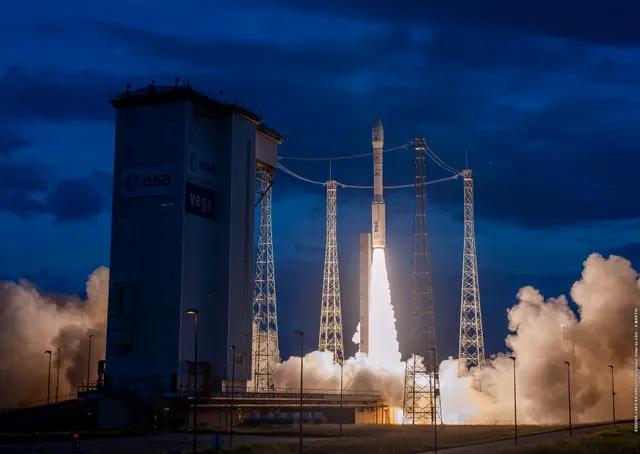
Vega is a solid-fuel launch vehicle system developed under the leadership of the European Space Agency (ESA) and the Italian Space Agency (ASI), designed to carry small satellites into low Earth orbit. Contrary to popular belief, its name does not derive from the Lebanese scientist Véga de Lyra, but rather from the Italian term "Vettore Europeo di Generazione Avanzata" (Advanced Generation European Carrier). Vega was developed to diversify and expand Europe’s launch capabilities, specifically tailored for low-mass payloads.

Vega is a four-stage rocket, with the first three stages powered by solid fuel and the fourth stage using liquid propellant. This configuration provides flexibility in placing payloads into various orbital profiles.
The development of Vega began in the late 1990s under the coordination of ESA. Italy played a significant role both technically and financially. Vega is marketed and operated by Arianespace. During its development, the rocket was specifically intended to serve ESA’s Small Satellite Missions program and meet the needs of commercial low Earth orbit operations.
The Story of Vega. (ESA)
Vega is typically used in the following types of missions:
Thanks to its ability to place payloads into orbit with high accuracy, Vega is especially preferred for observation and scientific missions.
Vega-C is an advanced version of the original Vega system. Its maiden flight took place on July 13, 2022. Featuring a more powerful first stage (P120C) and an upgraded AVUM+ upper stage, Vega-C allows the transportation of heavier payloads with greater precision. The P120C motor is a jointly developed technology also intended for use in the Ariane 6 rocket.

Vega VV07. (ESA)
Since its first flight, Vega has been used in a variety of missions. However, there have also been a few mission failures in its operational history. Notably, the VV15 mission on July 11, 2019, failed due to an anomaly attributed to the AVUM guidance system, resulting in payload loss. Similarly, an error during Vega-C’s mission on December 20, 2022, was reported to be due to a manufacturing defect in the second stage motor.
Vega is a collaborative project involving a consortium of companies across Europe. Led by Avio from Italy, various subsystem manufacturers from Belgium, France, Spain, and the Netherlands contribute to its production. Launch operations are conducted by Arianespace.
Vega strengthens Europe’s capacity for independent access to space. The growing demand in the small satellite sector makes Vega suitable for both scientific and commercial missions. Compared to heavy-lift launchers like Ariane 5, Vega offers a more cost-effective solution, making it competitive in the global light payload market.
Vega plays a crucial role in Europe’s space transportation systems within the light payload segment. Designed specifically for low Earth orbit missions, the system is suitable for both scientific and commercial use. With the development of its advanced version, Vega-C, the goal is to achieve higher capacity and improved reliability. In the coming years, the Vega systems are expected to solidify their position in both European and global satellite launch markets.
European Space Agency (ESA). “Vega.” European Space Agency. https://www.esa.int/Enabling_Support/Space_Transportation/Launch_vehicles/Vega. Accessed June 21, 2025.
European Space Agency (ESA). “Liftoff of Vega VV02.” ESA Multimedia, May 7, 2013. https://www.esa.int/ESA_Multimedia/Images/2013/05/Liftoff_of_Vega_VV0212. Accessed June 21, 2025.
European Space Agency (ESA). “Vega VV07.” ESA Multimedia, October 6, 2021. https://www.esa.int/ESA_Multimedia/Images/2021/10/Vega_VV07. Accessed June 21, 2025.
European Space Agency (ESA). “Vega VV20.” ESA Multimedia, November 24, 2021. https://www.esa.int/ESA_Multimedia/Images/2021/11/Vega_VV20. Accessed June 21, 2025.

Total Length | 29.9 m | ||||||||
|---|---|---|---|---|---|---|---|---|---|
Diameter | 3.0 m | ||||||||
Launch Mass | 137 tons | ||||||||
Maximum Payload Capacity | 1,500 kg (LEO, 700 km altitude) | ||||||||
First Flight(s) | February 13 2012 | ||||||||
Launch Site | Kourou (ELA-1), French Guiana | ||||||||
Technical Specifications
Stages
Development Process
Mission Profiles
Vega-C and Subsequent Developments
Success and Failures
Manufacturing and Operations
Strategic Importance
Bu madde yapay zeka desteği ile üretilmiştir.