


Bu içerik Türkçe olarak yazılmış olup yapay zeka ile otomatik olarak İngilizceye çevrilmiştir.
+1 Daha
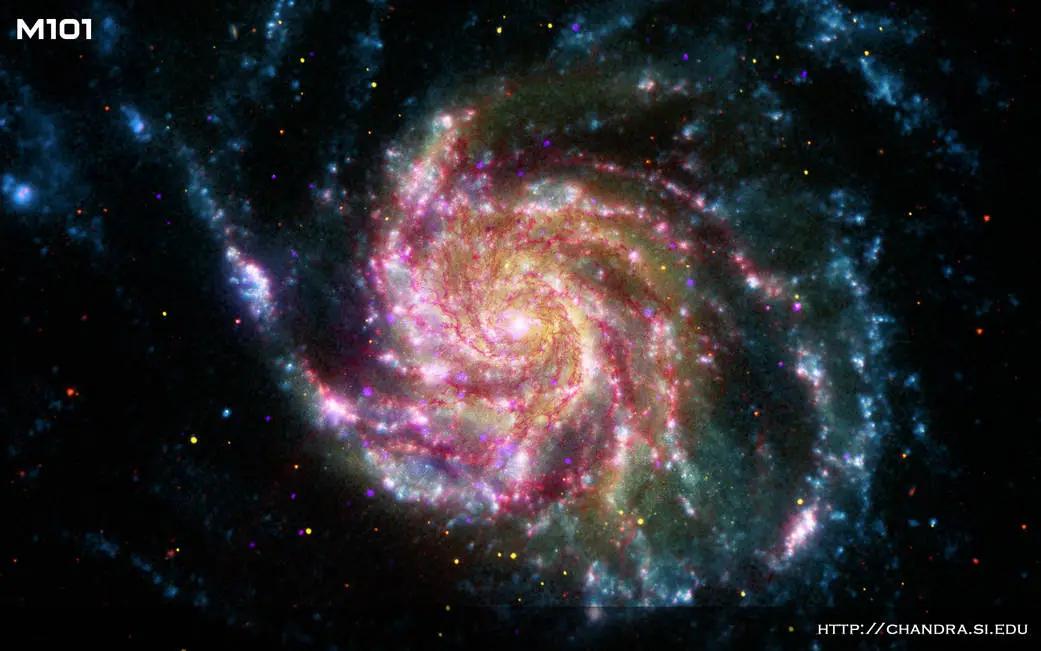
The Pinwheel Galaxy (English: Pinwheel Galaxy) is a spiral galaxy known in astronomy as Messier 101 (M101) and located in the direction of the Ursa Major constellation.

Pinwheel Galaxy generated by Artificial Intelligence.
It was first discovered on 27 March 1781 by French astronomer Pierre Méchain and later added to the catalog by Charles Messier. This galaxy is one of the most prominent and captivating objects for both amateur and professional astronomers due to its striking spiral structure and extensive spread amateur important sky.
The Pinwheel Galaxy lies at a distance of approximately 21 million light years place and has a diameter of about 170,000 light years. With these dimensions it is larger than the Milky Way Galaxy. Its apparent magnitude is +7.9 and it is observable with amateur telescopes under dark and clear darkness sky conditions.
Catalog Designations: Messier 101 (M101), NGC 5457
Galaxy Type: Spiral Galaxy
Location: Ursa Major Constellation (Ursa Major)
Distance: Approximately 21 million light years
Diameter: Approximately 170,000 light years
Hubble Classification: SAB(rs)cd
The prominent and asymmetric structure of the Pinwheel Galaxy has been disrupted by gravitational interactions with its satellite galaxies. In particular, the gravitational interaction with NGC 5474 has caused noticeable irregularities in the galaxy’s outer arms road.
The galaxy does not have a dense and prominent central nucleus; instead its central region is more diffuse and irregular. This situation is a typical feature of Scd-type galaxies.
Its spiral arms show significant concentrations of star-forming regions. The presence of gas and young hot stars enhances the brightness of these arms. Ionized hydrogen regions known as H II regions are identified as active star-forming areas.
The Pinwheel Galaxy is highly active in terms of star formation. The H II regions in the galaxy indicate the formation of young and hot stars that emit strongly in ultraviolet radiation. In this respect the galaxy provides an opportunity for sampling star formation processes that occurred in the early universe to understand.
Spectroscopic analyses have shown that the metallicity decreases from the center toward the outer regions of the galaxy. This is a common feature in galactic chemical evolution and indicates the presence of less processed (low-metallicity) stars in the outer regions.
The Pinwheel Galaxy has several satellite galaxies belonging to its local group, most of which are less massive. These include the galaxies NGC 5204, NGC 5474, NGC 5477 and UGC 8837 like. Gravitational interactions with these galaxies have caused structural distortions in M101 and triggered enhanced star formation.
The interaction with NGC 5474 is particularly important for explaining the asymmetry observed in M101’s outer spiral arms. This interaction is believed to have influenced the galaxy’s tectonic structure and affected the star formation rate and galactic morphology.
M101 has been the subject of numerous detailed observations using both ground-based and space-based telescopes. High-resolution images from the Hubble Space Telescope have revealed star clusters and interstellar gas clouds within the galaxy’s spiral arms, providing detailed data. Additionally, studies conducted by the Chandra X-ray Observatory have observed supernova remnants and black hole candidates within the galaxy.

NASA. “Messier 101.” Hubble Space Telescope – Explore the Night Sky – Hubble Messier Catalog. Pinwheel Galaxy Star Map.
In addition, several type II supernova events observed within the galaxy have been documented in the literature. These supernovae play a major role in the galaxy’s evolution by dispersing heavy elements into the interstellar medium.
The Pinwheel Galaxy is of great importance for observing and understanding the general characteristics of spiral galaxies due to its size and structural features. Thanks to its young stars, active star-forming regions and dynamic interactions, it is one of the most frequently studied galaxies in astronomy modern. For researchers working on galaxy evolution, chemical abundance variations and galactic interactions, M101 is considered a model system for study.

Henüz Tartışma Girilmemiştir
"Whirlpool Galaxy" maddesi için tartışma başlatın
Basic Characteristics
Structural Features
Star Formation and Chemical Composition
Satellites and Interactions
Observations and Research