

Bu içerik Türkçe olarak yazılmış olup yapay zeka ile otomatik olarak İngilizceye çevrilmiştir.
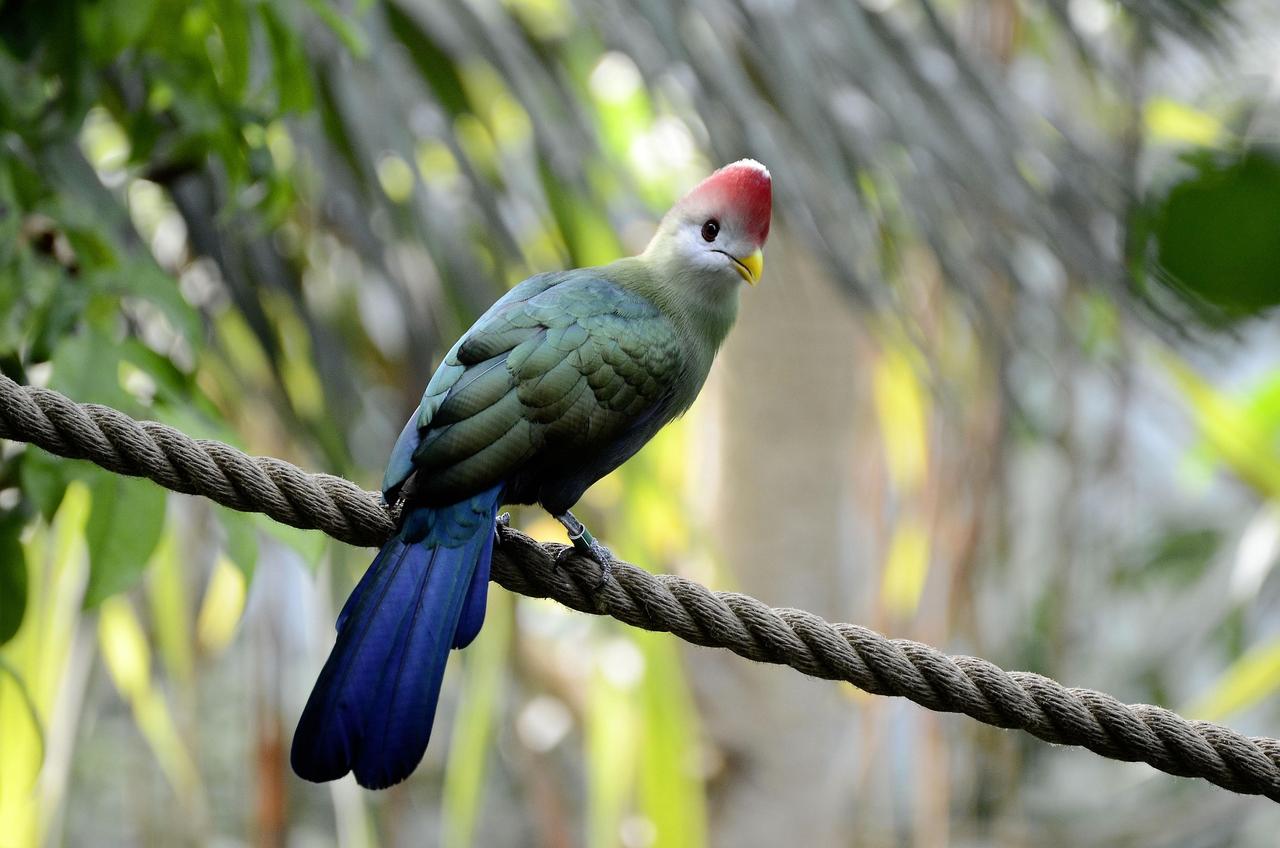
The white-cheeked turaco is a member of the Musophagidae family within the order Musophagiformes. Although traditionally classified under the genus Tauraco, modern molecular genetic studies and phylogenetic analyses support reclassifying the turaco species of Horn of Africa under the genus Menelikornis. Historically, the species was divided into two subspecies: the nominate subspecies T. l. leucotis and T. l. donaldsoni, known as the red-crested turaco. However, recent research argues that due to distinct morphological differences, genetic divergence, and sympatric distributions between these two taxa, donaldsoni should be recognized as a separate species.
The species’ natural range is restricted to East Africa, encompassing Ethiopia, Eritrea, South Sudan, and Sudan. The global distribution area of the white-cheeked turaco is estimated at approximately 1,100,000 km². Ecologically, the species shows moderate dependence on forested areas and is observed at elevations between 1,590 and 4,130 meters above sea level. It has a particularly widespread population in the Ethiopian highlands, especially in Podocarpus and juniper forests above 2,400 meters. According to habitat classification, the species inhabits a variety of ecosystems including subtropical and tropical moist montane forests, moist lowland forests, and dry shrublands.【1】
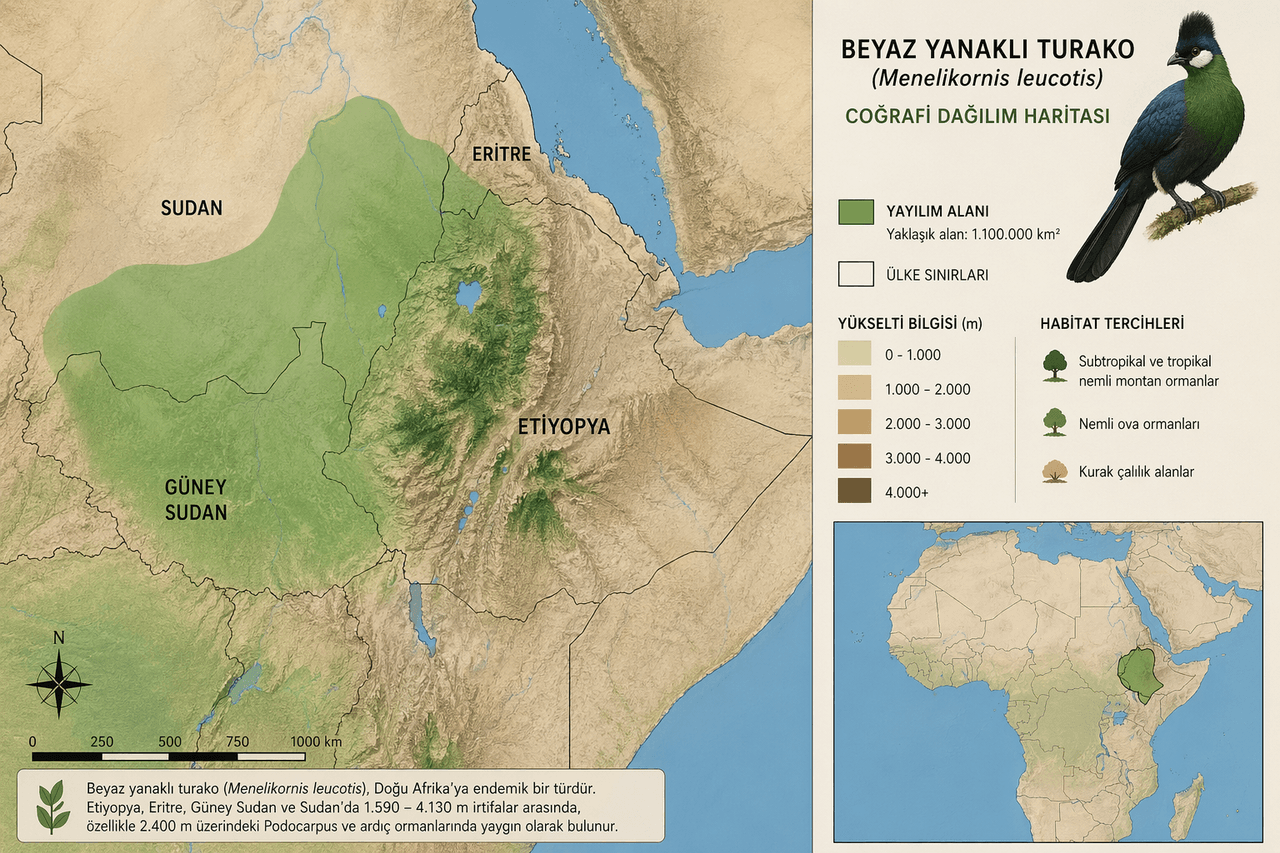
Geographic Distribution of the White-cheeked Turaco (Image Generated by Artificial Intelligence)
The white-cheeked turaco is a non-migratory terrestrial bird with an estimated average generation length of five years. Morphologically, it is characterized by a distinctive dark blue-black crown and prominent white cheek patches extending from eye level downward. Its diet is primarily frugivorous, with a strong preference for fruits of Ficus species as well as trees such as Juniperus procera and Podocarpus gracilior. This feeding behavior plays a critical role in seed dispersal within its ecosystem.
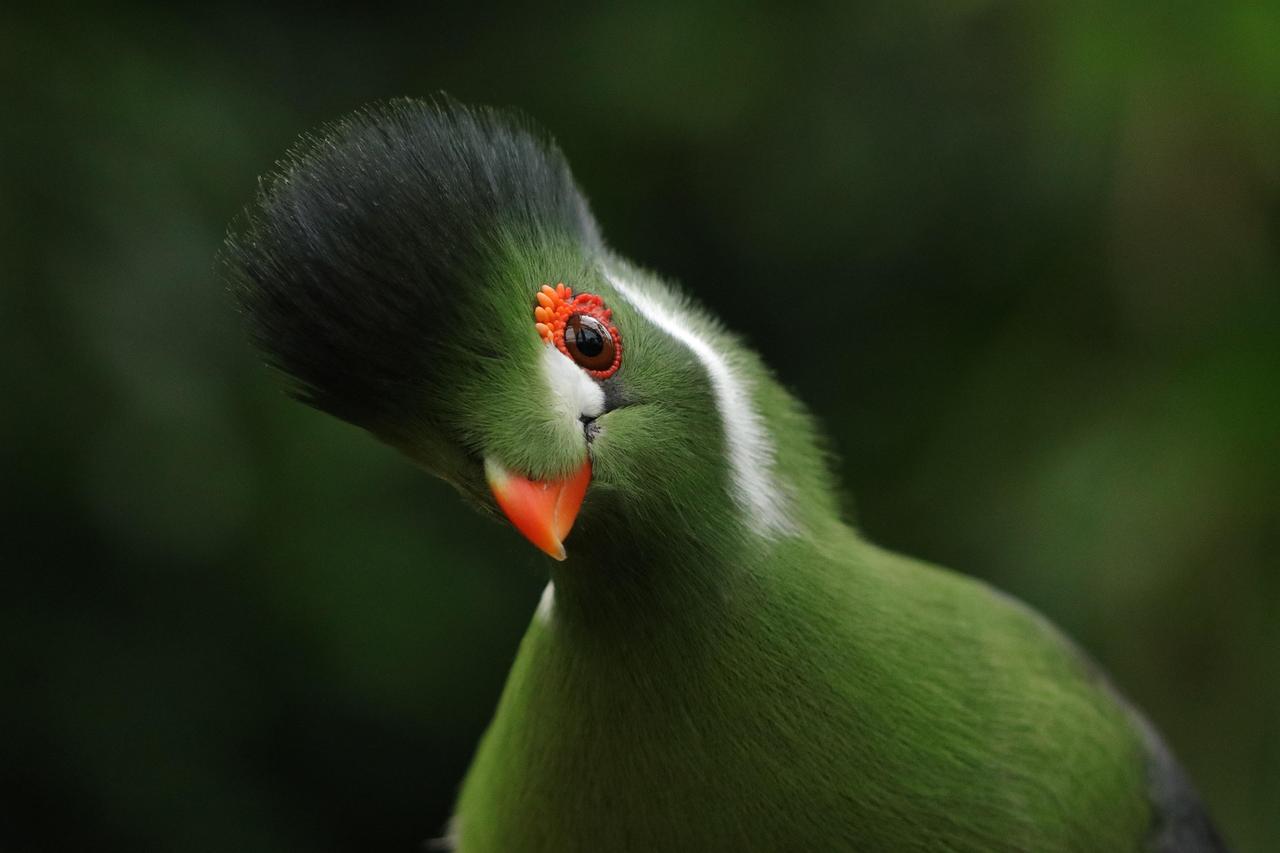
White-cheeked Turaco (Pixabay)
Although the global population size has not yet been fully quantified, the population trend is reported to be decreasing. Over the last three generations, a decline of approximately 5.7% in forest cover within its range has been documented, and this habitat loss is estimated to have caused a population reduction of between 1% and 19%. Climate change models predict a significant contraction of suitable habitats for the species; projections indicate that suitable habitat areas may decline by 40.84% by 2050 and by 68.67% by 2070. Additionally, the species is reported to have high prevalence in the international pet and exhibition bird trade. Another genetic threat is hybridization in the wild with Ruspoli’s turaco; this is considered a potential cause of genetic erosion in endemic populations.【2】
The white-cheeked turaco is listed as Least Concern on the IUCN Red List. This classification is justified by the species’ extensive range and the fact that its rate of population decline has not yet reached the thresholds for the Vulnerable category. Within its range, 20 Important Bird Areas have been designated for its conservation. Approximately 41.98% of these areas currently overlap with officially protected zones.【3】 The species is listed under CITES Appendix II, which regulates its international trade. However, no specific action recovery plan or systematic monitoring program has yet been implemented for this species.
Aligaz, M. A., C. A. Kufa, A. S. Ahmed, and others. "Distribution and extent of suitable habitats for Ruspoli’s Turaco (Tauraco ruspolii) and White-cheeked Turaco (Tauraco leucotis) under changing climate in Ethiopia." BMC Ecology and Evolution 24, no. 83 (2024). Accessed April 22, 2026. https://doi.org/10.1186/s12862-024-02245-y
BirdLife International. "Species factsheet: White-cheeked Turaco Tauraco leucotis." BirdLife International. 2024. Accessed April 22, 2026. https://datazone.birdlife.org/species/factsheet/white-cheeked-turaco-tauraco-leucotis
Gedeon, Kai, Olaf Jahn, and Till Töpfer. "The taxonomic status of Crimson-crested Turaco Menelikornis (leucotis) donaldsoni." Bulletin of the British Ornithologists’ Club 142, no. 3 (2022): 343–53. Accessed April 22, 2026. https://doi.org/10.25226/bboc.v142i3.2022.a7
Pixabay. "beyaz yanaklı turaco kuş hayvan." Accessed April 22, 2026. https://pixabay.com/tr/photos/beyaz-yanakl%c4%b1-turaco-ku%c5%9f-hayvan-8406175/
Pixabay. "kuş beyaz yanaklı turaco." Accessed April 22, 2026. https://pixabay.com/tr/photos/ku%c5%9f-beyaz-yanakl%c4%b1-turaco-7576994/
Pixabay. "tauraco erythrolophus rotschopfturako." Pixabay. Accessed April 22, 2026. https://pixabay.com/tr/photos/tauraco-erythrolophus-rotschopfturako-2672291/
[1]
BirdLife International, "Species factsheet: White-cheeked Turaco Tauraco leucotis," BirdLife International, 2024, access date: 22 April 2026, https://datazone.birdlife.org/species/factsheet/white-cheeked-turaco-tauraco-leucotis
[2]
M. A. Aligaz and others, "Distribution and extent of suitable habitats for Ruspoli’s Turaco (Tauraco ruspolii) and White-cheeked Turaco (Tauraco leucotis) under changing climate in Ethiopia," BMC Ecology and Evolution 24, no. 83 (2024), access date: 22 April 2026, https://doi.org/10.1186/s12862-024-02245-y
[3]
BirdLife International, "Species factsheet: White-cheeked Turaco Tauraco leucotis," BirdLife International, 2024, access date: 22 April 2026, https://datazone.birdlife.org/species/factsheet/white-cheeked-turaco-tauraco-leucotis

Henüz Tartışma Girilmemiştir
"White-cheeked Turaco (Menelikornis leucotis)" maddesi için tartışma başlatın
Geographic Distribution and Habitat Preferences
Biological Characteristics and Feeding Ecology
Population Dynamics and Environmental Threats
Conservation Status and International Measures