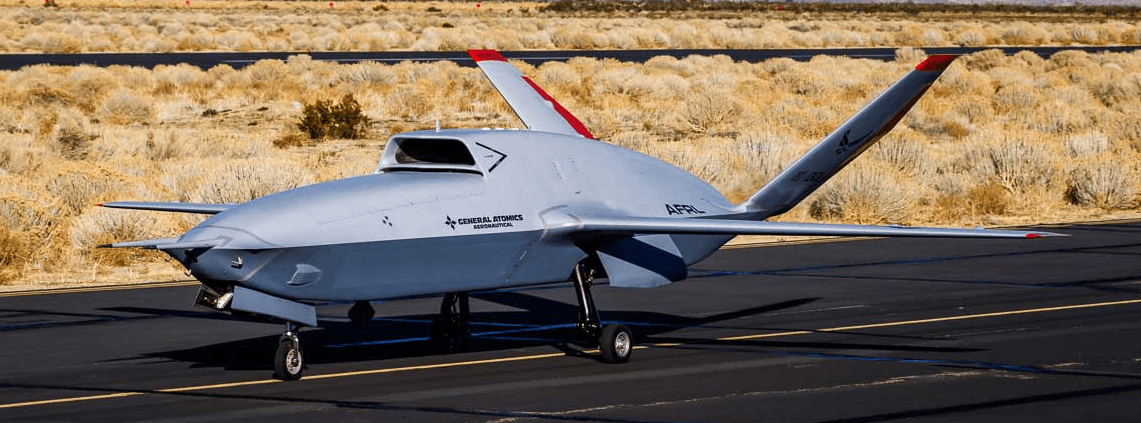


Full Name | XQ-67A Autonomous Collaborative Platform (ACP) | ||||||||
|---|---|---|---|---|---|---|---|---|---|
First Flight Date | February 28, 2024 | ||||||||
Generation | Second Generation Autonomous Collaborative Platform (2nd Generation ACP) | ||||||||
The XQ-67A is an unmanned aerial vehicle (UAV) developed by the United States Air Force Research Laboratory (AFRL) and belongs to the second-generation class of Autonomous Collaborative Platforms (ACP). The airframe was built by General Atomics Aeronautical Systems, Inc. (GA-ASI) and is designed for Off-Board Sensing Station (OBSS) missions.
The first flight of the XQ-67A took place on February 28, 2024, at the Gray Butte Flight Operations Facility near Palmdale, California. This flight marked the second phase of the AFRL’s development efforts for low-cost, combat-capable unmanned aircraft, following the XQ-58A Valkyrie program. The XQ-67A is distinguished as the first air vehicle developed under the "genus-species" design approach. Inspired by the automotive industry, this approach involves creating a common core platform (genus) onto which various mission-specific kits (species) can be integrated.
The design of the XQ-67A allows for modular and rapid integration of key mission systems, including autonomy, mission computing, networking, power and thermal management, and data links. The platform supports real-time information exchange through tactical datalinks, enabling coordination with both manned and unmanned systems.
During a flight test conducted on July 16, 2025, in the California High Desert, the XQ-67A was equipped with a government-owned autonomy software package. During this test, the vehicle successfully executed its internal mission control algorithms and responded dynamically to real-time mission updates received via tactical datalinks. This event was considered a significant milestone in demonstrating interoperability between manned and unmanned systems.
The XQ-67A serves as a critical testbed in support of the Air Force’s vision for a low-cost, rapidly producible fleet of interoperable air vehicles. Its development continues the objectives of the Low Cost Attritable Aircraft Technologies (LCAAT) and Low Cost Attritable Aircraft Platform Sharing (LCAAPS) programs, which aim to accelerate and reduce the cost of military aircraft development compared to traditional acquisition models.
The XQ-67A is a multi-role autonomous air platform developed under the Crewed-Uncrewed Teaming (C/U-T) concept, intended to enhance cooperative operations between manned and unmanned systems. Thanks to its low-cost production and modular design, the XQ-67A is suitable for a wide range of missions. Primary roles include:
Equipped with advanced tactical datalink systems, the XQ-67A functions as an airborne “data node” within a network-centric warfare architecture. It can exchange information with other assets in real time, contributing to shared operational awareness and collaborative targeting.
A core strategic objective in the development of the XQ-67A is the “affordable mass” concept. Its ability to be produced in large numbers at lower cost compared to traditional manned systems allows air forces to enhance force projection and achieve numerical superiority. This supports deterrence strategies and provides a saturation advantage against enemy systems in high-intensity conflict environments.
AFRL. “AFRL’s XQ-67A Makes 1st Successful Flight.” U.S. Air Force, March 5, 2024. Accessed July 20, 2025. .
GA-ASI. “The Future of Airpower: XQ-67A.” General Atomics Aeronautical Systems, Inc. Accessed July 20, 2025. .
GA-ASI. “XQ-67A Demonstrates Autonomy and Datalink Interoperability During High Desert Flight Test.” General Atomics Aeronautical Systems, Inc., July 16, 2025. Accessed July 20, 2025. .
GDH Digital. “General Atomics Yeni XQ-67A İsimli Yeni İHA’sını Tanıttı.” GDH Digital. Accessed July 20, 2025. .
Skybrary. “XQ-67A Demonstrates Autonomy.” European Security & Defence, July 2025. Accessed July 20, 2025. .
Ulus Savunma. “General Atomics XQ-67A İnsansız Hava Aracını (İHA) Tanıttı.” Ulus Savunma, July 2025. Accessed July 20, 2025. .
Unmanned Systems Technology. “XQ-67A First Flight.” Unmanned Systems Technology. Accessed July 20, 2025. .
YouTube. “XQ-67A First Flight | General Atomics Aeronautical Systems.” YouTube Video, February 28, 2024. Accessed July 20, 2025. https://www.youtube.com/watch?v=0hd0Mvn5m3s.

Full Name | XQ-67A Autonomous Collaborative Platform (ACP) | ||||||||
|---|---|---|---|---|---|---|---|---|---|
First Flight Date | February 28, 2024 | ||||||||
Generation | Second Generation Autonomous Collaborative Platform (2nd Generation ACP) | ||||||||
Henüz Tartışma Girilmemiştir
"XQ-67A" maddesi için tartışma başlatın
History and Development
Technical Features and System Integration
Flight Testing and Performance
Strategic Importance
Applications and Mission Roles
Network-Centric Capabilities
Affordability and Force Multiplication
Bu madde yapay zeka desteği ile üretilmiştir.