

+1 Daha

A ziggurat is a monumental, terraced temple structure that originated in ancient Mesopotamia, primarily constructed by the Sumerians, Akkadians, Babylonians, and Assyrians between approximately 3000 BCE and 500 BCE. These massive architectural complexes served as the religious and ceremonial centers of Mesopotamian city-states and were considered sacred spaces connecting the heavens and the earth.
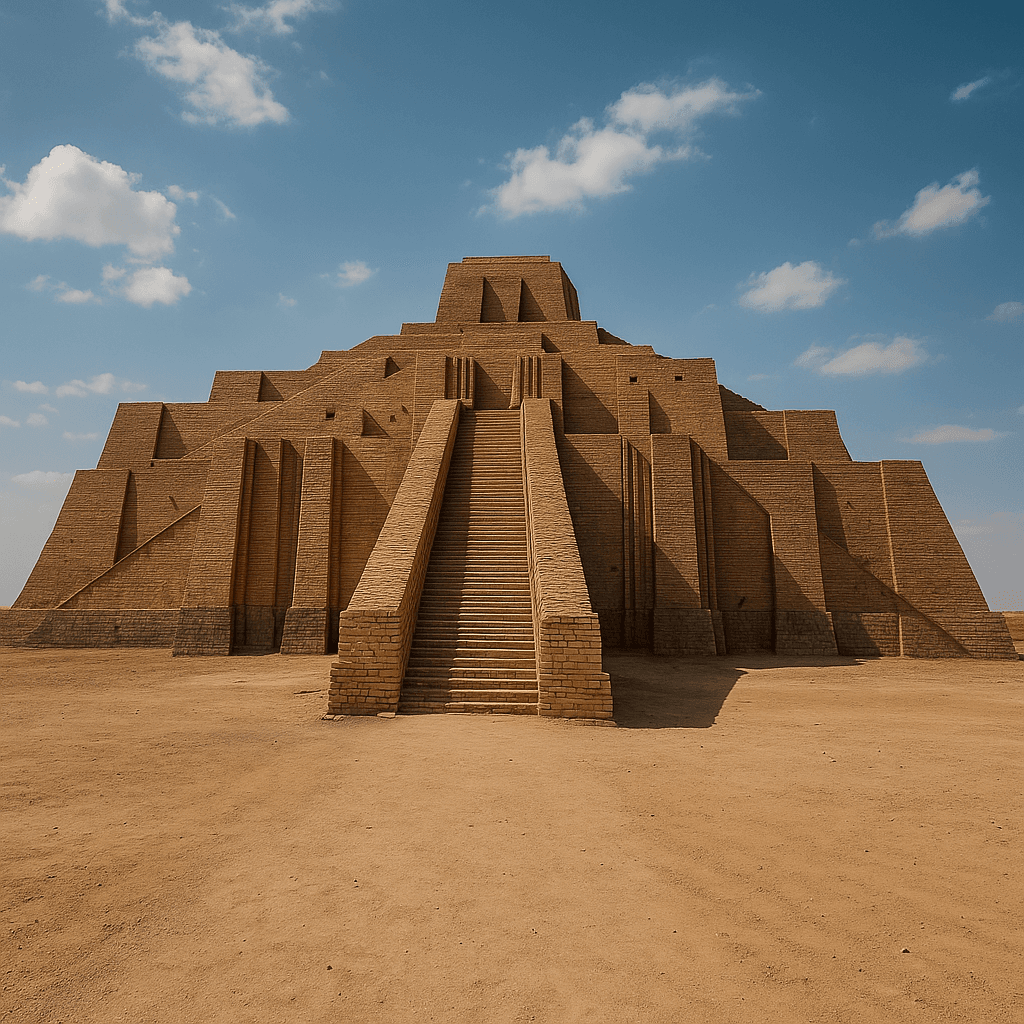
AI-generated image of an ancient ziggurat
Ziggurats were typically built as stepped towers with a rectangular, square, or occasionally oval base, rising in a series of successively smaller platforms or stories. Each level was accessed by broad ramps or staircases leading to the topmost platform, which housed a small temple or shrine dedicated to a city’s patron deity.
Unlike the smooth-sided Egyptian pyramids, ziggurats featured a tiered design with open terraces. They were constructed primarily from sun-dried mud bricks, often faced with fired bricks for added durability and decorated with glazed tiles. Some ziggurats were also painted in bright colors symbolizing celestial or elemental associations.
The number of tiers varied, ranging from two to seven, with higher levels reserved for divine use. Ordinary people were not allowed atop the ziggurat; only priests and temple staff had access to the sacred summit for rituals and offerings.
Ziggurats were not used as tombs, unlike pyramids, but rather as ritual temples and visible symbols of divine authority. They embodied the central role of religion in Mesopotamian political and civic life and were thought to serve as a “stairway to the gods” — a physical axis mundi linking the earth with the divine realm.
Their construction was often commissioned by kings to demonstrate piety and to legitimize rule through divine favor. Ziggurats were also linked to the administration of surrounding temple economies, often forming part of a larger religious complex including courtyards, storage rooms, and housing for priests.
The architectural and symbolic influence of the ziggurat persisted long after the decline of Mesopotamian civilizations. Elements of its tiered design can be seen in later temple architecture across the Near East and in structures symbolizing divine or royal authority.
While many ziggurats have been reduced to foundations or rubble due to erosion and time, their archaeological remains continue to offer crucial insights into Mesopotamian religion, engineering, and urban planning.
Gwendolyn Leick, Mesopotamia: The Invention of the City, Penguin Books, 2003.
Léon Legrain, "Unearthing History at Ur," Scientific American, Vol.138 No.6 (June 1928), pp.517-519. https://www.jstor.org/stable/24964993

Henüz Tartışma Girilmemiştir
"Ziggurat" maddesi için tartışma başlatın
Structure and Design
Function and Symbolism
Notable Examples
Legacy
Bu madde yapay zeka desteği ile üretilmiştir.