This article was automatically translated from the original Turkish version.

Books, newspapers, and magazines from the Ottoman period are valuable sources for understanding the written history of Turkish. The majority of these documents are currently preserved as scanned images. To utilize their historical and cultural value, their content must be converted into machine-readable text. This process is carried out using optical character recognition (Optical Character Recognition, OCR). Text on scanned pages can be automatically transferred to digital format, enabling searches within thousands of pages within minutes, allowing large archives to be processed without manual transcription, and facilitating the creation of linguistic resources from historical periods of Turkish. To take advantage of these capabilities for Ottoman Turkish archives, reliable OCR systems must be developed.
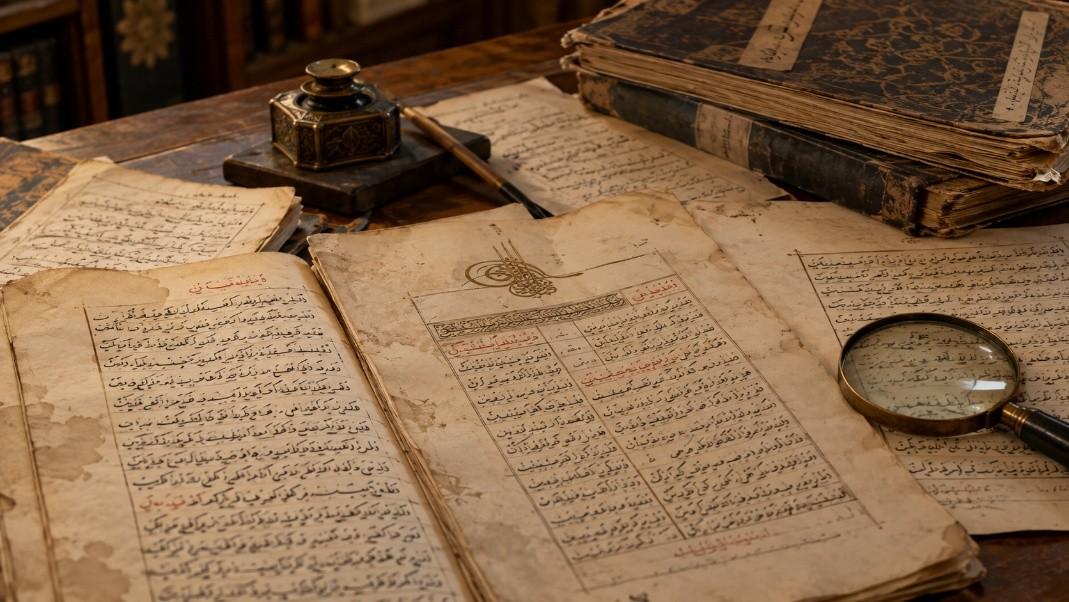
Manuscript Documents from the Ottoman Period (Generated by Artificial Intelligence.)
This article first addresses the fundamental challenges of Ottoman Turkish OCR and existing approaches in the field. It then presents the preparation of data sources for line-level use, the evaluation of existing OCR systems on a common test set, and a comparison of tokenizer options.
Ottoman Turkish is the form of Turkish written using the Arabic alphabet. Therefore, OCR tools developed for the Latin alphabet cannot be used directly. Most letters are connected to one another, and the same letter takes different forms depending on its position within a word. Consequently, it is difficult to obtain reliable results using classical methods that rely on character boundary detection. Similar letters are distinguished by small dots, but these dots can easily disappear due to poor print quality or low scanning resolution. Short vowels are mostly omitted in writing, causing the same orthography to be readable in multiple ways. As a result, the transition from Arabic-script text to Latin-script Turkish cannot be treated as a direct one-to-one character conversion. The simultaneous use of Turkish, Arabic, and Persian-derived words in texts further complicates the language modeling process.
In addition, labeled Ottoman Turkish data is scarce. This problem is particularly pronounced in handwritten texts, as their appearance varies significantly depending on the writer, historical period, and the scribe’s writing style. Existing literature includes studies on both printed and handwritten text recognition (Handwritten Text Recognition, HTR). Printed Ottoman Turkish texts pose fewer OCR challenges compared to handwritten ones due to their more regular and standardized script structure. Nevertheless, this study examines methods for processing both printed and handwritten Ottoman Turkish texts.
The literature on Ottoman Turkish text recognition addresses various tasks and output formats. Some studies focus on printed texts, while others aim to recognize handwritten texts. Similarly, the outputs produced vary between Arabic-script text and modern Turkish transcriptions. These differences directly affect the methods used and the evaluation results. This section summarizes relevant studies according to the tasks they address and the methods they employ.
Kirmizialtin and Wrisley conducted an automatic text recognition study on two Ottoman Turkish periodicals published in the early 20th century. Using the Transkribus platform, HTR models were trained with the goal of directly producing Latin-script Turkish transcriptions from Arabic-script Ottoman Turkish text. The study addressed the absence of one-to-one letter correspondences between the Arabic and Latin alphabets, ambiguities in text pronunciation, and variations arising from differences in typographic features across publications. The research demonstrated that successful transcription of Ottoman Turkish into Latin letters requires not only character recognition but also the incorporation of linguistic features.【1】
Bilgin Taşdemir and colleagues developed a Convolutional Neural Network–Bidirectional Long Short-Term Memory (CNN-BiLSTM) model to directly generate Latin-script Turkish transcriptions from printed Ottoman Turkish documents. The training of the model employed the Connectionist Temporal Classification (CTC) method. Instead of the traditional two-stage process of first recognizing Arabic-script text and then converting it to Latin letters, an end-to-end approach was adopted that produces Latin-script output directly from document images. Additionally, the Word Beam Search method with dictionary support was evaluated to improve the accuracy of the generated text. In this approach, the model learns to infer vowel letters that are not explicitly written in Ottoman Turkish orthography during transcription.【2】
Dölek and Kurt developed an OCR model based on CNN and Bidirectional LSTM layers for the automatic recognition of Ottoman Turkish documents printed in Naskh script. To examine the impact of training data on model performance, different training sets were used: real document images, synthetic examples, and a combination of both. The developed system was evaluated by comparing its performance against other OCR tools on the same test set. Furthermore, recognition results were analyzed separately in raw, normalized, and whitespace-stripped text formats. This enabled an assessment of the effects of both different training data sources and text normalization on evaluation outcomes.【3】
One of the significant challenges in Ottoman Turkish text recognition studies is the difficulty of obtaining sufficient labeled data covering diverse writing styles. Since Ottoman Turkish uses an Arabic-based script, evaluating text recognition approaches developed for languages with similar alphabets becomes particularly relevant. In this context, knowledge transfer studies conducted between languages such as Arabic, Urdu, and Persian offer methods that can be leveraged for Ottoman Turkish text recognition systems.
Al-azzawi and colleagues investigated the impact of cross-lingual knowledge transfer in recognizing handwritten texts in Arabic, Urdu, and Persian. In their study, joint training was performed using data from different languages with Convolutional Recurrent Neural Network (CRNN) and Transformer-based HTR-VT architectures.【4】 The contribution of data from other Arabic-script languages to recognition performance was evaluated by varying the amount of labeled data in the target language. The results demonstrated that knowledge transfer between languages sharing common characters can be beneficial, especially under conditions of limited training data. However, the extent of performance improvement was found to depend on the model architecture, the quantity of target language data, and the degree of character similarity between languages.【5】
TrOCR (Transformer-based Optical Character Recognition) is a Transformer-based OCR architecture designed to generate text directly from images.【6】 The model employs a visual encoder to extract image features and a Transformer decoder to generate text sequences from these features. During training, large-scale synthetic data is utilized, followed by fine-tuning on real text images. When adapting the model, initially developed primarily for English text recognition, to Arabic-script languages, it is crucial that the tokenizer supports the target language’s characters and writing characteristics.【7】
Chan and colleagues adapted the TrOCR architecture into the HATFormer model for recognizing historical Arabic handwritten texts. In their study, image preprocessing methods and the model’s training process were customized to better handle the writing styles found in historical documents. Additionally, a Byte-level Byte Pair Encoding (BBPE) tokenizer based on byte-level subword units was employed to improve the representation of Arabic characters. The model was trained on synthetic Arabic text images and subsequently fine-tuned on real historical handwritten data. This approach provides an example of adapting pre-trained Transformer models to historical Arabic documents.【8】
Momeni and BabaAli compared two different Transformer-based architectures for recognizing handwritten Arabic texts. In their study, pre-trained models were used for both the image encoder and text decoder, and a BERT-based model incorporating Arabic linguistic knowledge was adapted for the text generation component. Synthetic data was used during training, and the model was evaluated on the KHATT handwritten dataset. The comparison between the standard encoder-decoder Transformer and the Transformer Transducer architecture revealed that the Transducer model offered advantages in processing speed, while the standard Transformer architecture achieved a lower character error rate.【9】
These studies demonstrate that Transformer-based text recognition models can be adapted to Arabic documents through various components and training strategies. While TrOCR provides a general-purpose encoder-decoder architecture,【10】 HATFormer focuses on adapting this approach to historical Arabic handwriting.【11】 Momeni and BabaAli compared different Transformer architectures,【12】 while Qalam combined the SwinV2 image encoder with a RoBERTa-based decoder.【13】 Common themes across these studies include the use of language-appropriate text representations, the use of synthetic data for training, and the adaptation of models using limited real data.
In addition to transformer-based OCR models, large visual-language models are also employed for recognizing text in documents across different languages and formats. Unlike models focused on specific languages or writing systems, these approaches aim to process diverse historical documents by training on broader datasets. In this context, CHURRO has been developed as an open-weight visual-language model based on Qwen2.5-VL with three billion parameters. The model was trained using the comprehensive CHURRO-DS dataset, which consists of printed and handwritten documents from various historical periods, languages, and writing systems. The study examines the impact of different script styles, document layouts, and physical degradation on text recognition. The model’s performance was evaluated on both printed and handwritten documents and compared against results from other OCR systems and visual-language models. This work presents a significant example of using visual-language models trained on historical document-specific data for text recognition.【14】
Qalam is a transformer-based OCR model developed for recognizing Arabic printed and handwritten texts.【15】 The model employs a SwinV2 image encoder for feature extraction and a RoBERTa-based decoder for generating text sequences. During training, it leveraged extensive collections of Arabic handwritten documents and synthetically generated image-text pairs. In the study by G. Bhatia and colleagues, the effects of different script styles and structural characteristics of Arabic characters on text recognition were analyzed. This approach offers an important example of adapting pre-trained transformer architectures to Arabic text recognition tasks with support from synthetic data.【16】
The reviewed studies demonstrate that the challenges in Ottoman Turkish text recognition are not solely due to model architecture but are also significantly influenced by document type, script characteristics, and the desired output format.【17】 Printed texts exhibit a more consistent script structure, whereas handwritten documents show considerable variation in character forms depending on the writer, historical period, and scribe’s style. Moreover, directly recognizing Arabic-script text versus generating Latin-script transcriptions presents distinct challenges.【18】 In particular, generating Latin-script transcriptions requires not only accurate character recognition but also consideration of Ottoman Turkish’s linguistic features and orthographic variations.
An analysis of methods used in the literature reveals that various approaches have been evaluated, ranging from CNN and LSTM-based architectures,【19】 to transformer-based models,【20】 and large visual-language models.【21】 A common finding across these studies is that model performance depends not only on architectural choices but also on the quality and diversity of the training data. In particular, the use of synthetic data enables the expansion of training datasets when labeled historical documents are scarce. However, the extent to which synthetic data represents the script variations and physical degradation found in real documents remains critical for the model’s generalization ability.【22】
Studies conducted on languages with similar writing systems, such as Arabic, Persian, and Urdu, demonstrate that pre-trained models and cross-lingual knowledge transfer can be effectively utilized.【23】 However, the presence of shared characters does not imply that success achieved in these languages will translate directly to Ottoman Turkish. Differences in orthographic rules, character usage, and characteristics of historical texts mean that these approaches must be separately evaluated on Ottoman Turkish datasets.【24】
Overall, in developing Ottoman Turkish text recognition systems, creating training data that encompasses diverse script styles and document types is as important as comparing different architectures.【25】 In particular, combining real and synthetic data,【26】 transferring knowledge from similar writing systems,【27】 and adapting pre-trained models to Ottoman Turkish documents【28】 stand out as key approaches requiring further evaluation in this field.
From the perspective of an OCR model, data consists of more than just a large number of scanned pages. Each image must be accurately paired with its corresponding text, line boundaries within the page must be reliably extracted, sources need to be integrated into a unified directory structure, and evaluation data must be separated from training data. In the case of Ottoman Turkish, an additional challenge arises with the alphabet: Ottoman Turkish in Arabic script may not be adequately represented by a tokenizer designed for modern Arabic.
Among the primary sources of the data pool, OpenITI Makhzan provides texts in Arabic, Ottoman Turkish, Persian, Urdu and Malay, as well as multilingual documents containing combinations such as Arabic-Javanese, Arabic-Persian and Ottoman-Persian.【29】 The OpenITI PRINT collection includes printed examples in Arabic, Ottoman Turkish, Persian and Urdu.【30】 For Ottoman Turkish, additional data has been included from osmanlica.com.【31】 Other Arabic sources have been identified as KHATT, Muharaf, RASAM, TariMa and HICMA;【32】 through these collections, diverse Arabic text and printed samples have been added to the data pool. Due to the limited availability of labeled Ottoman Turkish data, examples from Arabic, Persian and Urdu have also been utilized. The shared Arabic script enables the model to encounter a broader variety of handwriting and print styles. Multilingual documents have been categorized according to their constituent languages rather than being forced into a single-language classification.
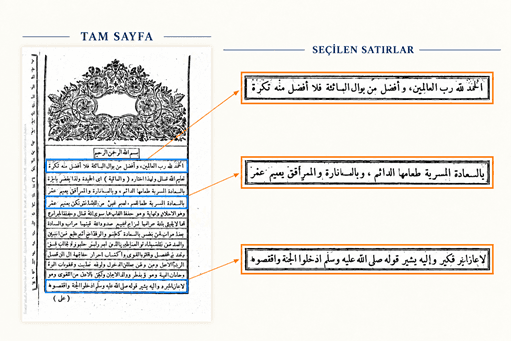
Sample Rows Selected from the Data Preparation Process (Generated by Artificial Intelligence.)
Some sources provided page images along with Extensible Markup Language (XML) files describing page layouts, rather than individual line images. Since training an OCR model requires pairing each line's image with its corresponding text, line crops were extracted from the page images using the line coordinates specified in the XML, and the corresponding line texts were extracted from the XML files. Thus, each line was converted into an image file and a text file bearing the same name.
The XML structures across sources also varied. For instance, in some datasets, line boundaries were defined using polygon points rather than rectangular coordinates. In such cases, the bounding rectangle encompassing the polygon points was calculated, and the text was extracted from the corresponding Unicode field. After these processing steps, data from different sources could be uniformly used in the form of line images and associated text.
After the data preparation process, the following distribution was obtained. The numbers in Table 1 indicate the number of line-image pairs in the training set and the test set (benchmark).
Table 1: Number of Line-Image Pairs in the Training and Test Sets by Language
In constructing the test set for this study, a source-based proportional stratified sampling approach was employed. First, the target number of samples for the test set was determined for each language. Subsequently, this number was distributed proportionally according to the sizes of the data sources for each language. For example, if 70 percent of the data for a given language originated from one source and 30 percent from another, the test set samples aimed to preserve approximately the same ratios. This ensured that the existing distribution of data sources for each language was represented in the test set. The method was designed to reduce excessive dependence of the test set results on the characteristics of any single data source. However, maintaining source proportions does not imply that all typefaces, image qualities, or document types are equally represented in the test set.
Before training experiments, pretrained OCR systems were evaluated on the same test set. The goal here is not to compare the models against a trainable model but to establish a baseline performance of general-purpose systems trained on different scripts before any Ottoman Turkish fine-tuning is applied. This provides a reference point for subsequent training experiments.
The test set consists of 1,569 line-image pairs across four languages. The Ottoman Turkish section includes 161 samples from OpenITI Makhzan,【33】 214 from OpenITI PRINT,【34】 and 87 from osmanlica.com; the Arabic section contains 656 samples, the Persian section 233, and the Urdu section 218.【35】 Model outputs were compared using Character Error Rate (CER). For the CER values in Table 2, standard deviation, confidence intervals, or sample distributions are not provided. Table 2 presents both language-specific averages and an overall average covering all four languages. The overall average was calculated by weighting the languages according to their number of lines. A lower CER indicates closer alignment with the reference text. Since values exceeding 1 imply that the total of insertions, deletions, and substitutions may surpass the reference length, the ratio should not be interpreted as a percentage.
Table 2: Character Error Rates (CER) of Pretrained OCR Systems by Language
Surya OCR 2 achieved the lowest CER values across all four languages and ranked first with an overall average CER of 0.3728; in Arabic, Surya scored 0.5071 while Kraken scored 0.6013. Kraken produced CER values between 0.3726 and 0.6225 across all four languages (overall CER 0.5266). EasyOCR’s language averages ranged from 0.5285 to 0.6351, while for OCR Verse, the Ottoman Turkish CER (0.6297) and Urdu CER (0.6525) were lower than the Arabic CER (0.9751) and Persian CER (0.7284). Table 2 shows that examining only the Ottoman Turkish ranking can yield an incomplete picture of overall performance on Arabic-script texts.
Distinct language profiles were observed among the models. For Tesseract, the Persian average was 0.4657 while the Ottoman Turkish average was 0.9388. With PaddleOCR-VL, a low CER of 0.4691 was achieved for Ottoman Turkish, but the Persian CER reached 1.7269. CHURRO’s results for Arabic, Persian and Urdu ranged between 0.84 and 1.07, while its Ottoman Turkish CER was determined at 4.0477. With MonkeyOCRv2-B, Ottoman Turkish achieved a CER of 1.5944 and Persian reached 16.1152. These differences suggest that the use of a shared alphabet alone does not guarantee equivalent OCR performance; the influence of model language distribution and visual characteristics of the sources was not separately tested in this experiment.
Several general-purpose vision-language models exhibited high error rates across all four languages. The overall CER was measured at 13.1636 for GLM OCR, 20.5732 for DeepSeek OCR 2, and 4.2361 for Ovis OCR2. These results enable comparison not only of model performance on the Ottoman Turkish test set but also across other Arabic-script languages.
Using language-level averages can obscure variability across sources. For instance, with HunyuanOCR, CER values of 0.5454 and 0.5192 were obtained on OpenITI Makhzan and OpenITI PRINT respectively, while the CER on osmanlica.com rose to 2.9996. For OCR Verse, these values were measured at 0.6267, 0.3771 and 1.2567. Therefore, reporting a single score per language is insufficient to characterize performance on a specific archive or print type.
For this reason, Table 2 should be interpreted not as a final model ranking but as the first comparative evaluation conducted on the same dataset. Models were run using their native resolutions and preprocessing pipelines; input formats and output normalization varied across systems. CER calculation is sensitive to orthographic normalization: differences in harakat, spacing, punctuation, or Unicode character encoding in Ottoman Turkish texts may be counted as errors even when the OCR output is visually close to the ground truth. Additionally, the average CER per line has been reported. Since source sizes are unequal, performance on each source is not equally represented in the overall average.
A model like TrOCR consists of two main components: the line image is converted into visual representations by an image encoder; the output is generated step-by-step by a text decoder. The decoder does not operate directly on characters but on tokens defined by the tokenizer—subunits that constitute the text. Therefore, the choice of tokenizer cannot be viewed merely as a preprocessing preference; it is an architectural decision that determines the model’s output space, sequence length, memory consumption, and which characters can be generated without loss.【50】
For example, if a frequently used Ottoman Turkish character is mapped to [UNK] (unknown token) by the tokenizer, the decoder cannot learn to distinguish between those characters. Conversely, even if a tokenizer encodes every character as a separate token—or even multiple byte tokens—this may produce excessively long output sequences. This slows training and increases the number of lines truncated due to fixed maximum length limits. The selection was not based solely on vocabulary size.
Six tokenizers were compared according to the following criteria:
The comparison included RoBERTa (roberta-base; the original TrOCR decoder tokenizer), XLM-RoBERTa (multilingual RoBERTa), AraBERT v2 (a BERT model for Arabic), mT5, CAMeLBERT (an Arabic BERT model), and mBART-50 (a multilingual BART model for 50 languages). During sampling, Ottoman Turkish, Malay, and all multilingual datasets were used in full; no more than 140 lines were selected from each Arabic dataset and no more than 250 lines from each Persian and Urdu dataset.
The most distinctive results for Ottoman Turkish are summarized in Table 3. The ranges show the values observed across three Ottoman Turkish data sources:
Table 3: Interval Results of Six Tokenizers on Three Ottoman Turkish Data Sources
The first notable finding is that being trained for Arabic is insufficient for Ottoman Turkish. All six Ottoman Turkish characters tested with AraBERT were represented as [UNK]. According to the data source, [UNK] occurred in 45.7% to 97.39% of Ottoman Turkish lines, and the round-trip CER increased to as high as 48%. In the single-character test with CAMeLBERT, although all six characters were covered, [UNK] was still generated in actual lines. Therefore, covering characters individually does not by itself guarantee reliable representation in context.
RoBERTa’s byte-level approach, by contrast, occupied the opposite extreme. All characters were transmitted without loss, no [UNK] was generated, and 100% accuracy was achieved in encoding and decoding. However, sequence length increased: approximately 1.1 tokens were produced per character. In the osmanlica.com dataset, which contains longer lines, the median sequence length was measured at 95 tokens and the p90 value at 147 tokens, indicating that 17.12% of lines would be truncated at the 128-token limit. Thus, it was determined that mere losslessness is insufficient; an efficient representation is also required.
XLM-RoBERTa and mBART-50 produced short sequences, and the experiments yielded very similar, even identical, results. Nevertheless, a small number of [UNK] instances were observed in some sources.
In the final training scripts, mT5 was selected as the decoder, and consequently the mT5 tokenizer was adopted. Across all three Ottoman Turkish sources, mT5 produced zero [UNK], fully covered all six critical characters, and reduced the median token-to-character ratio to between 0.42 and 0.44. In other words, the same text could be represented using approximately 40% of the tokens required by RoBERTa, based on median token-to-character ratios. Although the round-trip exact match was not 100%, the average character error rate remained low, between 0.067% and 0.80% depending on the source, and no Ottoman Turkish line was truncated at the 128-token limit. Thus, zero [UNK], short sequences, and a ready-made multilingual generative decoder were successfully combined.
Ottoman Turkish OCR requires that data preparation, model selection, and tokenizer decisions be addressed jointly, due to script morphology, historical linguistic features, and varying output targets. This paper examines approaches from the literature alongside the preparation of line-level data, evaluation of existing OCR systems, and analysis of tokenizer options. The findings demonstrate that printed text and handwritten text have distinct requirements, and that model results must be interpreted within the context of the data used and evaluation conditions.
Ottoman Turkish handwritten text recognition is a promising research area with the potential to facilitate the reading and scholarly use of archival documents. Therefore, continued efforts to develop data and methods for Ottoman Turkish HTR emerge as a significant research direction.
The follow-up article in this series, titled “From Print to Digital II: Data Generation and Model Training for Ottoman Turkish OCR”, will comprehensively address the technical stages, methods employed, and implementation details of this process.
Al-azzawi, S., E. Barney, and M. Liwicki. "Cross-Lingual Learning within Arabic Script for Low-Resource HTR." *arXiv*, 2026. Accessed October 24, 2026.https://doi.org/10.48550/arXiv.2605.02089
Antoun, W., F. Baly, and H. Hajj. "AraBERT: Transformer-based Model for Arabic Language Understanding." *Proceedings of the Fourth Workshop on Open-Source Arabic Corpora and Processing Tools* (2020): 9–15. Accessed October 24, 2026.https://aclanthology.org/2020.osact-1.2/
Bai, S., K. Chen, X. Liu, et al. "Qwen2.5-VL Technical Report." *arXiv* 2025. Accessed October 24, 2026.https://arxiv.org/abs/2502.13923
Bhatia, G., E. M. B. Nagoudi, F. Alwajih, and M. Abdul-Mageed. "Qalam: A Multimodal LLM for Arabic Optical Character and Handwriting Recognition." *arXiv*, 2024. Accessed October 24, 2026.https://doi.org/10.48550/arXiv.2407.13559
Bilgin Taşdemir, E. F., Z. Tandoğan, S. Doğan Akansu et al. "Automatic Transcription of Ottoman Documents Using Deep Learning." *Document Analysis Systems* (2024): 422-435. Accessed October 24, 2026.https://www.researchgate.net/publication/383922570_Automatic_Transcription_of_Ottoman_Documents_Using_Deep_Learning
Calfa. "RASAM Dataset: An Open Dataset for the Recognition and Analysis of Scripts in Arabic Maghrebi." GitHub. Accessed October 24, 2026.https://github.com/calfa-co/rasam-dataset
Calfa. "TariMa: Ground-truth of the TariMa Project (HTR of Maghrebi Arabic Documents)." GitHub. Accessed October 24, 2026.https://github.com/calfa-co/tarima
Chan, A., A. Mijar, M. Saeed, C.-W. Wong, and A. Khater. "HATFormer: Historic Handwritten Arabic Text Recognition with Transformers." *arXiv*, 2024. Accessed October 24, 2026.https://doi.org/10.48550/arXiv.2410.02179
Conneau, A., K. Khandelwal, N. Goyal et al. "Unsupervised Cross-lingual Representation Learning at Scale." *Proceedings of the 58th Annual Meeting of the Association for Computational Linguistics* (2020): 8440–8451. Accessed October 24, 2026.https://doi.org/10.18653/v1/2020.acl-main.747
Datalab Team. "Surya: A Lightweight Framework for Analyzing Documents and PDFs at Scale." GitHub. Accessed October 24, 2026.https://github.com/datalab-to/surya
Duan, S., Y. Xue, W. Wang, et al. "GLM-OCR Technical Report." *arXiv*, 2026. Accessed October 24, 2026.https://arxiv.org/abs/2603.10910
Dölek, İ. and A. Kurt. "Derin Sinir Ağlarıyla Osmanlıca Optik Karakter Tanıma." *Gazi Üniversitesi Mühendislik Mimarlık Fakültesi Dergisi* 38, no. 4 (2023): 2579–2594. Accessed October 24, 2026.https://doi.org/10.17341/gazimmfd.1062596
Graves, A., S. Fernandez, F. Gomez, and J. Schmidhuber. "Connectionist Temporal Classification: Labelling Unsegmented Sequence Data with Recurrent Neural Networks." *ICML '06: Proceedings of the 23rd International Conference on Machine Learning* (2006): 369–376. Accessed October 24, 2026.https://doi.org/10.1145/1143844.1143891
Inoue, G., B. Alhafni, N. Baimukan et al. "The Interplay of Variant, Size, and Task Type in Arabic Pre-trained Language Models." *Proceedings of the Sixth Arabic Natural Language Processing Workshop*, (2021): 92–104. Accessed October 24, 2026.https://aclanthology.org/2021.wanlp-1.10/
Ismail, A., Z. Kamel, and R. Mahmoud. "HICMA:The First Identification for Calligraphy and Manuscripts in Arabic Dataset." *Proceedings of the First Arabic Natural Language Processing Conference* (2023): 24-32. Accessed October 24, 2026.https://www.semanticscholar.org/paper/HICMA%3A-The-Handwriting-Identification-for-and-in-Ismail-Kamel/a3040695744ca4c871d35d9993875b7d6fe6c9e8
Jaided AI. "EasyOCR: Ready-to-use OCR." GitHub. Accessed October 23, 2026.https://github.com/JaidedAI/EasyOCR
Jaided AI. "EasyOCR: Ready-to-use OCR." GitHub. Accessed October 24, 2026.https://github.com/JaidedAI/EasyOCR
Kiessling, B. "Kraken – A Universal Text Recognizer for the Humanities." *Digital Humanities Conference* 2019. Accessed October 24, 2026.https://dh-abstracts.library.virginia.edu/works/9912
Kirmizialtin, S. and D. J. Wrisley. "Automated Transcription of Non-Latin Script Periodicals: A Case Study in the Ottoman Turkish Print Archive." DHQ: Digital Humanities Quarterly 16, no. 2 (2022). Accessed October 24, 2026.https://doi.org/10.63744/w8pr3b3ss2qa
Li G., X. Wan, S. Peng, et al. "HunyuanOCR-1.5: Making Lightweight OCR VLMs Faster and Better." *arXiv*, 2026. Accessed October 24, 2026.https://arxiv.org/abs/2607.04884
Li, M., T. Lv, J. Chen, et al. "TrOCR: Transformer-based Optical Character Recognition with Pre-trained Models." *arXiv*, 2021. Accessed October 24, 2026.https://doi.org/10.48550/arXiv.2109.10282
Li, Y., D. Chen, T. Tang, and X. Shen. "HTR-VT: Handwritten Text Recognition with Vision Transformer." *Pattern Recognition* 158 (2025): 110967. Accessed October 24, 2026.https://doi.org/10.1016/j.patcog.2024.110967
Liu, Y., J. Gu, N. Goyal et al. "Multilingual Denoising Pre-training for Neural Machine Translation." *Transactions of the Association for Computational Linguistics* 8 (2020): 726–742. Accessed October 24, 2026.https://doi.org/10.1162/tacl_a_00343
Liu, Y., M. Ott, N. Goyal, et al. "RoBERTa: A Robustly Optimized BERT Pretraining Approach." *arXiv*, 2019. Accessed October 24, 2026.https://arxiv.org/abs/1907.11692
Liu, Y., Z. Li, Z. Zhang et al. "MonkeyOCRv2: A Visual-Text Foundation Model for Document AI." *arXiv*, 2026. Accessed October 24, 2026.https://arxiv.org/abs/2607.11562
Liu, Z., H. Hu, Y. Lin, et al. "Swin Transformer V2: Scaling Up Capacity and Resolution." *2022 IEEE/CVF Conference on Computer Vision and Pattern Recognition (CVPR).* (2022): 11999–12009. Accessed October 24, 2026.https://doi.org/10.1109/CVPR52688.2022.01170
Lu, S., Y. Li, Y. Xia, et al. "OvisOCR2 Technical Report." *arXiv*, 2026. Accessed October 24, 2026.https://arxiv.org/abs/2607.13639
Mahmoud, S. A., I. Ahmad, W. Al-Khatib et al. "KHATT: Handwritten Arabic Text." Linguistic Data Consortium, 2015. Accessed October 24, 2026.https://doi.org/10.35111/vc52-tm53
Momeni, S. and B. BabaAli. "A Transformer-Based Approach for Arabic Offline Handwritten Text Recognition." *Signal, Image and Video Processing* 18 (2024): 3053–3062. Accessed October 24, 2026.https://doi.org/10.1007/s11760-023-02970-9
Muehlberger, G., L. Seaward, M. Terras, et al. "Transforming Scholarship in the Archives through Handwritten Text Recognition: Transkribus as a Case Study." *Journal of Documentation* 75, no. 5 (2019): 954–976. Accessed October 24, 2026.https://doi.org/10.1108/JD-07-2018-0114
OpenITI. "Arabic Print Data: Training Data for Arabic-script Print Transcription and Layout Analysis Models." GitHub. Accessed October 24, 2026.https://github.com/OpenITI/arabic_print_data
Osmanlica.com. "Test Veri Kümeleri: Osmanlıca OCR ve Transliterasyon Kıyaslama Veri Kümeleri." Accessed October 24, 2026.https://osmanlica.com/test
PaddlePaddle. "PaddleOCR-VL-1.6." PaddleOCR. 2026. Accessed October 24, 2026.https://www.paddleocr.ai/main/version3.x/algorithm/PaddleOCR-VL/PaddleOCR-VL-1.6.html
Parkes Allen, J., J. Mullan, L. Nigst, et al. "OpenITI MAKHZAN: An Open Annotated Dataset of Arabic, Persian, Ottoman Turkish, and Urdu Print and Manuscript Data." *Zenodo* 2025. Accessed October 24, 2026.https://doi.org/10.5281/zenodo.16410106
Rashad, M. "Arabic-Nougat: Fine-Tuning Vision Transformers for Arabic OCR and Markdown Extraction." *arXiv*, 2024. Accessed October 24, 2026.https://arxiv.org/abs/2411.17835
Saeed, M., A. Chan, A. Mijar, et al. "Muharaf-public: Manuscripts of Handwritten Arabic Dataset for Cursive Text Recognition." Zenodo, 2024. Accessed October 24, 2026.https://doi.org/10.5281/zenodo.11492215
Scheidl, H., S. Fiel, and R. Sablatnig. "Word Beam Search: A Connectionist Temporal Classification Decoding Algorithm." *2018 16th International Conference on Frontiers in Handwriting Recognition.* 2018. Accessed October 24, 2026.https://doi.org/10.1109/ICFHR-2018.2018.00052
Semnani, S. J., H. Zhang, X. He, M. Tekgürler, and M. S. Lam. "CHURRO: Making History Readable with an Open-Weight Large Vision-Language Model for High-Accuracy, Low-Cost Historical Text Recognition." *arXiv*, 2025. Accessed October 24, 2026.https://doi.org/10.48550/arXiv.2509.19768
Smith, R. "An Overview of the Tesseract OCR Engine." *Ninth International Conference on Document Analysis and Recognition (ICDAR 2007).* (2007): 629–633. Accessed October 24, 2026.https://doi.org/10.1109/ICDAR.2007.4376991
Wasfy, A., A. Nacar, A. Elkhateb, et al. "QARI-OCR: High-Fidelity Arabic Text Recognition through Multimodal Large Language Model Adaptation." *arXiv*, 2025. Accessed October 24, 2026.https://arxiv.org/abs/2506.02295
Wei, H., Y. Sun, and Y. Li. "DeepSeek-OCR 2: Visual Causal Flow." *arXiv*, 2026. Accessed October 24, 2026.https://arxiv.org/abs/2601.20552
Xue, L., N. Constant, A. Roberts et al. "mT5: A Massively Multilingual Pre-trained Text-to-Text Transformer." *Proceedings of the 2021 Conference of the North American Chapter of the Association for Computational Linguistics: Human Language Technologies.* (2021): 483–498. Accessed October 24, 2026.https://doi.org/10.18653/v1/2021.naacl-main.41
Zhong, Y., L. Chen, X. Zhao, et al. "OCRVerse: Towards Holistic OCR in End-to-End Vision-Language Models." *arXiv*, 2026. Accessed October 24, 2026.https://arxiv.org/abs/2601.21639
[1]
Suphan Kirmizialtin and David Joseph Wrisley, “Automated Transcription of Non-Latin Script Periodicals: A Case Study in the Ottoman Turkish Print Archive,” *Digital Humanities Quarterly* 16, no. 2 (2022): 6–11. Accessed October 24, 2026.
[2]
Esma F. Bilgin Taşdemir et al. "Automatic Transcription of Ottoman Documents Using Deep Learning," *Document Analysis Systems*, (2024): 425–429. Accessed October 20, 2026.
[3]
İshak Dölek and Atakan Kurt, “Derin Sinir Ağlarıyla Osmanlıca Optik Karakter Tanıma,” *Gazi Üniversitesi Mühendislik Mimarlık Fakültesi Dergisi* 38, no. 4 (2023): 2587–2590. Accessed October 19, 2026.
[4]
Sana Al-azzawi, Elisa Barney, and Marcus Liwicki, “Cross-Lingual Learning within Arabic Script for Low-Resource HTR,” *arXiv*, (2026): 5–6, Accessed October 19, 2026.
[5]
Al-Azzawi et al., 9–15.
[6]
M. Li et al., “TrOCR: Transformer-based Optical Character Recognition with Pre-trained Models,” *arXiv* (2022), 1–3, Accessed October 24, 2026.
[7]
A. Chan et al., "HATFormer: Historic Handwritten Arabic Text Recognition with Transformers," *arXiv* (2024), 3-4. Accessed October 24, 2026.
[8]
Chan et al., pp. 2-5.
[9]
Saleh Momeni and Bagher BabaAli, “A Transformer-Based Approach for Arabic Offline Handwritten Text Recognition,” *Signal, Image and Video Processing* 18 (2024): 3–5. Accessed October 19, 2026.
[10]
M. Li et al., 13094–13096.
[11]
Chan et al., 3-5.
[12]
Momeni and BabaAli, 1-4.
[13]
G. Bhatia et al. "Qalam: A Multimodal LLM for Arabic Optical Character and Handwriting Recognition," *arXiv* (2024), 6–7. Accessed October 24, 2026.
[14]
Sina J. Semnani et al. "CHURRO: Making History Readable with an Open-Weight Large Vision-Language Model for High-Accuracy, Low-Cost Historical Text Recognition," *arXiv* (2025), 1–8. Accessed October 21, 2026.
[15]
Bhatia et al., 1.
[16]
Bhatia et al., 6–8.
[17]
Kirmizialtin and Wrisley, 6–8; Dölek and Kurt, 2580
[18]
Bilgin Taşdemir et al., pp. 425-426.
[19]
Dölek and Kurt, 2587–2588.
[20]
M. Li et al., 1–2; Chan et al., 2–3.
[21]
Semnani et al., pp. 1-2.
[22]
Dölek and Kurt, 2588–2591; Chan et al., 4–5.
[23]
Al-Azzawi et al., 3, 9–11.
[24]
Al-Azzawi et al., 3–4, 13–15.
[25]
Dölek and Kurt, 2587–2591; Al-azzawi et al., 5, 9–11.
[26]
Dölek and Kurt, 2588–2591.
[27]
Al-azzawi et al., 3, 9–11, 13–15.
[28]
Chan et al., pp. 3-5.
[29]
J. Parkes Allen, J. Mullan, L. Nigst, et al. "OpenITI MAKHZAN: An Open Annotated Dataset of Arabic, Persian, Ottoman Turkish, and Urdu Print and Manuscript Data," Zenodo 2025, Accessed October 24, 2026.
[30]
OpenITI, "Arabic Print Data: Training Data for Arabic-script Print Transcription and Layout Analysis Models," GitHub, Accessed October 24, 2026.
[31]
Osmanlica.com. "Test Veri Kümeleri." Accessed October 27, 2026.https://osmanlica.com/test
[32]
S. A. Mahmoud, I. Ahmad, W. Al-Khatib, et al. "KHATT: Handwritten Arabic Text," Linguistic Data Consortium, 2015, Accessed October 24, 2026. M. Saeed, A. Chan, A. Mijar, et al. "Muharaf-public: Manuscripts of Handwritten Arabic Dataset for Cursive Text Recognition," Zenodo, 2024, Accessed October 24, 2026. Calfa, "RASAM Dataset: An Open Dataset for the Recognition and Analysis of Scripts in Arabic Maghrebi," GitHub, Accessed October 24, 2026. Calfa, "TariMa: Ground-truth of the TariMa Project (HTR of Maghrebi Arabic Documents)," GitHub, Accessed October 24, 2026. A. Ismail, Z. Kamel, and R. Mahmoud, "HICMA: The Handwriting Identification for Calligraphy and Manuscripts in Arabic Dataset," Proceedings of the First Arabic Natural Language Processing Conference (2023), 24–26, Accessed October 24, 2026.
[33]
Parkes Allen, et al. "OpenITI MAKHZAN: An Open Annotated Dataset of Arabic, Persian, Ottoman Turkish, and Urdu Print and Manuscript Data," Zenodo.
[34]
OpenITI, "Arabic Print Data: Training Data for Arabic-script Print Transcription and Layout Analysis Models," GitHub.
[35]
Osmanlica.com. "Test Veri Kümeleri."
[36]
Datalab Team, "Surya: A Lightweight Framework for Analyzing Documents and PDFs at Scale," GitHub, Accessed October 24, 2026.
[37]
B. Kiessling, "Kraken – A Universal Text Recognizer for the Humanities," *Digital Humanities Conference* 2019, Accessed October 24, 2026.
[38]
Jaided AI, "EasyOCR: Ready-to-use OCR," GitHub, Accessed October 23, 2026.
[39]
Y. Zhong, L. Chen, X. Zhao, et al. "OCRVerse: Towards Holistic OCR in End-to-End Vision-Language Models," *arXiv*, 2026, Accessed October 24, 2026.
[40]
R. Smith, "An Overview of the Tesseract OCR Engine," *Ninth International Conference on Document Analysis and Recognition (ICDAR 2007)*, (2007), 629–633. Accessed October 24, 2026.
[41]
PaddlePaddle, "PaddleOCR-VL-1.6," *PaddleOCR*, 2026. Accessed October 24, 2026.
[42]
G. Li, X. Wan, S. Peng, et al., "HunyuanOCR-1.5: Making Lightweight OCR VLMs Faster and Better," *arXiv*, 2026, Accessed October 24, 2026.
[43]
S. J. Semnani, H. Zhang, X. He, M. Tekgürler, and M. S. Lam, "CHURRO: Making History Readable with an Open-Weight Large Vision-Language Model for High-Accuracy, Low-Cost Historical Text Recognition," *arXiv*, 2025, Accessed October 24, 2026.
[44]
Y. Liu, Z. Li, Z. Zhang et al. "MonkeyOCRv2: A Visual-Text Foundation Model for Document AI." *arXiv*, 2026, Accessed October 24, 2026.
[45]
M. Rashad, "Arabic-Nougat: Fine-Tuning Vision Transformers for Arabic OCR and Markdown Extraction," *arXiv*, 2024, Accessed October 24, 2026.
[46]
S. Lu, Y. Li, Y. Xia, et al. "OvisOCR2 Technical Report," *arXiv*, 2026, Accessed October 24, 2026.
[47]
A. Wasfy, A. Nacar, A. Elkhateb et al. "QARI-OCR: High-Fidelity Arabic Text Recognition through Multimodal Large Language Model Adaptation," *arXiv*, 2025, Accessed October 24, 2026.
[48]
S. Duan, Y. Xue, W. Wang, et al. "GLM-OCR Technical Report," *arXiv*, 2026. Accessed October 24, 2026.
[49]
H. Wei, Y. Sun, and Y. Li, "DeepSeek-OCR 2: Visual Causal Flow," *arXiv*, 2026, Accessed October 24, 2026.
[50]
M. Li et al., 13095–13096; Chan et al., 37.
[51]
Y. Liu, M. Ott, N. Goyal, et al. "RoBERTa: A Robustly Optimized BERT Pretraining Approach." *arXiv*, 2019. Accessed October 24, 2026.
[52]
M. Li et al. "TrOCR: Transformer-Based Optical Character Recognition with Pre-Trained Models."
[53]
A. Conneau, K. Khandelwal, N. Goyal, et al. "Unsupervised Cross-lingual Representation Learning at Scale," *Proceedings of the 58th Annual Meeting of the Association for Computational Linguistics* (2020): 8440–8451. Accessed October 24, 2026.
[54]
W. Antoun, F. Baly, and H. Hajj, "AraBERT: Transformer-based Model for Arabic Language Understanding," *Proceedings of the Fourth Workshop on Open-Source Arabic Corpora and Processing Tools* (2020): 9–15, Accessed October 24, 2026.
[55]
L. Xue, N. Constant, A. Roberts, et al. "mT5: A Massively Multilingual Pre-trained Text-to-Text Transformer," *Proceedings of the 2021 Conference of the North American Chapter of the Association for Computational Linguistics: Human Language Technologies* (2021): 483–498, Accessed October 24, 2026.
[56]
G. Inoue, B. Alhafni, N. Baimukan et al. "The Interplay of Variant, Size, and Task Type in Arabic Pre-trained Language Models," *Proceedings of the Sixth Arabic Natural Language Processing Workshop*, (2021): 92–104. Accessed October 24, 2026.
[57]
Y. Liu, J. Gu, N. Goyal et al., "Multilingual Denoising Pre-training for Neural Machine Translation," *Transactions of the Association for Computational Linguistics* 8 (2020): 726–742, Accessed October 24, 2026.

Why Is Ottoman Turkish OCR Difficult?
Approaches in the Literature
Direct Studies on Ottoman Turkish
Transfer from Similar Writing Systems
Transformer Models and Arabic Adaptations
Large Visual-Language Models: Extensive Historical Datasets
Evaluation for Ottoman Turkish
Data Preparation and Tokenizer Selection
Sources in the Training Data
Converting Page Data into Line Samples
Data Distribution
How Well Do Pretrained OCR Models Read Ottoman Turkish?
Why Is the Tokenizer Part of OCR?
Results of Tokenizer Experiments
Conclusion