

This article was automatically translated from the original Turkish version.


In our İstiklal Marşı trial, when asked to generate the first two stanzas using 【1】, the output deviated significantly from the original text, producing rhymed but incorrect lines. With 【2】, incorrect continuations appeared from the first stanza onward, and fidelity to the text was again compromised in the second stanza. However, when our developed components Söz Süzgeci, Yön Dengesi, and Yol Sezgisi were activated together, the first two stanzas were generated without error. The correct text was neither prompted nor externally provided. This section explains our Özsezi architecture, developed with inspiration from multiple research directions, and the production control mechanisms that led to this result.
This article is the second part of the two-part series Hallucinations in Language Models. The first part, Causes and Mitigation Methods, distinguished token uncertainty from answer accuracy and outlined evaluation criteria for interventions. In this part, the same framework is extended to Özsezi’s broader architecture and its integration steps into the project.
The name Özsezi refers to the process of linking signals from the model’s internal operations to generation decisions. Monitoring generation, intervening in generation, allocating resources to alternative paths, and evaluating the final output are distinct functions of this system. The distinctions of accuracy, source fidelity, selective risk, and coverage introduced in the first part form the conceptual foundation for the decisions described here.
In this section, we explain how the research ideas we drew upon were adapted to meet Özsezi’s requirements. In our İstiklal Marşı trial, Söz Süzgeci, Yön Dengesi, and Yol Sezgisi were activated together. The accuracy head in the broader architecture, along with the SCTS and Meta-MDP options, are separately addressed as mechanisms for adapting production control to different tasks and budgets.
While developing Özsezi, research ideas were evaluated alongside the specific requirements of Turkish generation. For cases where single-token confidence, single-behavioral direction, or single-output score were insufficient to guide decisions, inter-component connections were designed. In our architecture, thresholds, multiple signals, intervention sequences, and final output decisions are defined within a unified framework. Our technical contribution lies in integrating these controls into a single coherent generation process.
Table 1: Research Inspirations and Project-Specific Adaptations
We describe the control layers developed under these names; the original works we drew upon are cited in the references under their own titles. The table shows each component’s function in our target application and the specific adaptation we designed for that function. Component ablation studies help examine each control’s individual contribution and its interactions with other layers by disabling one control under identical conditions.
Energy sources were evaluated alongside the functions they perform in our application. While ZIP-RC’s referenced application guide describes offline scoring, Özsezi addresses the integration of these predictions into live production decisions. The multi-directional and layered support in the Assistant Axis repository is part of the research infrastructure underlying direction balancing. In the Gnosis repository, a connection is made to a study extending from accuracy prediction to action selection.【5】 Özsezi’s design is explained through the unification of these ideas within a common control framework for Turkish tasks.
In our task, we were required to faithfully reproduce the first two stanzas of the İstiklal Marşı. In the unmodified output of a small model, verses other than the original were generated, and the first two stanzas were incorrectly labeled as “Tenth” and “Eleventh.” In the 31B output, familiar openings were followed by incorrect lines, deviating from the original text from the very first stanza. Therefore, in the comparison, both the poetic fluency and the content and sequence of all lines were taken as the basis.
Table 2: Texts Generated and Observed Outcomes in Our İstiklal Marşı Experiment
Two distinct error patterns emerged in the unmodified outputs. In the small model, two stanzas inconsistent with the original text were generated along with incorrect stanza labels. In the 31B model, familiar words were combined into incorrect lines; the end of the second stanza looped back to the opening line of the first stanza. In both cases, the poetic structure was not properly established, and the intended text was not accurately reproduced.
A key insight from this comparison is that an incorrect initial response does not by itself define the model’s usable capacity. The fact that the same small model, with unchanged weights and without external provision of the correct text, was able to generate the first two stanzas flawlessly demonstrates that the existing capacity can be more accurately harnessed through controlled inference. In this experiment, increasing the model size did not prevent erroneous continuation, but controlling the generation process in the small model enabled accurate reproduction of the original text.
The small model was tested under identical conditions of input and source text, with unchanged weights, comparing unmodified and Özsezi-active scenarios. Thus, the observed differences were attributed to the control mechanisms applied to the model’s generation process. In model size comparisons, the active parameter size referred to as E4B【6】 is a distinct concept from the total number of parameters.
Text fidelity encompasses the accurate completion of all lines with the correct content and in the correct order. Repeated trials help assess the consistency of this observation across different runs, while component comparison analyses examine the contribution of each control mechanism. In such an evaluation, the official reference text is predetermined and used solely as a comparison standard during the assessment phase.
Özsezi’s technical design does not treat its generation process as a closed box limited to input and output. At the activation level, behavioral tendencies are observed; at the token level, probability and reward signals are monitored; and at the response level, accuracy predictions are evaluated. Some of these signals serve only to measure, others modify generation, and still others determine what is shown to the user.
The first stage during generation aims to either early limit the growth of an erroneous continuation or select an alternative generation path. The post-generation stage decides whether to display, suppress, or send the completed response for additional verification. Early stopping and rejecting the final response are not the same process: the former alters the computation and the generated text, while the latter manages the presentation of the already-formed response.
Table 3: Roles and Scope of Components in the Broad Architecture
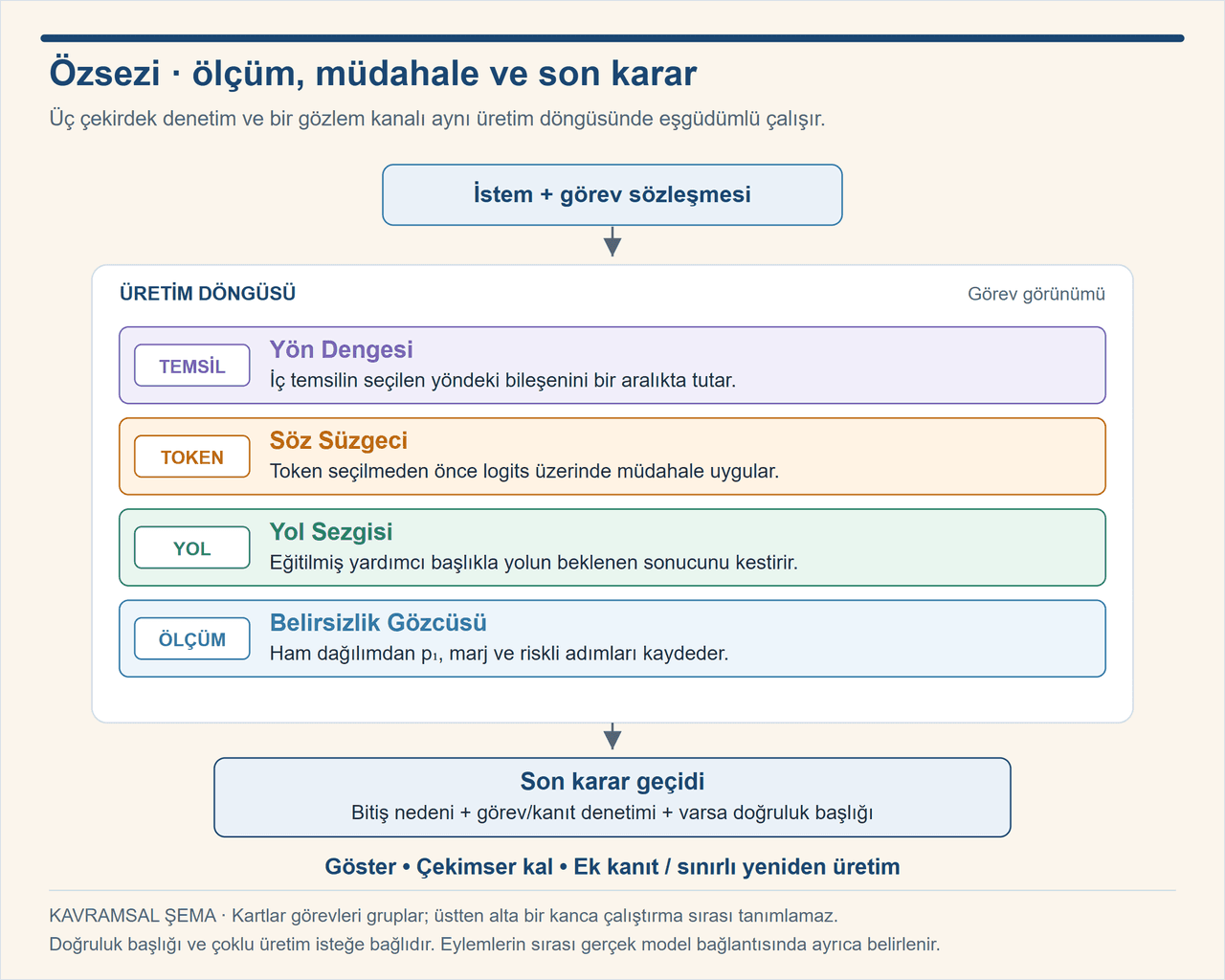
Özsezi’s Production and Response Control Layers (Created with Artificial Intelligence)
When layers operate together, their interactions also influence the outcome. Two signals derived from the same model may assign high confidence to the same incorrect response. An intervention on the representation or logits can alter the distribution seen by subsequent controllers. Therefore, in evaluating the architecture, both the individual effects of components and their collective generation behavior are considered.
The layer schematic illustrates each component’s role in the flow. The Uncertainty Observer gathers measurements; Direction Balance links to representations; the Word Filter connects to token selection; and Path Intuition informs decisions about the trajectory of generation. The optional accuracy head provides additional evaluation at the response level. The order and data processed by each component are detailed in the subsequent token step schematic.
The Uncertainty Monitor is a measurement layer we designed to record the highest probability token, the margin between the first two tokens, and the proportion of risky flagged steps. This layer implements the monitoring functions previously referred to as ProbMonitor and PHLP in our earlier design. The measurement is derived from the model’s output token distribution.
A simple indicator that flags a step as risky due to low highest probability or low margin, along with its average over the entire generation, can be expressed as follows:
Equation 1: Token-Level Risk
This ratio summarizes the frequency with which steps occur during generation where the highest token probability or the margin between the top two candidates falls below a threshold. The correlation of this indicator with accuracy depends on the task, the tokenizer, the generation domain, and the sampling settings. A rare word in a correct poetic line may receive low probability, while a common erroneous pattern may carry high probability. The monitor’s signal is used as a complementary measure to assessments at the behavior and response levels.
The distribution from which the measurement is taken determines the meaning of the signal. Raw logits reflect scores before any logit control; temperature-applied distributions show the effect of sampling settings; and distributions after the Word Filter reveal the outcome of intervention. When these stages are monitored separately, it becomes possible to identify which specific operation contributed to increased confidence. For example, an intervention that sharpens the distribution may increase the probability of the top token; this change is interpreted as the intervention’s effect on the distribution.
The Word Filter is inspired by logit processors that modify raw scores before token selection. NVIDIA’s PreventHallucinationLogitsProcessor, 【7】 generates a predefined fallback response when the highest token probability falls below a threshold, using a counter mechanism. In the examined code, the counter accumulates low-confidence counts even after safe steps. This cumulative structure produces a different behavior than a patience mechanism that resets only after a sequence of safe steps.
In our developed Word Filter, the triggering mechanism has been expanded to support multiple intervention types. Our design defines options including direct termination with EOS, reducing the dominant logit, combining the highest probability with margin and entropy, searching for risk within a sliding window, and adjusting thresholds based on sentence position. This allows the separate selection of risk continuity, context, and intervention type.
EOS is the token that marks the end of a sequence. Forcing an EOS selection under persistent risk conditions terminates the current generation path prematurely. In modes that use a fallback response, hesitation is explicitly communicated to the user. The purpose of this layer is to limit the extension of risky generation; the truthfulness of the generated text is evaluated at the response level.
In the logit reduction approach, the score of the dominant token is lowered to increase the likelihood of alternative continuations. The direct effect of the intervention is to alter the probability ranking of candidate tokens. Its contribution to textual fidelity is assessed based on the quality of the generated alternatives. When processors that force EOS and those that redirect to another token are used together, their application order determines which decision takes precedence.
The mathematics of this intervention is straightforward. For the highest-scoring candidate v* and a reduction amount δ, a clear rule can be expressed as follows:
Equation 2: Reducing the Logit of the Dominant Candidate
This equation shows how the reduction in the dominant candidate’s score affects the probability distribution. After re-normalization, the probabilities of other candidates also change. This enables testing of alternatives to a confidently incorrect continuation. The same operation may also suppress a correct but rare word. In evaluating the intervention, both outcomes must be considered together: corrected erroneous continuations and correctly generated responses that were unnecessarily altered.
The operational modes of the Word Filter address different decision problems. Termination with EOS halts the current path. Fallback responses communicate hesitation to the user. Logit reduction redirects generation toward alternative choices. Sliding window and patience rules distinguish isolated low-confidence steps from sustained risk. Uncertainty at the beginning of a sentence versus in the middle of a proper noun carries different contextual meanings. Mode selection and threshold values are evaluated in relation to their impact on the specific task.
In our İstiklal Marşı experiment, the Word Filter, Direction Balance, and Path Intuition were activated together. Under this control, the small model was able to generate the first two stanzas faithfully to the original text without modifying its weights.
The foundation of Directional Balance lies in the idea of tracking behavioral orientations from the Assistant Axis work within the model’s internal representations. In the source study, the relationship between deviation from assistant behavior and persona drift is investigated, along with the effect of activation limiting. In our architecture, this layer addresses behavioral stability, and the evaluation of factual claims is conducted at the response level through control mechanisms.【8】
During the preparation of a behavioral orientation, the model collects representative examples appropriate to the layer and generation region. In an explanatory framework, a direction can be derived by normalizing the difference between the average representation of the target behavior and the average representation of the contrasting behavior. The source implementation supports the calculation of such axes and various interventions. The accompanying data—method and model version information—clarify which representation the axis corresponds to.【9】
During inference, ensuring that the vector u has unit length guarantees that the projection and the subsequent correction are computed on the same scale. The center μ and bounds a and b are defined within the representation space of the model and layer from which the axis is derived. This makes it clear which range of behaviors the numerical bounds correspond to. When the direction of the axis is reversed, the interpretation of the lower and upper bounds is also inverted.
In the constraint process examined in the repository【10】, a unilateral threshold is applied; whether the lower or upper bound is interpreted depends on the chosen direction of the axis. The same repository already supports multiple orientations and layers. In our additional design for Directional Balance, we incorporate a bilateral interval, hard or soft constraints, and task-dependent tolerances. Tolerances for the reasoning and final response regions are also defined separately. The following equation describes our bilateral adaptation: Let h be the hidden state in a layer, μ the reference center, u the unit axis, and s the projection.
Equation 3: Directional Balance; Projection and Correction
In this equation, only the component along the selected direction is modified. If the projection lies within the interval, the correction is zero; if it lies outside, the difference to the nearest bound is added back along the unit axis. The same operation can be formulated without using μ in an uncentered definition. In this case, the axis and bounds are computed directly over uncentered representations.
In a numerical example, let u = (1; 0), μ = (0; 0), the acceptable interval be [−1; 1], and h = (2.4; 1.1). The projection is 2.4; the clamped value is 1. The correction is (−1.4; 0), so the new representation becomes h′ = (1; 1.1). Only the horizontal component is altered. If h = (0.2; 1.1) had been within the same interval, the correction would have been zero.
The operation illustrated in this two-dimensional example applies identically to a single selected direction in a high-dimensional representation. In the following diagram, selected representation projections are tracked across token steps to illustrate the behavior of the equation. When the raw continuous curve exits the band, the clamped curve remains at the boundary; values within the band are preserved. In soft constraint, the shape of the transition depends on the curvature of the chosen function.
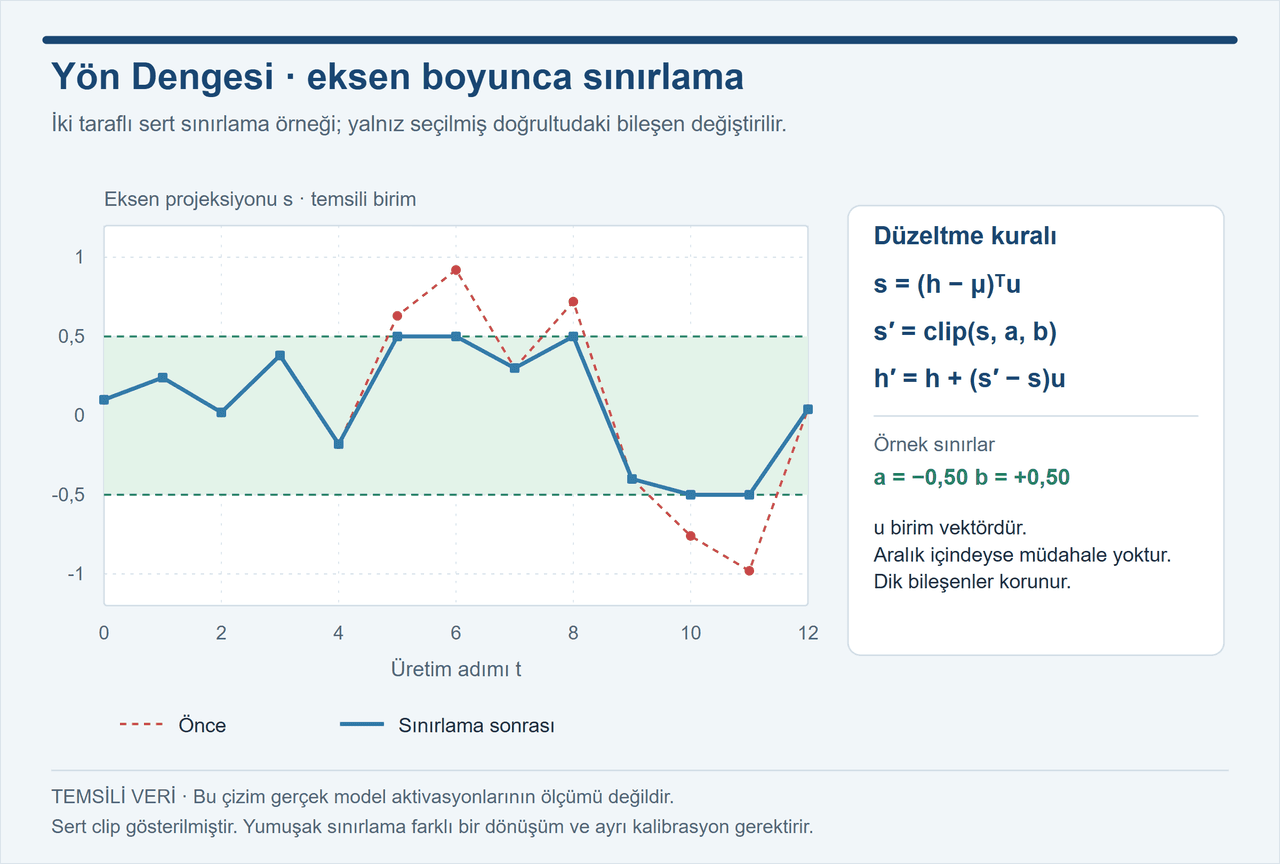
Bilateral Hard Constraint in Direction Balance (Generated with Artificial Intelligence.)
In our design, the assistant addresses multiple behavioral orientations, including excessive affirmation and rejection. A clipping operation on non-orthogonal axes can alter the projection of a previously applied axis. The interaction between these effects becomes apparent when the order of axis application, the total magnitude of correction, and the final projections are jointly analyzed.
In our İstiklal Marşı experiment, Directional Balance was activated alongside Prompt Filtering and Path Intuition, and the correct two continents were achieved under this combined framework. To examine more closely the relationship between behavioral stability and text fidelity, the same comparison can be repeated with Directional Balance disabled. This allows the individual contribution of the layer and its interactions with other controls to be studied.
Path Intuition is inspired by the idea of predicting in advance where a generation prefix will terminate. Drawing from ZIP-RC, it reads the joint distribution of the final reward and remaining length from the same forward pass, using separate logits alongside the standard token logits. The following equations describe this joint distribution. The interpretation of these predictions is determined by the reward and length targets used to train the auxiliary outputs.【11】
Let the reward intervals be denoted by b and the remaining length intervals by ℓ. The joint distribution and its expected values can be computed via the auxiliary logits:
Equation 4: Reward and Remaining Length Distribution
Equation 5: Expected Reward and Remaining Length
In these sums, r and l represent the values corresponding to the reward and remaining length intervals respectively. Auxiliary tokens are masked during text selection; the predictions are read as control signals. What the reward represents depends on the task and labeling scheme. In a setup where the target is defined as answer correctness, calibration evaluation also measures the relationship between the predicted reward and the actual correctness.
In our Path Intuition adaptation, we adopt a hook connected to the generation model and an auxiliary prediction head. While the original ZIP-RC implementation uses separate dictionary logits, in this design the signal is read from the representation provided by the hook. First, the representation is intervened upon by Direction Balance; then the updated representation is fed to the auxiliary head, and the prediction is linked to token generation via the control policy. When the head also outputs a length prediction, the remaining generation cost can be estimated using this information.
The official ZIP-RC repository provides an offline scoring pipeline; adaptive sampling is part of the search approach described in the paper. In our self-observation design, we address how such predictions can be tied to stopping decisions and optional branch management during live generation. In evaluating the hook-based setup, both the correlation of the prediction with the task and the latency it introduces into the generation flow are examined.
Noisy token predictions in the project flow can be smoothed using an exponential moving average.
Equation 6: Exponential Moving Average of Reward
When the number of consecutive low values reaches a patience threshold, generation or a branch may be terminated. The minimum generation length prevents premature decisions on very short prefixes. Region-specific thresholds treat signals from different generation stages separately. The selection of these parameters is made based on the balance of accuracy, coverage, and latency in the target task.
The difference between smoothing and patience can be observed in an instructional trace consisting of eight decision calls. Suppose the raw reward predictions are sequentially 0.82, 0.36, 0.80, 0.74, 0.35, 0.28, 0.25, and 0.20. With α = 0.50, the moving average remains at 0.59 after the single drop at the second call, and generation continues. The average drops to approximately 0.407 by the sixth call and remains below the 0.50 threshold for the next two calls. With a patience of three observations and a minimum observation count of five, the example policy terminates at the eighth call. Here, t denotes the decision call before the next token is selected: Tokens are selected in the first seven calls, and generation ends at the eighth call without adding a new token.
The artificial values in this example allow separate tracking of the raw prediction, the moving average, the consecutive risk counter, and the final decision. In the shown policy, a safe observation resets the counter; risk counting begins only after the minimum observation limit is reached, and the threshold comparison is strictly enforced. These three choices explain why a specific call in the same reward sequence triggers termination.
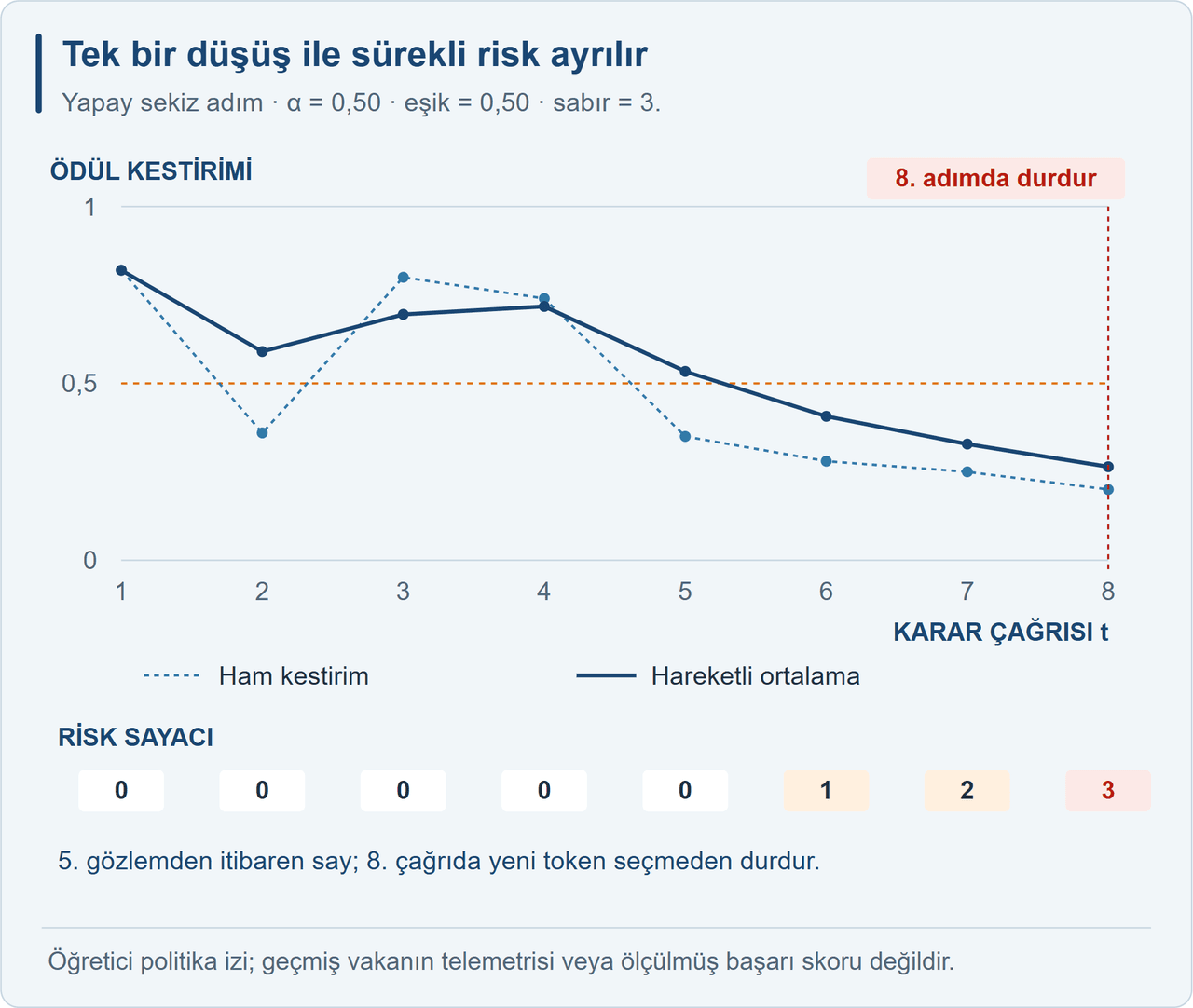
Moving Average and Patience Counter (Generated with Artificial Intelligence.)
Reading the auxiliary prediction from the same forward pass eliminates the need for an additional language model call. The total computational cost arises from the number of candidates, the number of generated tokens, and the operations of the controller. Therefore, in cost evaluation, latency, total token usage, GPU memory, and the load of the auxiliary head are treated as separate metrics.
In our production control design, the pre-production, thinking, and final response regions are treated as distinct components. In the thinking region, the diversity of exploratory continuations is emphasized, while in the final response, form and claim decisiveness are more determining. This distinction justifies the need for threshold and tolerance adjustments specific to each region.
The basis for regional separation lies in the model’s conversation template. Textual thinking labels and special channel tokens are different representations; the boundaries of the production region are inferred from the structure used by the model. The Gemma 4 model cards describe the thinking setting and output format. The thinking setting in the experimental configuration is among the information that determines how these boundaries are interpreted.【12】
Region-sensitive control also encompasses the patience counter, minimum length, and stance decision alongside thresholds. In models with a thinking channel, the start and end boundaries are read from special tokens or structured output. In models that do not use such a channel, the flow proceeds through the existing production regions.
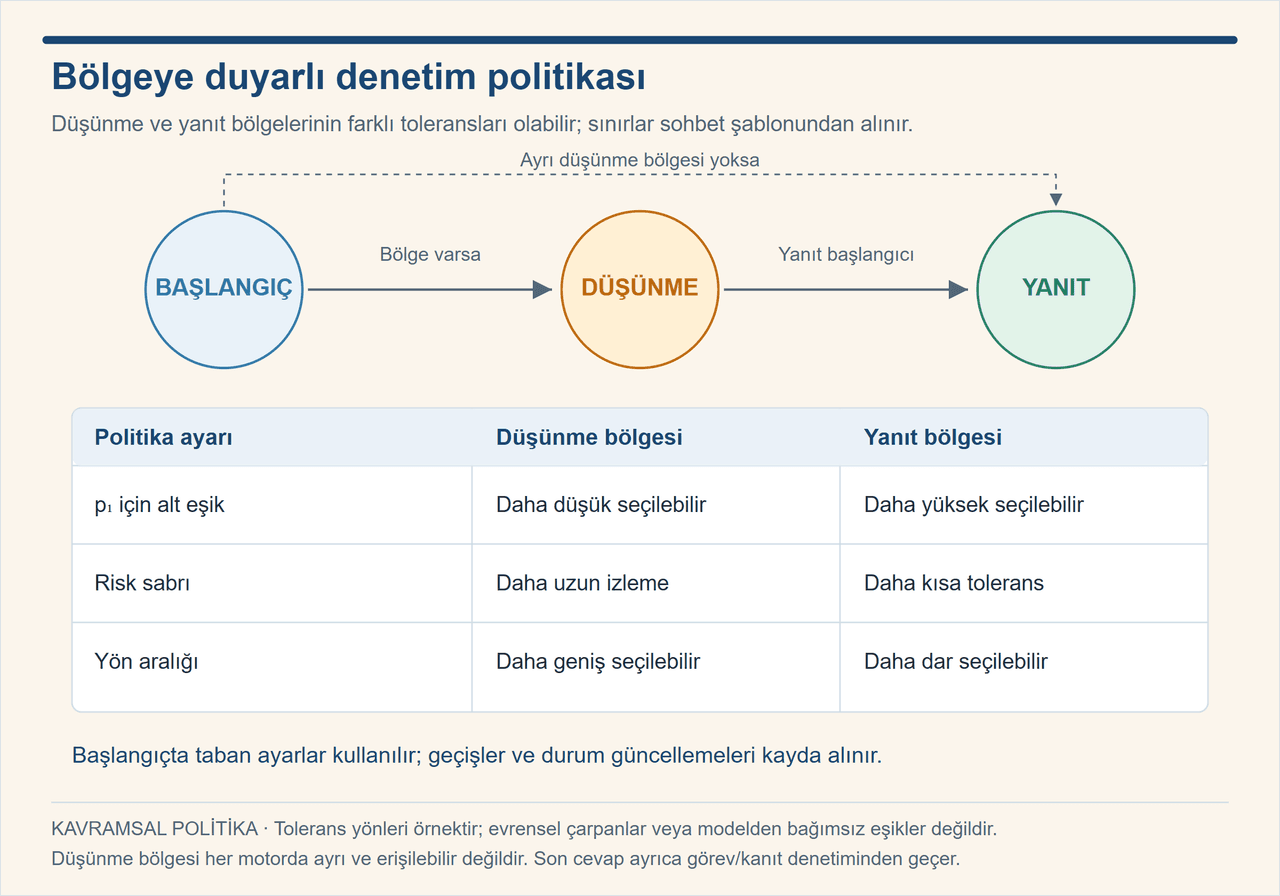
Inspection Policy According to Production Regions (Generated by Artificial Intelligence.)
The more flexible and stricter expressions in the diagram illustrate how control can be adjusted across regions. For instance, reducing tolerance in the final response may cause some correct answers to be prematurely terminated alongside incorrect continuations. An appropriate setting is chosen by jointly evaluating risk, coverage, and false suppression within each region. Resetting or transferring the counter during region transitions is also part of the same policy.
The processor order also determines the distribution of representations seen by auxiliary heads. The activation read after Direction Balance may differ from its state prior to intervention. When the Path Intuition head’s calibration includes this processing order, predictions are evaluated based on the representations encountered in practice. Positioning the Uncertainty Observer before the Logit Control of the Word Filter enables separate monitoring of the distribution generated by the model under the filter’s influence.
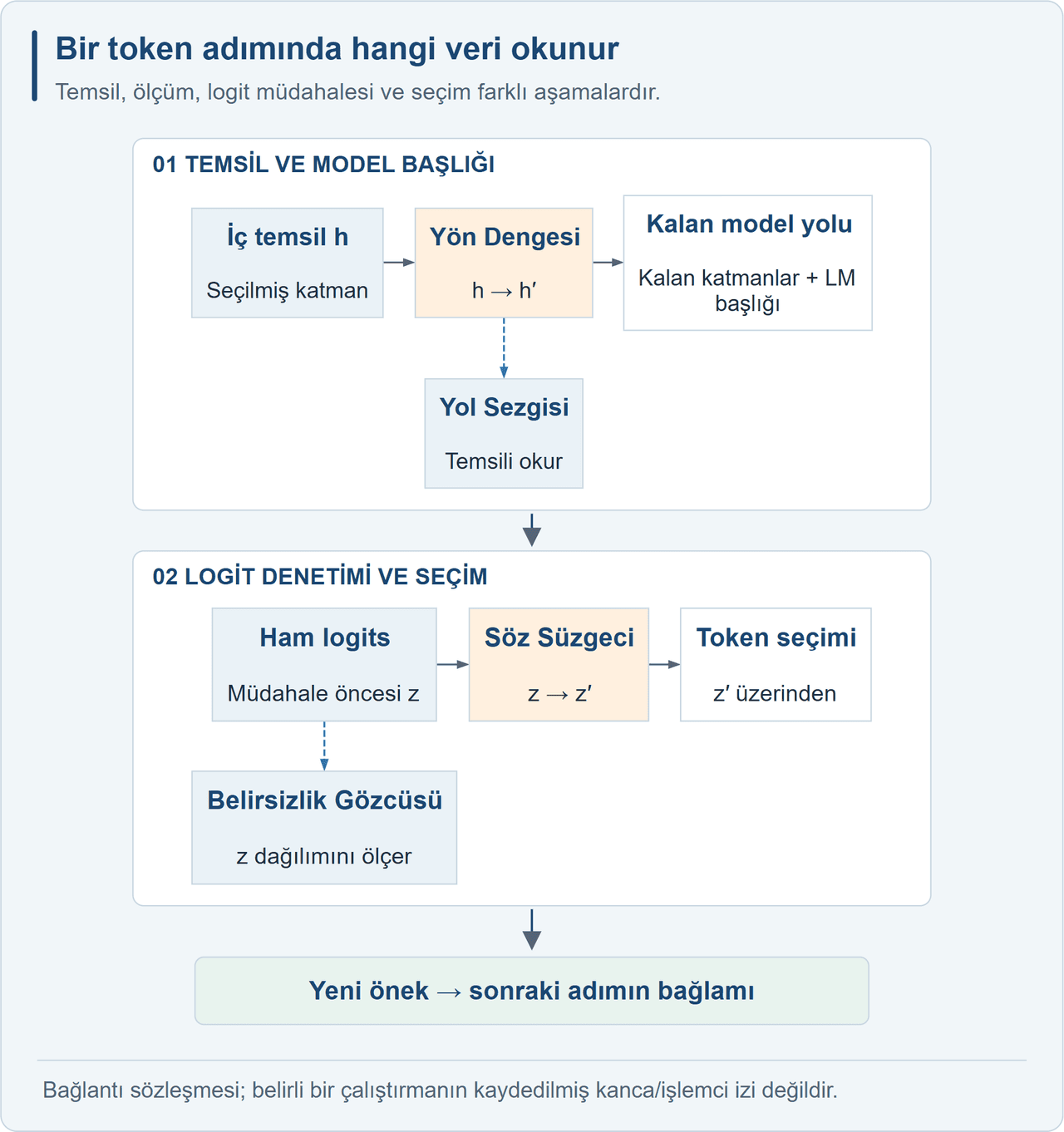
Representation, Measurement, and Intervention at the Token Level (Generated by Artificial Intelligence)
Tracking a production step through data types concretizes this order. The hidden representation h at the selected layer becomes h′ after Direction Balance. If intervention occurs at an intermediate layer, the remaining transformer layers execute; the final representation is converted to logits at the language model’s output head. The Path Intuition head reads its assigned representation. In the shown flow, the Uncertainty Observer measures scores prior to the Word Filter’s logit intervention. The Word Filter then updates the logits, a token is selected from them, and this token is appended to the prefix of the next step.
The diagram illustrates how representations are processed between control layers during production. The layer to which the hook is attached must encompass either the full prefix or the final position of the representation read by the auxiliary head, and the order of processor application forms part of this flow. The version of this configuration determines which processing sequence the record belongs to. Separate monitoring of logits before and after intervention enables differentiation between the model’s initial distribution and the controller’s effect. The thinking and final response regions are determined by the boundaries defined in the model’s conversation template.
Integration begins by defining which data the inference engine provides at each stage. The following access profiles indicate the required entities and connections for each control layer. Once the appropriate profile is selected, the layers can be activated sequentially. The eight-decision instructional trace in the following section explains step by step how the state and decisions evolve within this flow.
Table 4: Integration Profiles Based on Model Access Levels
The available data determines the scope of the control that can be established. In an API that returns only text, evaluations at the response level are feasible; access to hidden states is required for activation control. In services that provide log probabilities, the scope is determined by the shared dictionary segment and the position of scores within the generation pipeline. The hook connection is also established according to the inference engine in use. If an entity required for a control is missing, the configuration explicitly reports this; the flow may be halted or switched to a narrower profile as appropriate.
Let B denote the number of requests being processed at a given time, V the vocabulary size, and D the representation dimension of the selected layer. While the initial context transition involves multiple positions, the following h record represents the most recent valid position for each request. Position selection separates padding areas from the active representation. Response length is tracked via generated tokens, and activation intervention is applied to the selected layer and position.
Table 5: Data and Ownership Contract of a Decision Call
In the Hugging Face Transformers documentation, the output_logits requested are the raw scores from the LM head; the scores returned via output_scores may have been processed during generation. These two output fields serve to track different stages of the pipeline. The online control connection is established via a processor or hook that activates before token selection in the generation loop. The flow described here assumes single-path inference without beam search.
The order of measurement and intervention determines the decision flow. First, the raw logits are measured; then, the selected logit intervention is applied in a configured sequence alongside special token masks and sampling operations such as temperature and top-p. In cases where the natural EOS is masked for minimum length due to risk, termination is treated as a separate decision. In the presented design, this decision is decoupled from token selection, so normal completion and risk-driven termination are recorded under distinct causes.
The Path Intuition auxiliary head is trained on records that associate production prefixes with achieved task outcomes. Each record contains the client ID, the production prefix, the completed response, the task label, and the version of the evaluator who provided the label. In document-supported tasks, the evidence ID and passage are also included in this context. For heads trained on length estimation, the target is the number of tokens remaining to completion, calculated using the tokenizer used during generation. For heads trained solely on reward targets, the head estimates this reward.
The label of the completed response evaluates the final outcome of the generation, not the truthfulness of individual tokens in the prefix. The beginning of an incorrectly completed response may still be correct. The head that predicts the final success from the prefix learns what outcome will be reached under the current continuation behavior. Including diverse continuations and tasks in training allows this expectation to be examined across a broader set of examples. Data separation at the client or source group level before prefix duplication ensures that short and long prefixes derived from the same response remain within the same partition.
The record accompanying the Direction Balance includes the model version, layer name, position selection, axis direction and sign, center, bounds, preparation data, and generation region. The auxiliary head adds whether this information was sourced before or after intervention. These details help verify the compatibility of the loaded artifact with the operational workflow. In a sourceless test setup, the reference response, generation, and control artifact are kept in separate evaluation branches without preparation.
Each controller maintains a separate state per request: decision step, current region, moving average, consecutive risk counter, buffered candidate, and termination reason. For a new request, the average is empty and the counter is zero; the first valid reward estimate becomes the starting point of the average. The threshold comparison in this example is definitive: if the average is below the threshold, it is considered risky; if equal, it is not. Before reaching the minimum observation limit, the counter remains zero; from the limit onward, a safe observation resets the counter.
In the training flow, when the region changes, the average and counter are reset, so thinking and final response statistics are tracked separately. This preference is one of the policy options evaluated via calibration in the target model. A retry begins with a clean state. When branching from the same prefix, the state of the common prefix is copied, and subsequent updates are tracked per branch. KV cache and randomness state are also part of this distinction. Since the cache holds past token computations, matching the prefix with the cache upon restart ensures generation consistency.【14】
The table below shows the decision priorities of the training controller. First, required artifacts, signals, and data formats are verified. In a valid call, the source limit, termination due to risk, and token selection are evaluated in sequence. This order clarifies which decision takes precedence when multiple conditions occur simultaneously.
Table 6: Decision Priorities in the Reference Controller
In this policy, when the production token budget is exhausted along a single path, the last selected token is retained in the internal buffer and production ends with BUDGET. If a natural EOS is selected during the same call, the termination reason is preserved as EOS. Completed requests are excluded from further production steps. The delay control mechanism, which checks the time elapsed before the model call, is the responsibility of the policy shown; its role is to process the timeout signal. The retry option can be limited by total budget and number of attempts; for example, an additional attempt may be configured as part of this policy.
The artificial signals in the Path Intuition section enable step-by-step tracking of how the state evolves. It begins with an average of 0.82 in the first call. After the first seven calls, the internal buffer contains seven token IDs. The eighth call’s reward estimate of 0.20 lowers the average to approximately 0.264 and brings the consecutive risk count to three. A RISK decision is then triggered; the selected_token field is left empty and the buffer retains the seven tokens. The following event log illustrates the state of this instructional step.
Table 7: Example Event Log (Termination Due to Risk)
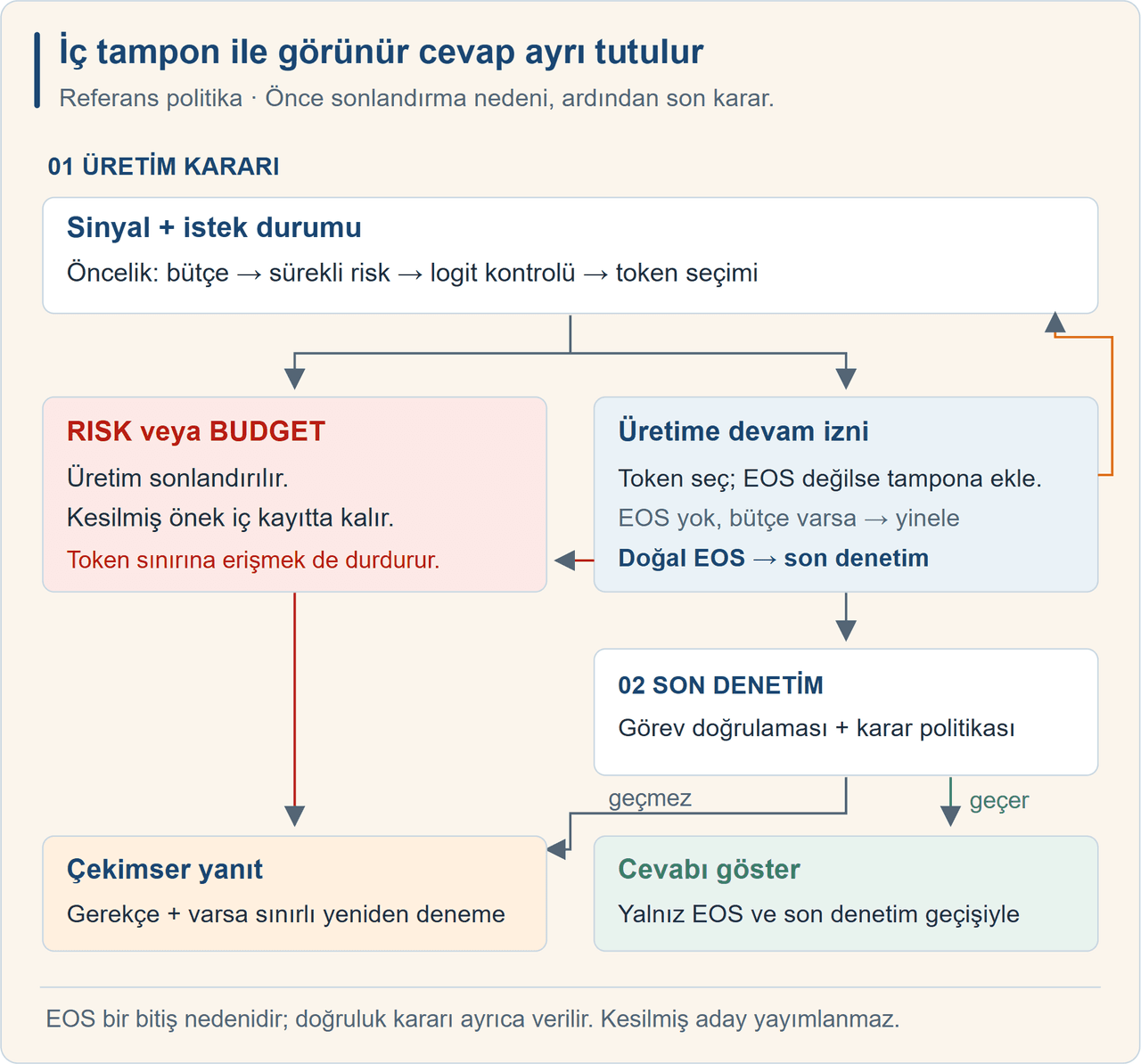
Internal Buffer and Visible Response (Generated by Artificial Intelligence.)
The internal buffer holds the candidate for production, while the presentation layer carries the response to be shown to the user. In the displayed policy, candidates ending with the standard EOS are subject to final decision review; responses that pass this review are presented to the user. Candidates ending with RISK or BUDGET are retained for logging, and the user is informed with the message "I could not complete the response reliably." If source verification and limited regeneration options are enabled, the flow may also be directed along these paths. Thus, the reason for production termination and the suitability of the response for presentation are treated as separate decisions.
In streaming interfaces, buffering ensures that evaluation is completed before any content is shown to the user. While production is ongoing, the user sees the processing status; the response becomes visible only after passing the decision checkpoint. When direct token streaming is preferred, content becomes visible before evaluation is complete. In this case, partial output can be marked as a draft. The difference between these two presentation formats also determines how calculated confidence scores affect the perception of errors by the user.
In standard production, only a single continuation path is followed. In multi-candidate methods, multiple continuations are generated from the same prompt or prefix, and the computational budget is distributed among these paths. After outlining the core flow established by the three production checks, the optional search options of the broader architecture—SCTS and Meta-MDP—are described.
Segment Commit Tree Search (SCTS) was introduced in our design to persistently incorporate the common prefix shared among branches generating short segments. Risky branches can be pruned and a new round can be initiated from the accepted prefix. Each acceptance step in a round expands the search’s common internal prefix. The response presented to the user is determined by the final evaluation of the resulting candidate.
Let c be the longest prefix shared by at least M branches. A waiting strategy that does not immediately accept the last L tokens can be formally expressed as follows:
Equation 7: Common Prefix and Delayed Final Segment
This expression captures the intuition of the method; in practical implementation, sentence boundaries, minimum progress thresholds, risk scores, and stopping rules may also be incorporated. When the common word prefix remains too short, the system may stall. Candidates expressing the same correct meaning through different phrasings may unnecessarily diverge due to lexical disagreement.
To concretize the process, consider three candidates where each word is treated as a unit. The first candidate is “Başvuru 15 Mayıs günü kapanır”, the second is “Başvuru 15 Mayıs tarihinde biter”, and the third is “Başvuru 16 Mayıs günü kapanır”. The common prefix of the first two candidates consists of three units: “Başvuru 15 Mayıs”. When the final unit is delayed, this round accepts “Başvuru 15”; “Mayıs” is held until the next context is observed. For readability, word units are used in this example; in the model’s internal processing, the same procedure operates over token IDs generated by the tokenizer.
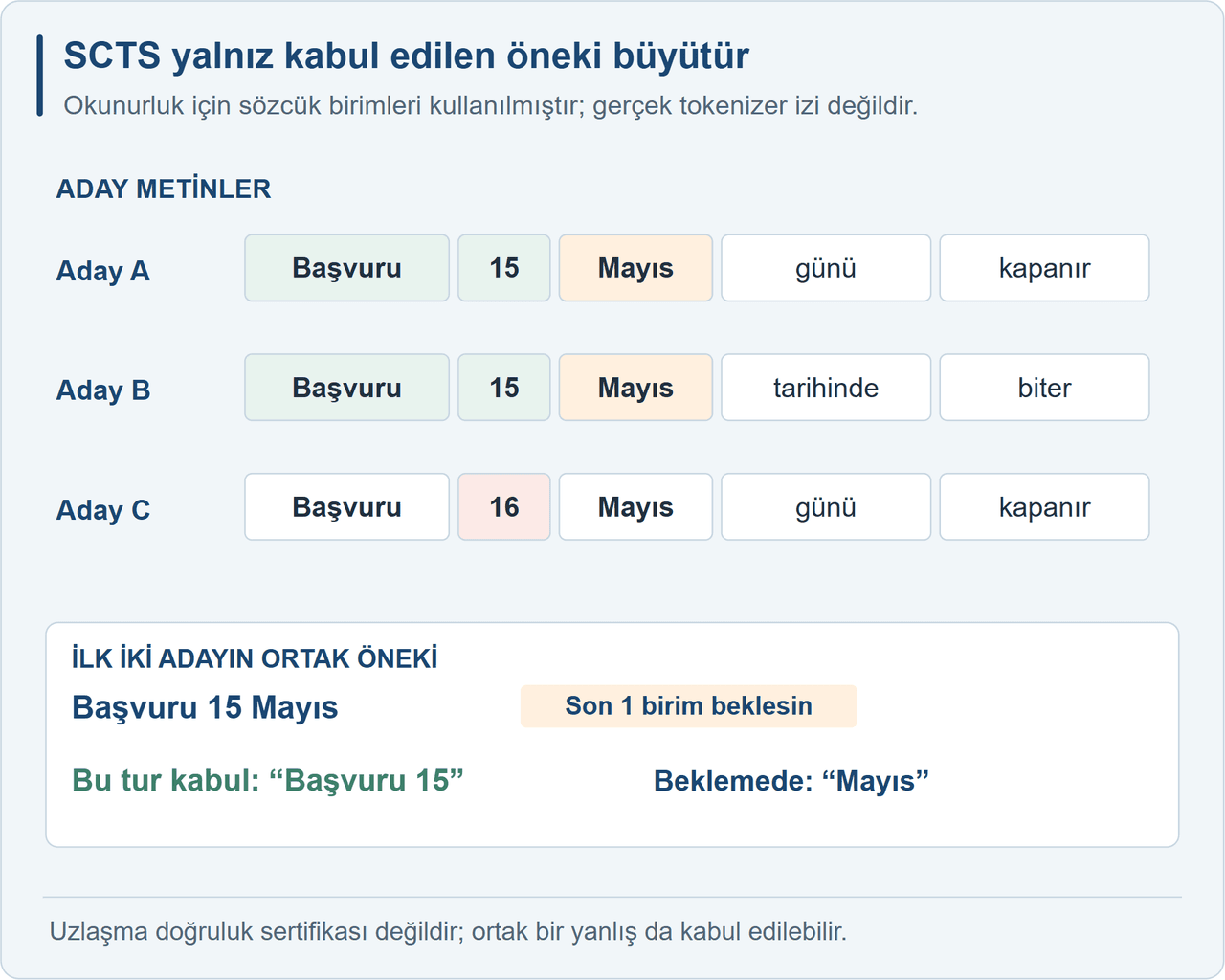
Adoption of the Common Prefix with SCTS. (Generated by Artificial Intelligence.)
In this example, the consensus criterion determines which candidates share the same prefix. The correctness of the application date is then verified through the relevant document or an independent evaluation channel. Two candidates may produce the same incorrect date, while the third, differing in its remainder, may carry the correct date. Therefore, in SCTS, merging candidates addresses the search flow, while evidence-based evaluation addresses the truthfulness of the response.
This distinction becomes tangible in tasks requiring verbatim reproduction, such as reciting the İstiklal Marşı. Accepting the common continuation advances the search, while evaluating the content, boundaries, and order of lines assesses textual fidelity.
The Meta Markov Decision Process (Meta-MDP) frames action selection over generation paths rather than individual tokens. Actions at this level include continuing along the current path, branching into a new path from a promising candidate, pruning a low-value path, or reorganizing the candidate pool. The ZIP-RC study treats search as a decision problem balancing expected quality, computation, and latency.【15】
In our design for Meta-MDP, the candidate pool and benefit calculation are jointly considered. The reward distribution of alternatives, expected remaining length, and current computational budget serve as inputs to this calculation. The value of allocating production to a path or initiating a new branch is evaluated by weighing the expected additional quality against the resources consumed.
To formalize this trade-off, a utility function can be defined for each path using its final reward R, total computation C, and latency D:
Equation 8: Computation and Latency Balance
In this utility expression, the value of finding a high-quality candidate is balanced against the resources spent to find it. The marginal gain of initiating a new branch depends on the probability of discovering a better result than the current best path. Candidate similarity and expected remaining length are critical inputs to this decision. Additional production in branches repeating the same error yields diminishing returns; in contrast, for a promising long path, latency is weighed against quality expectations. The joint distribution of reward and length ensures both expectations are jointly accounted for.【16】
In Meta-MDP, “continue” allocates more production to the current path; “branch” initiates a new sample from a given prefix; and “prune” terminates production on the path and removes it from the active pool. When actions are tracked alongside the signal and budget at the time of selection, it becomes possible to trace which search decisions led to the final response. These records facilitate analysis of the contributions of candidate count, path selection, and production budget.
In the broader architecture, SCTS handles the incremental expansion of the accepted prefix, while Meta-MDP manages resource allocation and action selection across candidate paths. Our previous design’s AdaptiveSampler and intermittent accuracy scoring mechanisms are also available as optional configurations. The production configuration determines the flow most suitable for the target task and budget.
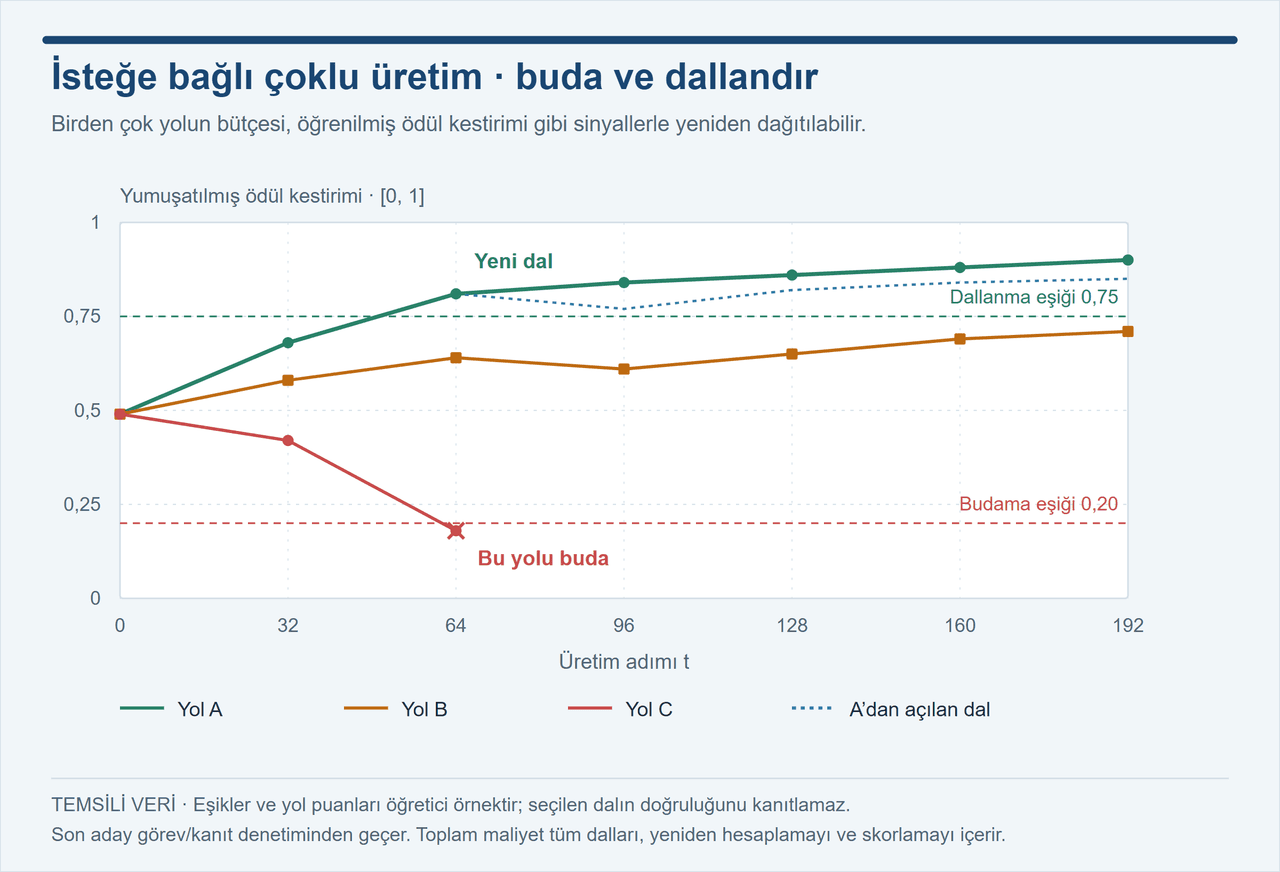
Branching and Pruning in Multiple Production Paths (Generated by Artificial Intelligence.)
The multi-path view makes the temporal impact of these decisions tangible. If a path’s score remains low, the budget may not be allocated to its continuation. When a new branch is spawned from a promising prefix, two paths share the same history but diverge in subsequent token selection. The following curves illustrate this branching and pruning logic with a synthetic example.
The intermediate score indicates which path appears most promising during the search; the final response evaluation assesses the selected candidate’s task performance. Branches derived from the same model may also share similar errors. When branching events are tracked together with the common prefix, per-branch score, consumed budget, and final verification outcome, both the contribution of the search and the production and memory costs become visible.
The original design of Gnosis compresses the hidden states and attention traces from a frozen language model into low-dimensional identifiers. These two streams are transformed into a truth prediction via a small learned structure.【17】 The schematic representation is as follows:
Equation 9: Truth Probability Estimation
Here, φ denotes the parameters of the learned truth head. In our Gnosis adaptation, token confidence features, hidden state summaries, and optional attention features are jointly considered. Our decision framework aims to combine this score with context of evidence and production telemetry. The head’s behavior on the target task is evaluated through feature selection, training labels, and rescaling methodology.
In our flow, the answer can be reprocessed using the model’s tokenizer and chat template. This path involves an additional forward pass but leverages existing computations by directly reading production traces. The cost difference between these two operational modes is measured. Inclusion of the reasoning segment defines the evaluation input by specifying where the context is truncated and the format of the evidence packet.
Alongside the full answer, partial responses can be re-evaluated at specified intervals. In this optional path, partial text is fed to the truth head; the Path Intuition pathway reads reward estimates from the representation during generation. The data input and computation structure differ between the two paths. As the frequency of interval-based evaluation increases, partial outputs are examined more frequently; the reprocessed prefix and head computation add to the cost.
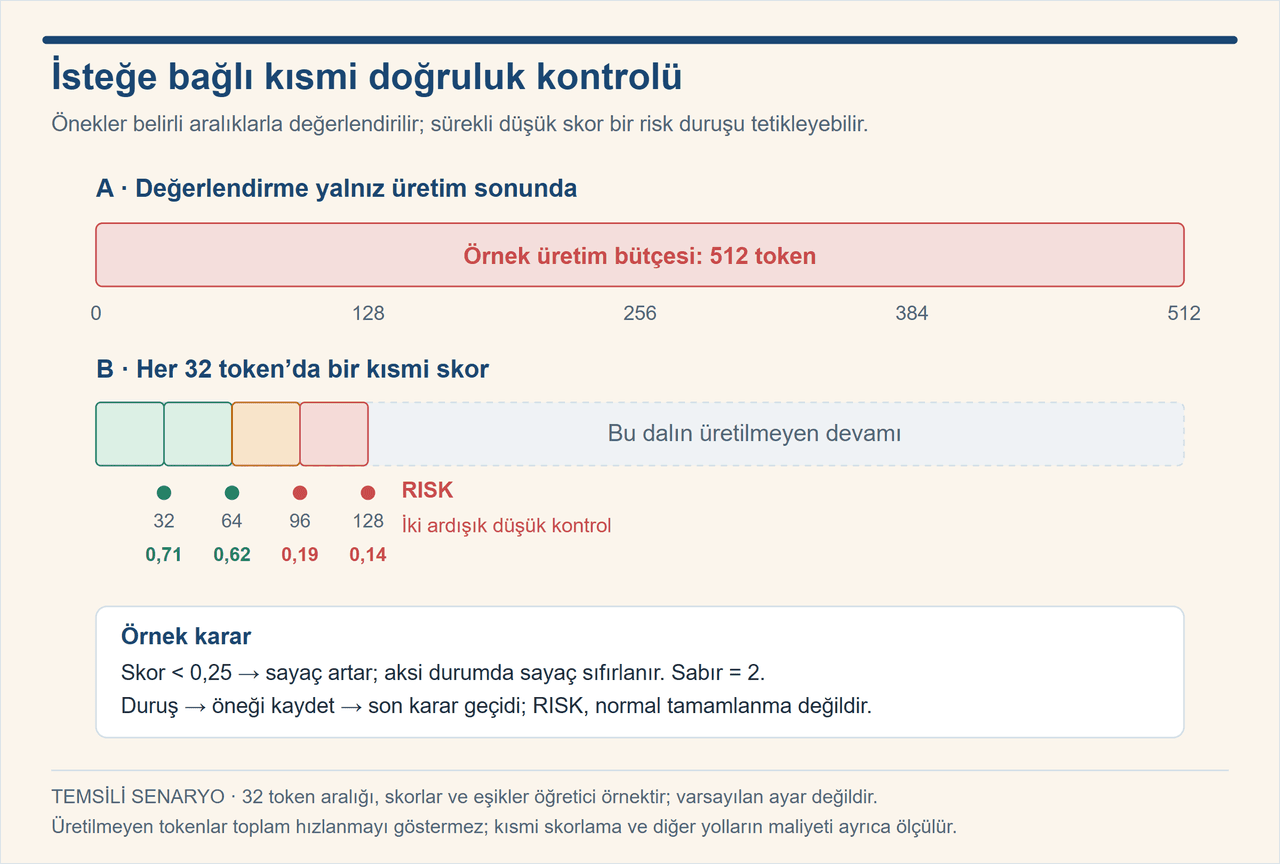
Intermittent Truth Verification and Early Review (Generated by Artificial Intelligence.)
When generation is early-stopped on the timeline, the candidate remains limited to the prefix generated up to that point. The wall-clock gain is determined by the control frequency, the length of the reprocessed prefix, and the cost of the head. Flows terminating due to risk are logged as RISK, and the partial candidate is passed to the task-evidence transition. Normal completion is separately tracked via the EOS signal.
For document-based questions, answer evaluation relies on scoring the relevant evidence within the same context. For instance, a verifier assessing a claim of an upward trend in a graph requires access to the data representing the graph or its description. Our EvidenceBundle is a packaging layer that carries externally provided text and source provenance into this context. Evidence acquisition processes such as web search or OCR serve as separate connections feeding data into this layer.
In a simple decision rule, if the truth score falls below a threshold, the answer is suppressed. In the following combined rule that uses both signals, suppression is triggered only when a low truth score is accompanied by token-level risk:
Equation 10: Combined Suppression Rule
The AND rule reduces unnecessary suppression by requiring both risk conditions to be met simultaneously, but may allow errors captured by only one signal to pass. The OR rule requires only one condition to trigger suppression; it catches more errors but also blocks more correct answers. The data distribution and cost of each error type determine the choice between these two policies.
For example, when the truth score is below threshold but token risk is also below its own threshold, the signals point in opposite directions. The AND policy passes this answer because it requires both risk conditions; the OR policy suppresses it based solely on the low truth score. The outcome of these two choices is evaluated by measuring the rates of false positives (passing incorrect answers) and false negatives (suppressing correct answers). Threshold selection is determined by the task’s relative cost assigned to each error type.
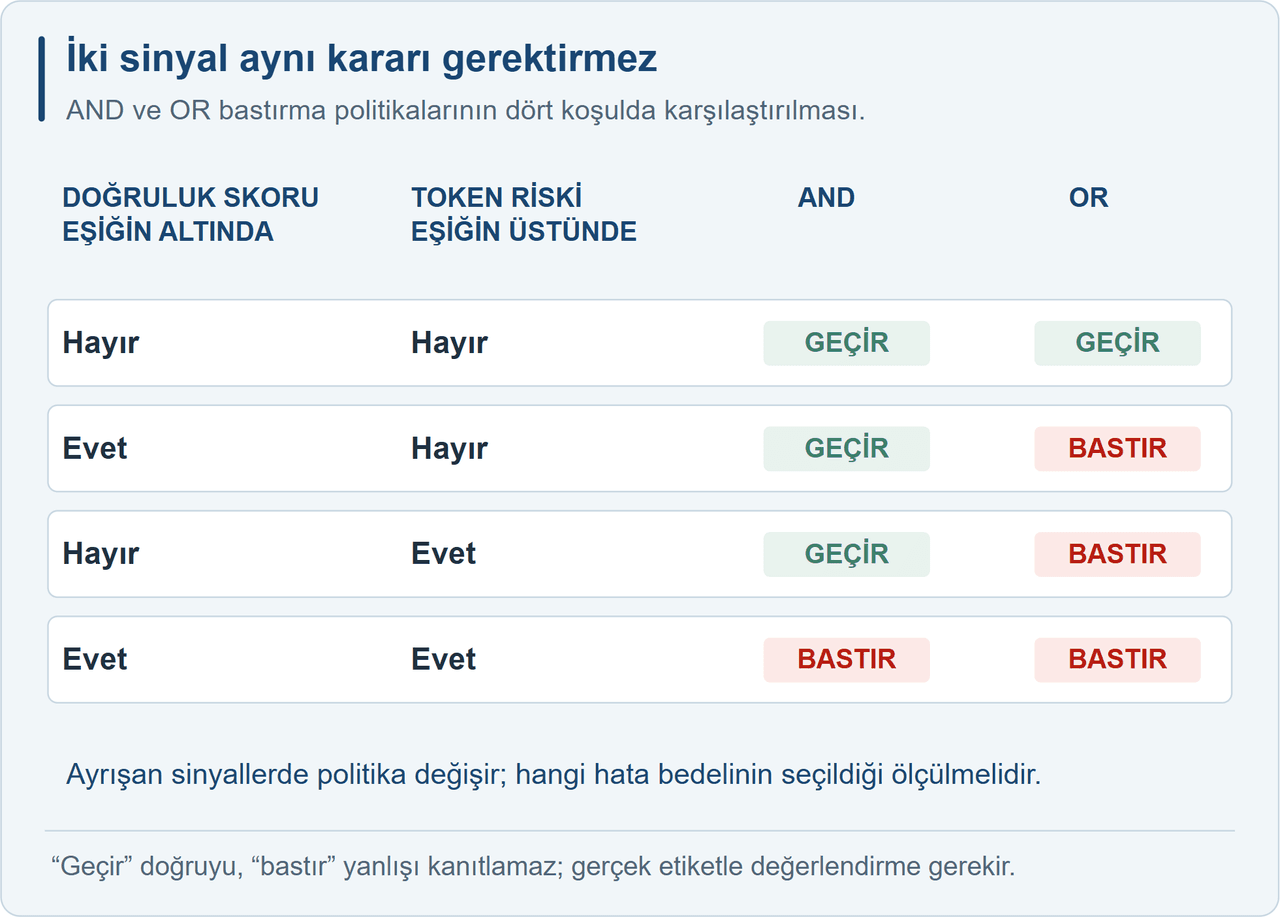
Comparison of AND and OR Decision Rules (Generated by Artificial Intelligence)
In our prior design, the option discussed under the Bayesian ensemble head relies on combining signals via logistic regression. Here, we refer to this structure as the logistic combined decision model. Dependencies among signals derived from the same model are addressed alongside calibration of the combined score. Memory that leverages past decisions on similar questions serves as an auxiliary context channel. The contribution of the memory option can be assessed by examining the alignment of past decisions with current evidence and the impact of repeating prior errors.
Our research’s evaluation plan includes examining the İstiklal Marşı observation under reproducible conditions. The comparison record includes the model and weight version, the tokenizer and chat template, the thinking setting, the prompt, the generation budget, the sampling conditions, and the active components. Trigger and modification logs also indicate which control intervened at which point in the generation, enabling the alignment of configuration with actual operational behavior.
Table 8: Proposed Component Extraction and Budget Comparisons
The comparisons in the table form the framework of the planned evaluation phase. The distribution of results is analyzed by considering all repetitions of each condition together. Since using the same seed across different models does not imply identical sampling paths, comparisons are established across multiple runs. As additional task families are introduced, it becomes possible to investigate which gain occurs under which condition.
In the İstiklal Marşı task, exact line-by-line matching and accurate full translation across two continents are distinct criteria. Missing or extra lines, line order errors, and incorrect words can be examined using separate error labels. When the raw response and its post-hoc corrected version are evaluated separately, the model’s direct generation becomes visible. Prompt and tool access logs clarify how the source-free generation condition is established.
Evaluation across the broad task set encompasses accuracy, coverage, false suppression, user-perceived errors, and cost. Calibration evaluation measures the relationship between predictions and actual outcomes; decision evaluation measures the consequences of actions taken based on these scores. Maintaining a separate final test set distinct from the data used for tuning and calibration enables examination of how selected configurations behave on new examples.
The data setup includes three functions. Preparation data is used to construct auxiliary headers and behavioral axes. Calibration and development data are allocated for selecting thresholds and control parameters via score transformations. Final testing is conducted after these selections are fixed. In the source-free condition, reference responses are held in an independent evaluation branch; the setup where the source is provided to generation is treated as a separate experimental condition.
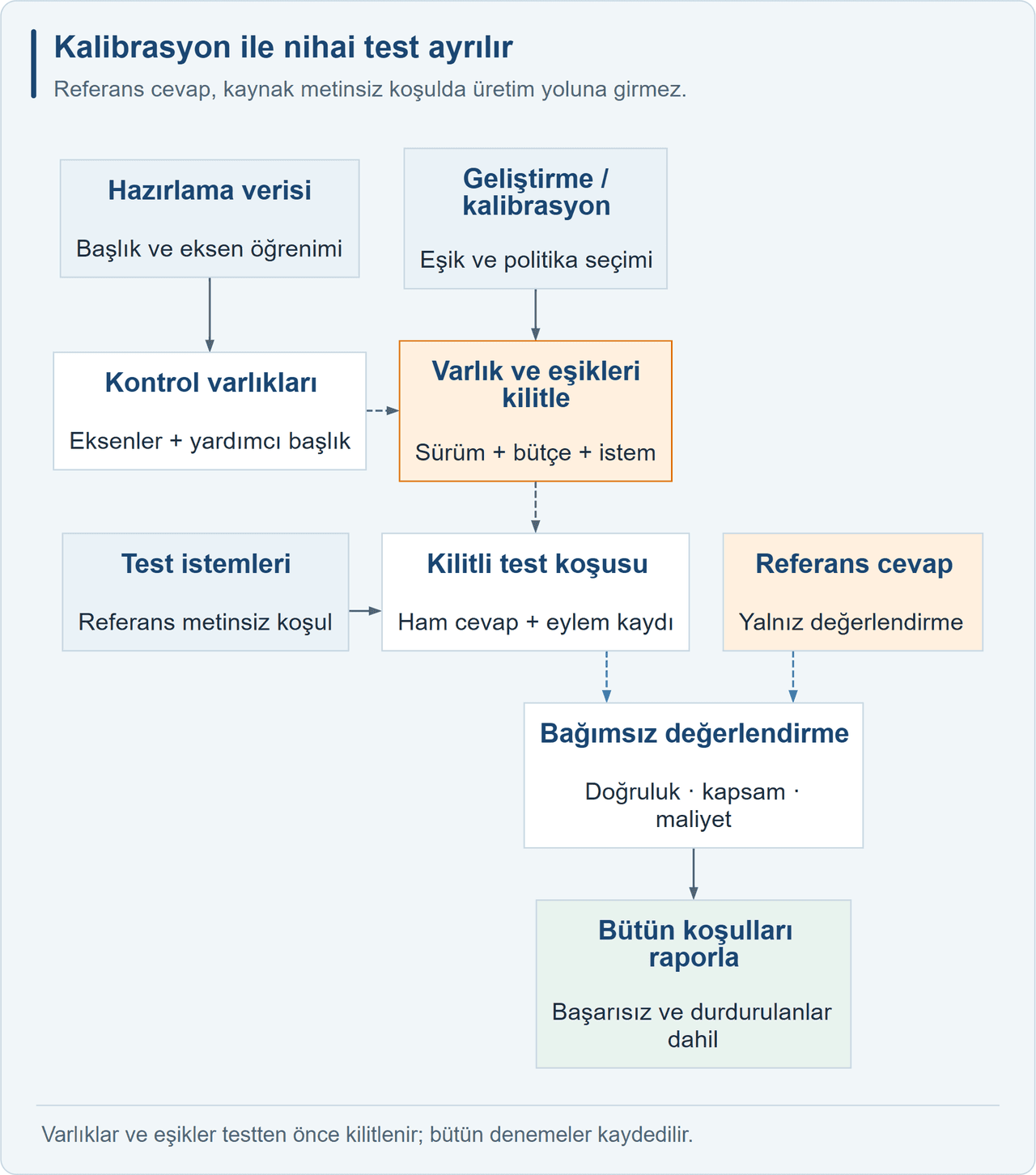
Preparation, Calibration, and Final Test Distinction (Generated by Artificial Intelligence.)
Cost evaluation compares response quality achieved within the same generation budget and the resource amount required to meet a given quality target. The number of candidates, generation length, total token usage, latency, and hardware information constitute the metrics of this comparison. Thus, the gain in reaching correct answers and computational efficiency can be examined separately.
In the continuation of our research, we aim to integrate these signals within a metacognitive controller. In such a structure, validation calls, regeneration, branch selection, and hesitation can be managed under a unified decision policy. This allows the timing and resource allocation for each control to be addressed within the same policy for every task.
In the İstiklal Marşı task, the same small model produces an incorrect output when operating without intervention but generates the correct text when under control, demonstrating how existing capacity can be utilized through an oversight framework. In this case, the distinction between representing accurate information and transforming it into the desired text at the right moment becomes evident. In this task, where the large model continues to produce errors, controlling the small model’s output ensured the accurate transmission of the first two stanzas.
Our engineering contribution in Özsezi lies in establishing connections that the source inspirations alone cannot fulfill in our target application. Token selection via the Word Filter, internal representations via Direction Balance, and expected production outcomes via Path Intuition were jointly addressed within a unified oversight framework. In our broad architecture, the headings of accuracy, evidence context, and final decision policy provide additional evaluation capabilities. The core design question is how each signal is linked to which intervention and to what extent the resulting production meets the task criteria.
Multiple repetitions, component extraction, and budget-balanced comparisons form the next evaluation step in our research. This framework enables analysis of under what conditions, at what resource cost, and with which controls the correct output is achieved.
The first section of the series established the causes of hallucinations, the criteria for accuracy, and the methods for reduction; this second section connects the same framework to control layers, desire states, and the decision of what response to present to the user. The İstiklal Marşı case serves as a concrete starting point for investigating the relationship between these two levels.
The transition to implementation begins with the tasks and evaluation criteria from the first section. Then, the smallest control flow compatible with model access can be established. Interventions are incrementally added on top of signals collected in observation mode; accuracy, coverage, error suppression, and cost are monitored together. Thus, the approach outlined in the two sections can be transferred into a production framework that is measurable and improvable across different projects.
Safety Research. “steering.py.” GitHub. Accessed November 12, 2026.https://github.com/safety-research/assistant-axis/blob/master/assistant_axis/steering.py
Ghasemabadi, Amirhosein and Di Niu. “Can LLMs Predict Their Own Failures? Self-Awareness via Internal Circuits.” arXiv 2026. Accessed November 12, 2026.https://arxiv.org/html/2512.20578v2
Ghasemabadi, Amirhosein and Di Niu. “Gnosis.” GitHub. Accessed November 12, 2026.https://github.com/Amirhosein-gh98/Gnosis
Google DeepMind. "Gemma 4 31B IT." AI Model Card. Hugging Face. Accessed November 12, 2026.https://huggingface.co/google/gemma-4-31B-it
Google DeepMind. “Gemma 4 E4B IT.” Artificial intelligence model card. Hugging Face. Accessed November 12, 2026.https://huggingface.co/google/gemma-4-E4B-it
Hugging Face. "Cache Strategies." Transformers Documentation. Hugging Face. Accessed November 13, 2026.https://huggingface.co/docs/transformers/main/en/kv_cache
Hugging Face. “Utilities for Generation.” Transformers Documentation. Hugging Face. Accessed November 13, 2026.https://huggingface.co/docs/transformers/main/en/internal/generation_utils
Lu, Christina, Jack Gallagher, Jonathan Michala, Kyle Fish, and Jack Lindsey. “The Assistant Axis: Situating and Stabilizing the Default Persona of Language Models.” arXiv 2026. Accessed November 12, 2026.https://arxiv.org/html/2601.10387v1
Manvi, Rohin, Joey Hong, Tim Seyde, Maxime Labonne, Mathias Lechner, and Sergey Levine. “Zero-Overhead Introspection for Adaptive Test-Time Compute.” arXiv 2025. Accessed November 12, 2026.https://arxiv.org/html/2512.01457v4
Manvi, Rohin. “ZIP-RC: Training Pipeline and Script Reference.” Teknik Dokümantasyon. GitHub. Accessed November 12, 2026.https://github.com/rohinmanvi/ZIP-RC/blob/main/docs/pipeline.md
NVIDIA. “prevent_hallucination.py.” GitHub. Accessed November 12, 2026.https://github.com/NVIDIA/logits-processor-zoo/blob/main/logits_processor_zoo/transformers/prevent_hallucination.py
T.C. Millî Eğitim Bakanlığı. “TBMM’nde İstiklâl Marşı Görüşmeleri ve Kabulü.” Accessed November 12, 2026.https://meb.gov.tr/istiklalmarsi/istiklalmarsi/Meclisten/Kabulu
[1]
Google DeepMind, “Gemma 4 E4B IT,” Yapay zekâ model kartı, Hugging Face, Accessed November 12, 2026.https://huggingface.co/google/gemma-4-E4B-it
[2]
Google DeepMind, “Gemma 4 31B IT,” Yapay zekâ model kartı, Hugging Face, Accessed November 12, 2026.https://huggingface.co/google/gemma-4-31B-it
[5]
Amirhosein Ghasemabadi and Di Niu, “Gnosis,” GitHub, Accessed November 12, 2026.https://github.com/Amirhosein-gh98/Gnosis
[6]
Google DeepMind, “Gemma 4 E4B IT.”
[7]
NVIDIA, “prevent_hallucination.py,” GitHub, Accessed November 12, 2026.https://github.com/NVIDIA/logits-processor-zoo/blob/main/logits_processor_zoo/transformers/prevent_hallucination.py
[8]
Christina Lu, Jack Gallagher, Jonathan Michala, Kyle Fish, and Jack Lindsey, “The Assistant Axis: Situating and Stabilizing the Default Persona of Language Models,” arXiv 2026, Accessed November 12, 2026.https://arxiv.org/html/2601.10387v1
[9]
Safety Research. "steering.py."
[10]
Safety Research. "steering.py."
[11]
Rohin Manvi, Joey Hong, Tim Seyde, Maxime Labonne, Mathias Lechner, and Sergey Levine, “Zero-Overhead Introspection for Adaptive Test-Time Compute,” arXiv 2025, Accessed November 12, 2026.https://arxiv.org/html/2512.01457v4
[12]
Google DeepMind, “Gemma 4 E4B IT”; Google DeepMind, “Gemma 4 31B IT.”
[14]
Hugging Face, “Cache Strategies,” Transformers Documentation, Hugging Face, Accessed November 13, 2026.https://huggingface.co/docs/transformers/main/en/kv_cache
[15]
Manvi, et al. “Zero-Overhead Introspection for Adaptive Test-Time Compute.”
[16]
Manvi, et al. “Zero-Overhead Introspection for Adaptive Test-Time Compute.”
[17]
Amirhosein Ghasemabadi and Di Niu, “Can LLMs Predict Their Own Failures? Self-Awareness via Internal Circuits,” arXiv 2026, Accessed November 12, 2026.https://arxiv.org/html/2512.20578v2

From Research Inspirations to Project-Specific Design
What Does the İstiklal Marşı Case Reveal?
Three Levels of Observation and Two Control Stages
What Does the Uncertainty Monitor Measure Without Altering Production?
How Does the Word Filter Transform Uncertainty into Intervention?
How Does Directional Balance Limit Internal Representations?
Preparation of the Axis and Its Application During Inference
How Does Path Intuition Predict the Progress of Generation?
Thinking Region and Processor Order
Model Access and Data Flow in Integration
Input and Output Logging of a Forward Transition
What Data Does the Training Target Depend On?
State, Termination, and Visible Response in a Single Flow
A Trace from the Eighth Call to the User
When Do SCTS and Meta MDP Come Into Play?
Acceptance of Segments via SCTS
Resource Allocation via Meta-MDP
Truth Head and Decision at Answer Level
Auditing Partial Answers at Intervals
Evaluating Completed Answers with Evidence
Accuracy, Repetition, and Cost Evaluation
Converting Existing Capacity into Reliable Production
Transition from Two Sections to a Project