

Bu içerik Türkçe olarak yazılmış olup yapay zeka ile otomatik olarak İngilizceye çevrilmiştir.
+2 Daha
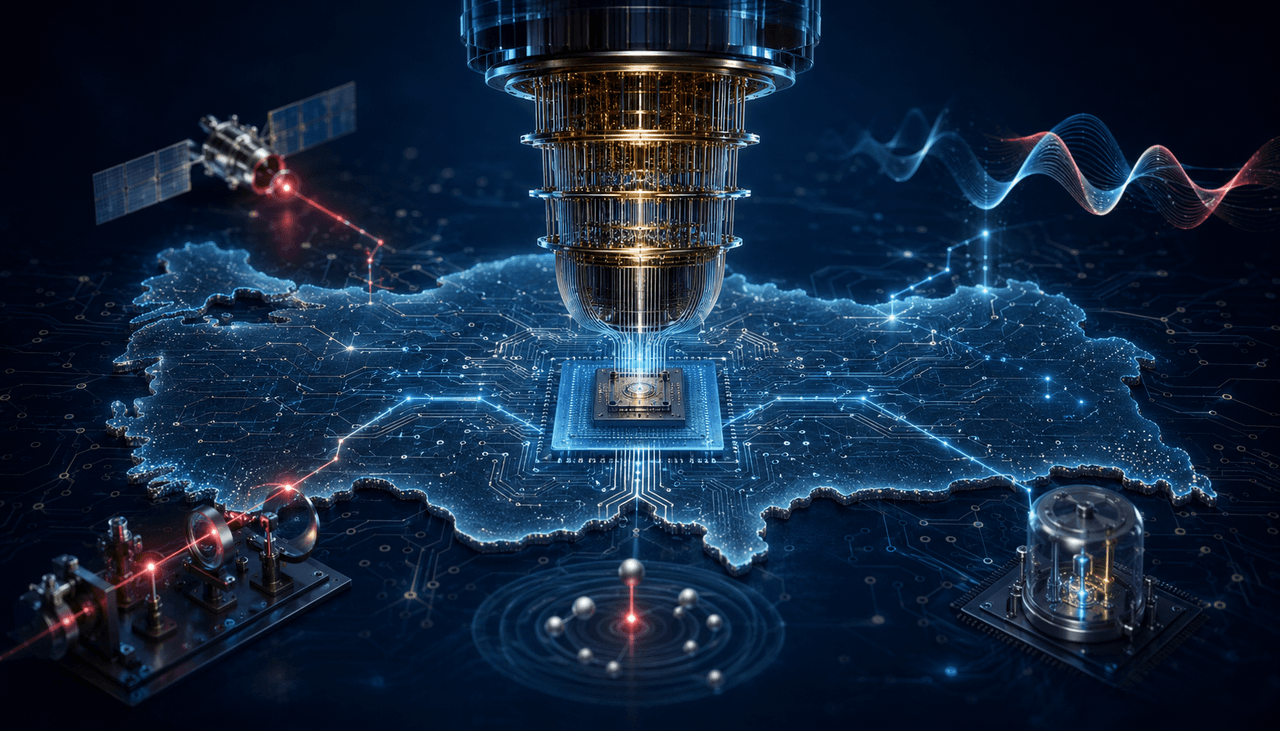
Quantum Technologies in Türkiye (Generated by Artificial Intelligence.)
Basic fields | Quantum computing Quantum communication Quantum sensing Quantum metrology | ||||||||
|---|---|---|---|---|---|---|---|---|---|
Research institutions | TÜBİTAK BİLGEM TÜBİTAK National Metrology Institute İzmir High Technology Institute Quantum Technologies Application and Research Center | ||||||||
University laboratory | TOBB ETÜ Quantum Technologies Research Laboratory (KUANTAL) | ||||||||
Relevant industrial organization | ASELSAN | ||||||||
First quantum computer | QuanT | ||||||||
Main program | Quantum Technologies Development Program | ||||||||
Areas of study | Quantum processors Quantum sensors Quantum radar and lidar systems Quantum cryptography Post-quantum cryptography Atomic clocks Quantum random number generation | ||||||||
Quantum Technologies in Türkiye encompasses the totality of scientific research, technological infrastructure, educational activities, and industrial projects aimed at developing computing, communication, sensing, and metrology systems by leveraging properties of quantum mechanics such as superposition, entanglement, and measurement. Research in this field in Türkiye is conducted by universities, research centers, public institutions, defense industry organizations, and technology companies, covering stages ranging from fundamental research to the development of experimental systems and technological components.
Quantum technologies encompass fields of technology that utilize quantum mechanical phenomena—superposition, entanglement, and measurement—for information processing, communication, and sensing systems. These technologies are generally examined under the headings of quantum computing, quantum communication, quantum sensing, and quantum metrology. Research spans various stages from fundamental physics investigations to the development of quantum processors, sensors, communication components, control systems, and application software.
Quantum computing is a computational approach that processes information based on physical and mathematical principles distinct from those of classical computers. In classical computers, information is represented by bits that take values of 0 or 1. In quantum computers, the basic unit of information is the quantum bit, or qubit. Due to superposition, qubits can carry a combination of the 0 and 1 states. Entanglement, a relationship with no classical counterpart, can also be established between multiple qubits.【1】
The quantum states of qubits enable different arrangements of computational operations for specific problem classes. Quantum algorithms are designed to exploit superposition, entanglement, and interference. At the end of computation, qubits are measured and converted into classical information. Because the measurement process alters the quantum state, the way quantum algorithms produce outputs differs from classical algorithms.
Quantum computing research includes diverse areas such as quantum processors, electronic systems for controlling qubits, cryogenic infrastructure, signal readout components, quantum algorithms, and software tools. Superconducting circuits are one of the physical approaches used in quantum processors. In this method, quantum circuits operate at extremely low temperatures, and the state of qubits is controlled via electronic signals.
Current quantum computers are systems with a limited number of qubits and are susceptible to computational errors arising from environmental interactions. This stage is defined by the term NISQ, meaning Noisy Intermediate-Scale Quantum. Key technical challenges in quantum computing include increasing the number of qubits, maintaining quantum states for sufficient durations, reducing error rates, and implementing error correction methods. Large-scale quantum systems capable of self-correcting errors are currently under research and development.【2】
Application areas of quantum computing include optimization, simulation of molecular systems, materials research, data analysis, financial modeling, and cryptography. The performance of algorithms and hardware developed for these areas depends on the structure of the problem, the number of qubits used, error rates, and characteristics of the quantum circuit. Efforts focus on using quantum computers alongside classical systems for specific computational problems rather than replacing classical computers entirely.【3】
Quantum sensing encompasses methods and devices that exploit quantum mechanical effects for measuring physical quantities. The sensitivity level achievable by classical measurement systems is related to the standard quantum limit. Quantum sensing systems aim to surpass this limit by employing techniques such as entanglement, squeezed quantum states, and control at the single-atom level.【4】
Quantum sensors are being developed for measuring physical quantities such as time, frequency, acceleration, rotational motion, gravity, magnetic fields, and electric fields. Their operation depends on the quantum system used. Quantum properties of atoms, ions, photons, superconducting circuits, and solid-state systems can be utilized for measurement purposes.
Atomic clocks use the transition frequencies between specific energy levels of atoms for time measurement. These systems are studied in relation to establishing time and frequency standards, synchronizing communication networks, and positioning systems. In Türkiye, research has been conducted on rubidium- and strontium-based optical lattice clock prototypes and quantum chip samples.【5】
Quantum gravimeters are sensors designed to measure variations in gravitational fields. Their use is being explored for detecting density differences, voids, or geological structures underground. Quantum magnetometers, on the other hand, are based on measuring weak magnetic fields. These systems are associated with medical measurements, materials inspection, and navigation research.
Quantum imaging systems exploit the quantum properties of photons. Their application is being investigated in areas such as imaging under low-light conditions, detection at different wavelengths, and acquisition of measurement data. Research in quantum sensing also includes measurement electronics, miniaturization, manufacturing methods, data processing, and integration with existing systems alongside the sensor itself.【6】
Quantum communication encompasses technologies that use quantum states for transmitting information and ensuring communication security. In classical communication systems, information security largely relies on the computational difficulty of solving specific mathematical problems. In quantum communication, security is derived from the behavior of quantum states during measurement.
Quantum key distribution is one of the primary applications of quantum communication. In this method, an encryption key is shared between parties not as a direct message but via quantum states. Any third party attempting to eavesdrop on the communication channel by measuring the quantum states will introduce disturbances into the transmitted states. After transmission, the parties compare results to examine error rates and determine whether eavesdropping occurred.【7】
Quantum key distribution is not an encryption algorithm itself but a method for generating and sharing keys used in encryption processes. The obtained keys can then be used in classical encryption systems. A quantum communication infrastructure may consist of single-photon sources, photon detectors, optical channels, key management systems, and classical communication components.【8】
Quantum communication research can be conducted via fiber optic lines, free-space links, and satellite-based systems. As transmission distance increases, photon losses and environmental effects degrade communication performance. Quantum repeaters, quantum memories, and interconnected quantum nodes are among the research topics for establishing long-distance quantum networks. The long-term goal of these efforts is to connect devices capable of transmitting quantum information into a network structure.【9】
Post-quantum cryptography encompasses classical encryption algorithms designed to be resistant to attacks that could be carried out using quantum computers. These algorithms are designed to operate on classical computers and communication infrastructures. In this respect, post-quantum cryptography is distinct from quantum communication, which relies on the transmission of quantum states.【10】
The ability of quantum computers to solve certain mathematical problems has prompted research into the security of public-key encryption methods. Within this context, transitioning existing systems to post-quantum algorithms, ensuring software and hardware compatibility, updating key management, and revising communication protocols are being addressed. Quantum key distribution and post-quantum cryptography represent two distinct methods applicable at different layers of communication security.【11】
Quantum metrology involves developing measurement standards and methods based on quantum mechanical systems. Measuring, verifying, and comparing time, frequency, electrical quantities, and other physical parameters are among its research areas. Quantum metrology research includes not only the development of measurement devices but also calibration, testing, validation, certification, and standardization processes.【12】
Quantum metrology and quantum sensing are closely related fields. While quantum sensing focuses on sensors and systems for measuring specific physical quantities, quantum metrology is concerned with linking these measurements to standards and ensuring comparable results. In Türkiye’s applied quantum technology support programs, measurement infrastructure, testing methods, validation procedures, and standardization efforts have been addressed under the umbrella of quantum metrology.
Research related to quantum technologies in Türkiye initially developed within the framework of studies conducted at universities and public research institutions in the fields of quantum optics, quantum information, and quantum cryptography. TÜBİTAK’s 2004 Vision 2023 document included a strategic objective related to quantum technologies. The Quantum Optics and Information Conference, bringing together academic researchers, began to be organized from 2016 onward.【13】
A study examining academic output in quantum technologies identified, as of the data collection date, 108 master’s and doctoral theses related to the field in YÖK’s National Thesis Center. The same study detected 152 articles in journals indexed by Web of Science with at least one Turkish-affiliated researcher. These figures reflect the volume of academic work during the period under study.【14】
A quantum cryptography infrastructure established with public support within TÜBİTAK BİLGEM has been used for research on quantum communication and information security. Research conducted through this infrastructure is linked to TÜBİTAK BİLGEM’s participation in the QuantERA network and the development of a quantum-based random number generator.【15】
Under a collaboration between TOBB, TOBB University of Economics and Technology, and ASELSAN, the Quantum Technologies Research Laboratory was established at the TOBB ETÜ Technology Center. The laboratory, coordinated by the Presidency of the Defense Industry, became operational in 2022. Research at the laboratory focused on superconducting quantum electronics and quantum computer hardware.【16】
The Quantum Technologies Application and Research Center was established within İzmir Institute of Technology. The center is one of the academic structures within universities conducting research activities in quantum technologies.
The five-qubit quantum computer named QuanT, developed as a result of research at TOBB ETÜ, was unveiled on 21 November 2024. The development of the system, based on superconducting circuit technology, utilized the infrastructure of the TOBB ETÜ Quantum Technologies Research Laboratory and the Nanotechnology Research Center.【17】
The Ministry of Industry and Technology’s 2030 Industry and Technology Strategy plans the establishment of the TÜBİTAK National Quantum Institute to coordinate research and technology development efforts in the quantum field. The institute is expected to engage in activities related to aligning research infrastructure, developing human resources, and conducting inter-institutional collaborations.【18】
In 2023, TÜBİTAK BİLGEM established the Quantum Technologies Department. Its research areas were defined as quantum computing, communication, cryptography, imaging, sensing, and metrology. Systems targeting these areas are planned for development within the department.【19】
TÜBİTAK participated in the QuantERA III Consortium’s 2025 call. The call was structured under the themes “Quantum Phenomena and Resources” and “Applied Quantum Science.” Projects to be funded must cover at least one of the following areas: quantum communication, quantum simulation, quantum computing, quantum sensing, metrology, or general quantum science. It was stipulated that project consortia must consist of at least three partners from at least three participating countries eligible for funding.【20】
Under the QuantERA 2025 Call, higher education institutions, educational and research hospitals, public institutions, and capital-based companies established in Türkiye were eligible for support. Project durations were set at a maximum of 36 months. The maximum contribution requested from TÜBİTAK per project was capped at 240,000 euros; the upper limit per lead organization was set at 100,000 euros for public institutions and higher education institutions and 240,000 euros for private organizations.【21】
TÜBİTAK National Metrology Institute exhibited rubidium and strontium optical lattice clock prototypes and quantum chip samples in 2026. The institute’s Rubidium Atomic Frequency Standard, within its time and frequency technology scope, was launched into space aboard SpaceX’s Transporter-17 mission.【22】
TÜBİTAK’s EUREKA Xecs 2026 Applied Quantum Technologies Call was prepared for research and development consortia led by the private sector and involving universities and public institutions. The call aimed to elevate the technology readiness levels of projects from levels 4–5 to levels 6–7. The national call budget was set at 3 million euros, with the upper limit for the total budget of Turkish partners per project set at 600,000 euros.【23】
For quantum sensing, the call identified measurement electronics, miniaturization, and manufacturability as focus areas. For quantum metrology, it included testing, validation, certification, and standardization. For quantum communication, integration with existing communication and security infrastructures was specified. In quantum computing, electronic systems for initializing, controlling, calibrating, and reading qubits, as well as photonic components, were included in the support scope.
Among the research areas planned for the National Quantum Institute to be established within TÜBİTAK are the production of diamond- or crystal-based quantum emitters, photonic circuits, and single-photon detectors. Additionally, development of a Rydberg atom-based quantum antenna and quantum radar and lidar prototypes, as well as work on superconducting and photonic-based quantum computer systems, are planned.【24】
Research on superconducting quantum technologies at TOBB University of Economics and Technology began in 2010. These efforts continued under a collaboration with ASELSAN within the Quantum Technologies Research Laboratory, also known by its abbreviation KUANTAL.【25】
Research at the laboratory focused on designing superconducting quantum chips and constructing a quantum computer system. The first chips used in the project were prototyped at a production facility abroad following design work. The manufactured chips were integrated into the laboratory’s systems to develop a five-qubit quantum computer.
Research conducted at the laboratory involved contributions from diverse engineering fields such as electronics, materials science, and integrated circuit design. While chip design was performed within the university, physical fabrication utilized overseas production infrastructure.
The system developed as a result of laboratory work was named QuanT, an abbreviation for “Quantum Computer of TOBB ETÜ.” The five-qubit system was officially launched at a ceremony held at the TOBB ETÜ Technology Center on 21 November 2024.【26】
The hardware infrastructure of QuanT is planned to be used for developing and testing quantum algorithms. Related research includes algorithms for cryptography, artificial intelligence, optimization, energy, and climate modeling.
TOBB ETÜ, ASELSAN, and the Presidency of the Defense Industry plan to establish a production facility for superconducting chips. This infrastructure is expected to be used in the manufacturing processes of superconducting quantum chips and in developing quantum computers with a higher number of qubits.【27】
The system developed under the QuanT project is intended to provide researchers access to a quantum computer infrastructure and enable them to develop algorithms on this platform. The project was conducted with the aim of addressing both the hardware components of the quantum computer and the algorithms designed to operate on them within the same research process.
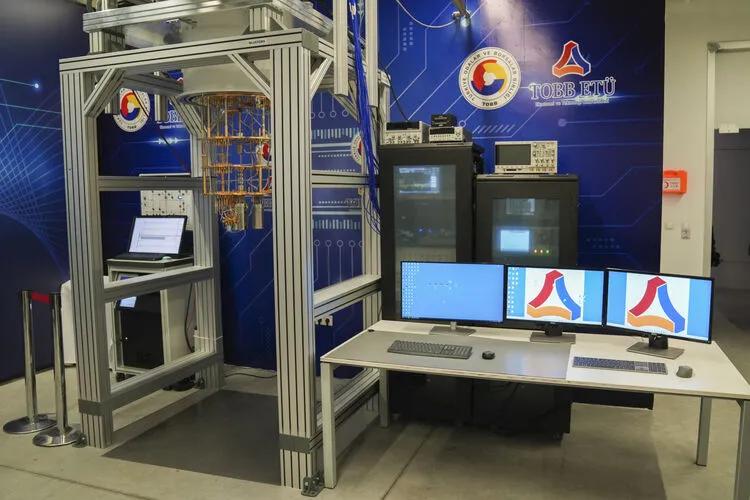
Türkiyenin İlk Kuantum Bilgisayarı (Anadolu Ajansı)
The project was led by TOBB ETÜ faculty members Prof. Dr. Ali Bozbey and Prof. Dr. Mehmet Ünlü. The system’s features and functions were presented to participants during a demonstration program held at the TOBB ETÜ Technology Center. In addition to TOBB ETÜ, ASELSAN and the Presidency of the Defense Industry participated in the development of QuanT.【28】
The design of the circuits used in the quantum computer was carried out in Türkiye. The first quantum chips prepared under the project were prototyped at a production facility abroad. The manufactured chips were incorporated into the quantum computer system as part of the work conducted within KUANTAL.【29】
About Türkiye’s First Quantum Computer (Anadolu Agency)
Following the launch of QuanT, plans were made to establish a production facility for superconducting chips. This infrastructure is expected to be developed through a collaboration between TOBB ETÜ, ASELSAN, and the Presidency of the Defense Industry.【30】
In 2022, the Presidency of the Defense Industry launched eight research and development projects encompassing quantum technologies. A signing ceremony for these projects was held in January 2023. The research was conducted within the framework of AR-GE technology roadmaps developed based on the short- and long-term technical needs of the Turkish Armed Forces and security units.【31】
The program included quantum computing, communication, and sensing. Related research topics included cryptography, optimization, data analysis, simulation, and navigation systems independent of external signals. The program’s presentation meeting on 24 June 2026 was attended by representatives of the Council of Higher Education, university rectors, academics, and defense industry organizations.【32】
The Defense Industry Presidency’s broad-area calls aimed to achieve outputs validated at the level of analysis, experimental results, technical demonstrations, or prototypes. Large companies were expected to handle system integration, small and medium enterprises to develop subsystems and components, and universities and research centers to conduct fundamental and applied research.
Among the sensing projects under the program were the Quantum Lidar and Quantum Radar Projects. These projects were initiated to develop sensing technologies capable of detecting targets that cannot be identified by classical radar systems.【33】
A decision to establish the Türkiye Quantum Technologies Development Center was made at the Defense Industry Executive Committee meeting on 6 August 2024. The center’s areas of activity were defined as establishing research infrastructure for quantum technologies, developing human resources, and enhancing the country’s technological accumulation.【34】
The center is planned to ensure that quantum technology research is conducted within defined research areas. Its responsibilities include coordinating research between universities, research institutions, and industry companies, as well as increasing national and international collaborations.
ASELSAN’s work in the quantum field covers communication, sensing, information systems, and cryptography applications. Experimental test environments capable of operating at temperatures approaching −273 degrees Celsius have been established for these efforts. As a result of research, a quantum random number generator and quantum integrated circuit samples were developed.【35】
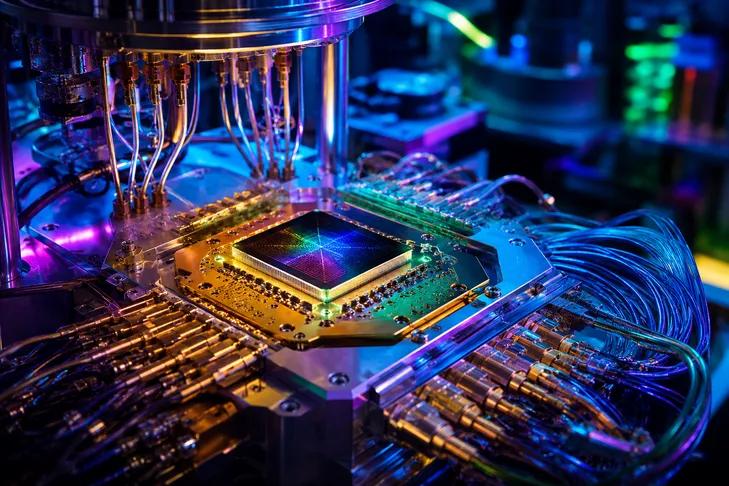
ASELSAN İlk Yerli Süper İletken Kuantum İşlemcisini Geliştirecek (Anadolu Ajansı)
A project titled “Development of a Superconducting Quantum Processor Unit,” led by ASELSAN, was initiated. The project plans to conduct research in condensed matter physics, microwave engineering, electronics, and quantum information theory. Collaboration from Sabancı University, Koç University, and TÜBİTAK National Metrology Institute is anticipated.【36】
The project aims to design and produce quantum processor units. Work has begun to establish a superconducting production facility and quantum chip manufacturing infrastructure within ASELSAN.
The Quantum Technologies Awareness Program was implemented under a cooperation protocol signed between the Türkiye Technology Team Foundation and Q&CO Quantum Computing Technology Inc. It targeted high school students and teachers, covering fundamental principles of quantum science, the operation of quantum computers, and applications of quantum technologies in healthcare, defense, communication, and information technology.【37】
Quantum İTÜ, a student initiative for university students, was founded in September 2022 by Istanbul Technical University students under the supervision of Assoc. Prof. Dr. Deniz Türkpençe. The group began operating as one of the university student branches affiliated with QWorld’s Türkiye unit, QTurkey, and joined the European Association for Innovation and Science in Engineering Education.【38】
For projects submitted to the QuantERA 2025 Call, roles for principal investigators, researchers, advisors, support staff, and fellows were permitted. Principal investigators at universities were required to hold a doctorate, specialization, or artistic proficiency. For principal investigators in public institutions and private organizations, a minimum of four years of undergraduate education was required.【39】
Quantum İTÜ’s educational activities include QTalk seminars, academic visits, summits, article review meetings, and Qiskit-based quantum computing training. QTalk events cover topics such as quantum computing, optics, thermodynamics, optimization, artificial intelligence, and sensors. Academic visits aim to allow participants to examine research environments and meet researchers.【40】
Following the Quantum Technologies Awareness Program, a Quantum High School Hackathon and talent development programs are planned. These activities aim to involve high school students interested in quantum technologies in project development processes and expose them to research and development work.【41】
The QuantERA 2025 Call included provisions for undergraduate students to serve as fellows in projects. A maximum of four undergraduate students per project may serve as fellows. Fellowship support is structured to cover researchers at the undergraduate, master’s, doctoral, and postdoctoral levels.【42】
In Qiskit-based training, participants are introduced to software tools that enable them to construct quantum circuits, perform simulations, and conduct experiments on quantum computers. These trainings are conducted as practical exercises focused on creating and testing quantum algorithms.
One of Türkiye’s international project activities in quantum technologies is conducted under the QuantERA III Consortium. A matching tool was provided for researchers seeking partners and organizations seeking projects for the QuantERA 2025 Call. An online information session was planned by the QuantERA Coordination Office and Call Secretariat to clarify technical and administrative matters related to the call process.【43】
For TÜBİTAK’s EUREKA Xecs 2026 Applied Quantum Technologies Call, projects must involve at least two institutions from EUREKA member countries. At least one of the partner institutions must be located in an European Union member state or a country associated with the Horizon Europe program. Projects are expected to be carried out by consortia led by the private sector and including universities and public research institutions.【44】
For the QuantERA 2025 Call, applications from higher education institutions, educational and research hospitals, public institutions, and capital-based companies registered in Türkiye’s trade registry were permitted. Foundations, associations, cooperatives, unions, sole proprietorships, and general partnerships were excluded from support. Support rates were set at 100 percent for higher education institutions, educational and research hospitals, and public institutions; 60 percent for large private organizations; and 75 percent for small and medium enterprises, based on approved project budgets.【45】
For the EUREKA Xecs Call, project durations were set at a maximum of 36 months. Support covered personnel, travel, consultancy, service procurement, equipment, instrumentation, software, publication, materials, and consumables. It was specified that certain consultancy and service acquisitions between consortium members and commercialization-related expenses would not be eligible for support.【46】
Under the QuantERA Call, separate travel support was defined for consortium members attending scientific meetings and research visits. Up to 116,000 Turkish lira per lead organization was allowed for participation in domestic and international congresses and conferences. Up to 195,000 Turkish lira was permitted for research visits and networking activities among project partners.【47】
For the EUREKA Xecs Call, the deadline for international pre-proposals was set for 26 November 2026 and for full proposals for 5 March 2027. The national call in Türkiye was scheduled to open on 8 January 2027, with institutional pre-registrations due by 30 March and project applications by 31 March 2027.【48】
International project proposals under QuantERA were required to be submitted through both the international call system and TÜBİTAK’s national application system in a two-stage process. Turkish institutions were required to submit a national pre-application via TÜBİTAK’s Project Application System and complete the application with an electronic signature.【49】
Akçomak, İ. Semih, and Zeki C. Seskir. “Türkiye’de ve Dünya’da Kuantum Teknolojilerinin Mevcut Durumu: Toplumsal Çerçeveden Bir Bakış.” PDF document. Accessed September 4, 2026.
Anadolu Ajansı. "Kuantum Teknolojileri ‘TÜBİTAK Ulusal Kuantum Enstitüsü’ ile Desteklenecek." March 28, 2025. Accessed September 4, 2026.https://www.aa.com.tr/tr/bilim-teknoloji/kuantum-teknolojileri-tubitak-ulusal-kuantum-enstitusu-ile-desteklenecek/3522214
Anadolu Ajansı. "Türk Savunma Sanayisinde ‘Kuantum’ Dönemi." June 24, 2026. Accessed September 4, 2026.https://www.aa.com.tr/tr/bilim-teknoloji/turk-savunma-sanayisinde-kuantum-donemi/3976753
Anadolu Ajansı. “ASELSAN İlk Yerli Süper İletken Kuantum İşlemci Birimini Geliştirecek.” June 25, 2026. Accessed September 4, 2026.https://www.aa.com.tr/tr/bilim-teknoloji/aselsan-ilk-yerli-super-iletken-kuantum-islemci-birimini-gelistirecek/3977564
Anadolu Ajansı. “ASELSAN’ın Kuantum Çalışmalarında İlk Ürünler Ortaya Çıktı.” December 27, 2023. Accessed September 4, 2026.https://www.aa.com.tr/tr/bilim-teknoloji/aselsanin-kuantum-calismalarinda-ilk-urunler-ortaya-cikti/3093412
Anadolu Ajansı. “Kuantum Hesaplamalarının 20 Yılda Trilyon Dolarlık Piyasaya Ulaşması Bekleniyor.” April 24, 2026. Accessed September 4, 2026.https://www.aa.com.tr/tr/bilim-teknoloji/kuantum-hesaplamalarinin-20-yilda-trilyon-dolarlik-piyasaya-ulasmasi-bekleniyor/3916580
Anadolu Ajansı. “Türkiye Kuantum Teknolojileri Geliştirme Merkezi Kuruluyor.” August 21, 2024. Accessed September 4, 2026.https://www.aa.com.tr/tr/bilim-teknoloji/turkiye-kuantum-teknolojileri-gelistirme-merkezi-kuruluyor/3309243
Anadolu Ajansı. “Türkiye’nin Kuantum Çalışmaları Sınır Ötesi İşbirliğiyle Hızlandırılacak.” September 24, 2025. Accessed September 4, 2026.https://www.aa.com.tr/tr/bilim-teknoloji/turkiyenin-kuantum-calismalari-sinir-otesi-isbirligiyle-hizlandirilacak/3697282
Anadolu Ajansı. “Türkiye’nin Uygulamalı Kuantum Teknolojileri Uluslararası Çağrılarla Geliştirilecek.” July 25, 2026. Accessed September 4, 2026.https://www.aa.com.tr/tr/bilim-teknoloji/turkiyenin-uygulamali-kuantum-teknolojileri-uluslararasi-cagrilarla-gelistirilecek/4008898
Anadolu Ajansı. “Türkiye’nin İlk Kuantum Bilgisayarı ‘QuanT’ Tanıtıldı.” November 21, 2024. Accessed September 4, 2026.https://www.aa.com.tr/tr/bilim-teknoloji/turkiyenin-ilk-kuantum-bilgisayari-quant-tanitildi/3400083
Anadolu Ajansı. “İlk Kuantum Bilgisayarı Türkiye’nin Teknoloji Sahnesinde İddiasını Artıracak.” December 20, 2024. Accessed September 4, 2026.https://www.aa.com.tr/tr/bilim-teknoloji/ilk-kuantum-bilgisayari-turkiye-nin-teknoloji-sahnesinde-iddiasini-artiracak/3429743
Anadolu Ajansı. “İlk Kuantum Bilgisayarı Türkiye’nin Teknoloji Sahnesinde İddiasını Artıracak.” YouTube, 20 December 2024. Accessed September 4, 2026.https://www.youtube.com/watch?v=AytL89RMXpM
Presidency of Defense Industries. "Kuantum Algılama." Türkiye Kuantum Platformu. Accessed September 4, 2026.https://kuantum.ssb.gov.tr/teknoloji-alanlari/kuantum-algilama
Presidency of Defense Industries. "Kuantum Haberleşme." Türkiye Kuantum Platformu. Accessed September 4, 2026.https://kuantum.ssb.gov.tr/teknoloji-alanlari/kuantum-haberlesme
Presidency of Defense Industries. "Kuantum Hesaplama." Türkiye Kuantum Platformu. Accessed September 4, 2026.https://kuantum.ssb.gov.tr/teknoloji-alanlari/kuantum-hesaplama
Presidency of Defense Industries. "Türk SavunmaSanayii Kuantum Teknolojilerine Kapı Araladı." January 11, 2023. Accessed September 4, 2026.https://www.ssb.gov.tr/haber/turk-savunma-sanayii-kuantum-teknolojilerine-kapi-araladi-yRyNEN
TOBB Ekonomi of Economics and Technology. "Türkiye’nin İlk Kuantum Bilgisayarı QuanT Tanıtım Töreni Gerçekleştirildi." November 21, 2024. Accessed September 4, 2026.https://www.etu.edu.tr/tr/haber/turkiye-nin-ilk-kuantum-bilgisayari-quant-tanitim-toreni-gerceklestirildi
Türkiye Teknoloji Team Foundation. "Türkiye’s Investment in the Quantum Future: Over 3,500 Students Meet Quantum Technologies." June 19, 2026. Accessed September 4, 2026.https://t3vakfi.org/tr/haberler/turkiyenin-kuantum-gelecegine-yatirim-3-bin-500den-fazla-ogrenci-kuantum-teknolojileriyle-bulustu
Yılmaz, Ayşe, Berna Hanım Subaşı, and Büşra Arslan. “Kuantum Bilim ve Teknolojilerinde Farkındalık.” İTÜ Vakfı. November 14, 2025. Accessed September 4, 2026.https://www.ituvakif.org.tr/kuantum-bilim-ve-teknolojilerinde-farkindalik
İzmir Yüksek Teknoloji Enstitüsü. "Kuantum Teknolojileri Uygulama ve Araştırma Merkezi." Accessed September 4, 2026.https://kuantam.iyte.edu.tr/
[1]
Cumhurbaşkanlığı Savunma Sanayii Başkanlığı, “Kuantum Hesaplama,” Türkiye Kuantum Platformu, erişim 4 Eylül 2026, https://kuantum.ssb.gov.tr/teknoloji-alanlari/kuantum-hesaplama
[2]
Cumhurbaşkanlığı Savunma Sanayii Başkanlığı, “Kuantum Hesaplama.”
[3]
Anadolu Ajansı, “Kuantum Hesaplamalarının 20 Yılda Trilyon Dolarlık Piyasaya Ulaşması Bekleniyor,” 24 Nisan 2026, erişim 4 Eylül 2026, https://www.aa.com.tr/tr/bilim-teknoloji/kuantum-hesaplamalarinin-20-yilda-trilyon-dolarlik-piyasaya-ulasmasi-bekleniyor/3916580
[4]
Cumhurbaşkanlığı Savunma Sanayii Başkanlığı, “Kuantum Algılama,” Türkiye Kuantum Platformu, erişim 4 Eylül 2026, https://kuantum.ssb.gov.tr/teknoloji-alanlari/kuantum-algilama
[5]
Anadolu Ajansı, “Türkiye’nin Uygulamalı Kuantum Teknolojileri Uluslararası Çağrılarla Geliştirilecek,” 25 Temmuz 2026, erişim 4 Eylül 2026, https://www.aa.com.tr/tr/bilim-teknoloji/turkiyenin-uygulamali-kuantum-teknolojileri-uluslararasi-cagrilarla-gelistirilecek/4008898
[6]
Anadolu Ajansı, “Türkiye’nin Uygulamalı Kuantum Teknolojileri Uluslararası Çağrılarla Geliştirilecek.”
[7]
Cumhurbaşkanlığı Savunma Sanayii Başkanlığı, “Kuantum Haberleşme,” Türkiye Kuantum Platformu, erişim 4 Eylül 2026, https://kuantum.ssb.gov.tr/teknoloji-alanlari/kuantum-haberlesme
[8]
TÜBİTAK BİLGEM, “Kuantum Teknolojileri,” erişim 4 Eylül 2026, https://bilgem.tubitak.gov.tr/kuantum-teknolojileri/
[9]
Cumhurbaşkanlığı Savunma Sanayii Başkanlığı, “Kuantum Haberleşme.”
[10]
TÜBİTAK BİLGEM, “Kuantum Bilgisayarların Güvenli İletişim Üzerine Olumsuz Etkileri ve Alınacak Önlemler,” erişim 4 Eylül 2026, https://bilgem.tubitak.gov.tr/kuantum-bilgisayarlarin-guvenli-iletisim-uzerine-olumsuz-etkileri-ve-alinacak-onlemler/
[11]
Cumhurbaşkanlığı Savunma Sanayii Başkanlığı, “Kuantum Haberleşme.”
[12]
Anadolu Ajansı, “Türkiye’nin Uygulamalı Kuantum Teknolojileri Uluslararası Çağrılarla Geliştirilecek.”
[13]
İ. Semih Akçomak and Zeki C. Seskir, “Türkiye’de ve Dünya’da Kuantum Teknolojilerinin Mevcut Durumu: Toplumsal Çerçeveden Bir Bakış,” 2, 7, Accessed September 4, 2026.
[14]
Akçomak ve Seskir, “Türkiye’de ve Dünya’da Kuantum Teknolojilerinin Mevcut Durumu,” 12–13.
[15]
Akçomak ve Seskir, “Türkiye’de ve Dünya’da Kuantum Teknolojilerinin Mevcut Durumu,” 15.
[16]
Anadolu Ajansı, “Türkiye’nin Uygulamalı Kuantum Teknolojileri Uluslararası Çağrılarla Geliştirilecek,” 25 Temmuz 2026, erişim 4 Eylül 2026, https://www.aa.com.tr/tr/bilim-teknoloji/turkiyenin-uygulamali-kuantum-teknolojileri-uluslararasi-cagrilarla-gelistirilecek/4008898
[17]
Anadolu Ajansı, “Türkiye’nin İlk Kuantum Bilgisayarı QuanT Tanıtıldı,” 21 Kasım 2024, erişim 4 Eylül 2026, https://www.aa.com.tr/tr/bilim-teknoloji/turkiyenin-ilk-kuantum-bilgisayari-quant-tanitildi/3400083
[18]
Anadolu Ajansı, “Kuantum Teknolojileri ‘TÜBİTAK Ulusal Kuantum Enstitüsü’ ile Desteklenecek,” 28 Mart 2025, erişim 4 Eylül 2026,https://www.aa.com.tr/tr/bilim-teknoloji/kuantum-teknolojileri-tubitak-ulusal-kuantum-enstitusu-ile-desteklenecek/3522214
[19]
Anadolu Ajansı, “Kuantum Teknolojileri ‘TÜBİTAK Ulusal Kuantum Enstitüsü’ ile Desteklenecek,” 28 Mart 2025, erişim 4 Eylül 2026, https://www.aa.com.tr/tr/bilim-teknoloji/kuantum-teknolojileri-tubitak-ulusal-kuantum-enstitusu-ile-desteklenecek/3522214
[20]
Anadolu Ajansı, “Türkiye’nin Kuantum Çalışmaları Sınır Ötesi İşbirliğiyle Hızlandırılacak,” 24 Eylül 2025, erişim 4 Eylül 2026, https://www.aa.com.tr/tr/bilim-teknoloji/turkiyenin-kuantum-calismalari-sinir-otesi-isbirligiyle-hizlandirilacak/3697282
[21]
Anadolu Ajansı, “Türkiye’nin Kuantum Çalışmaları Sınır Ötesi İşbirliğiyle Hızlandırılacak.”
[22]
Anadolu Ajansı, “Türkiye’nin Uygulamalı Kuantum Teknolojileri Uluslararası Çağrılarla Geliştirilecek,” 25 Temmuz 2026, erişim 4 Eylül 2026, https://www.aa.com.tr/tr/bilim-teknoloji/turkiyenin-uygulamali-kuantum-teknolojileri-uluslararasi-cagrilarla-gelistirilecek/4008898
[23]
Anadolu Ajansı, “Türkiye’nin Uygulamalı Kuantum Teknolojileri Uluslararası Çağrılarla Geliştirilecek.”
[24]
Anadolu Ajansı, “Kuantum Teknolojileri ‘TÜBİTAK Ulusal Kuantum Enstitüsü’ ile Desteklenecek.”
[25]
Anadolu Ajansı, “İlk Kuantum Bilgisayarı Türkiye’nin Teknoloji Sahnesinde İddiasını Artıracak,” 20 Aralık 2024, erişim 4 Eylül 2026, https://www.aa.com.tr/tr/bilim-teknoloji/ilk-kuantum-bilgisayari-turkiye-nin-teknoloji-sahnesinde-iddiasini-artiracak/3429743
[26]
Anadolu Ajansı, “Türkiye’nin İlk Kuantum Bilgisayarı ‘QuanT’ Tanıtıldı,” 21 Kasım 2024, erişim 4 Eylül 2026, https://www.aa.com.tr/tr/bilim-teknoloji/turkiyenin-ilk-kuantum-bilgisayari-quant-tanitildi/3400083
[27]
TOBB Ekonomi ve Teknoloji Üniversitesi, “Türkiye’nin İlk Kuantum Bilgisayarı QuanT Tanıtım Töreni Gerçekleştirildi,” 21 Kasım 2024, erişim 4 Eylül 2026, https://www.etu.edu.tr/tr/haber/turkiye-nin-ilk-kuantum-bilgisayari-quant-tanitim-toreni-gerceklestirildi
[28]
TOBB Ekonomi ve Teknoloji Üniversitesi, “Türkiye’nin İlk Kuantum Bilgisayarı QuanT Tanıtım Töreni Gerçekleştirildi,” 21 Kasım 2024, erişim 4 Eylül 2026, https://www.etu.edu.tr/tr/haber/turkiye-nin-ilk-kuantum-bilgisayari-quant-tanitim-toreni-gerceklestirildi
[29]
Anadolu Ajansı, “İlk Kuantum Bilgisayarı Türkiye’nin Teknoloji Sahnesinde İddiasını Artıracak,” 20 Aralık 2024, erişim 4 Eylül 2026, https://www.aa.com.tr/tr/bilim-teknoloji/ilk-kuantum-bilgisayari-turkiye-nin-teknoloji-sahnesinde-iddiasini-artiracak/3429743
[30]
Anadolu Ajansı, “Türkiye’nin İlk Kuantum Bilgisayarı ‘QuanT’ Tanıtıldı.”
[31]
Cumhurbaşkanlığı Savunma Sanayii Başkanlığı, “Türk Savunma Sanayii Kuantum Teknolojilerine Kapı Araladı,” 11 Ocak 2023, erişim 4 Eylül 2026, https://www.ssb.gov.tr/haber/turk-savunma-sanayii-kuantum-teknolojilerine-kapi-araladi-yRyNEN
[32]
Anadolu Ajansı, “Türk Savunma Sanayisinde ‘Kuantum’ Dönemi,” 24 Haziran 2026, erişim 4 Eylül 2026, https://www.aa.com.tr/tr/bilim-teknoloji/turk-savunma-sanayisinde-kuantum-donemi/3976753
[33]
Cumhurbaşkanlığı Savunma Sanayii Başkanlığı, “Türk Savunma Sanayii Kuantum Teknolojilerine Kapı Araladı.”
[34]
Anadolu Ajansı, “Türkiye Kuantum Teknolojileri Geliştirme Merkezi Kuruluyor,” 21 Ağustos 2024, erişim 4 Eylül 2026, https://www.aa.com.tr/tr/bilim-teknoloji/turkiye-kuantum-teknolojileri-gelistirme-merkezi-kuruluyor/3309243
[35]
Anadolu Ajansı, “ASELSAN’ın Kuantum Çalışmalarında İlk Ürünler Ortaya Çıktı,” 27 Aralık 2023, erişim 4 Eylül 2026, https://www.aa.com.tr/tr/bilim-teknoloji/aselsanin-kuantum-calismalarinda-ilk-urunler-ortaya-cikti/3093412
[36]
Anadolu Ajansı, “ASELSAN İlk Yerli Süper İletken Kuantum İşlemci Birimini Geliştirecek,” 25 Haziran 2026, erişim 4 Eylül 2026, https://www.aa.com.tr/tr/bilim-teknoloji/aselsan-ilk-yerli-super-iletken-kuantum-islemci-birimini-gelistirecek/3977564
[37]
Türkiye Teknoloji Takımı Vakfı, “Türkiye’nin Kuantum Geleceğine Yatırım, 3 Bin 500’den Fazla Öğrenci Kuantum Teknolojileriyle Buluştu,” 19 Haziran 2026, erişim 4 Eylül 2026, https://t3vakfi.org/tr/haberler/turkiyenin-kuantum-gelecegine-yatirim-3-bin-500den-fazla-ogrenci-kuantum-teknolojileriyle-bulustu
[38]
Ayşe Yılmaz, Berna Hanım Subaşı ve Büşra Arslan, “Kuantum Bilim ve Teknolojilerinde Farkındalık,” İTÜ Vakfı, 14 Kasım 2025, erişim 4 Eylül 2026, https://www.ituvakif.org.tr/kuantum-bilim-ve-teknolojilerinde-farkindalik
[39]
Anadolu Ajansı, “Türkiye’nin Kuantum Çalışmaları Sınır Ötesi İşbirliğiyle Hızlandırılacak,” 24 Eylül 2025, erişim 4 Eylül 2026, https://www.aa.com.tr/tr/bilim-teknoloji/turkiyenin-kuantum-calismalari-sinir-otesi-isbirligiyle-hizlandirilacak/3697282
[40]
Yılmaz, Subaşı ve Arslan, “Kuantum Bilim ve Teknolojilerinde Farkındalık.”
[41]
Türkiye Teknoloji Takımı Vakfı, “Türkiye’nin Kuantum Geleceğine Yatırım.”
[42]
Anadolu Ajansı, “Türkiye’nin Kuantum Çalışmaları Sınır Ötesi İşbirliğiyle Hızlandırılacak.”
[43]
Anadolu Ajansı, “Türkiye’nin Kuantum Çalışmaları Sınır Ötesi İşbirliğiyle Hızlandırılacak,” 24 Eylül 2025, erişim 4 Eylül 2026, https://www.aa.com.tr/tr/bilim-teknoloji/turkiyenin-kuantum-calismalari-sinir-otesi-isbirligiyle-hizlandirilacak/3697282
[44]
Anadolu Ajansı, “Türkiye’nin Uygulamalı Kuantum Teknolojileri Uluslararası Çağrılarla Geliştirilecek,” 25 Temmuz 2026, erişim 4 Eylül 2026, https://www.aa.com.tr/tr/bilim-teknoloji/turkiyenin-uygulamali-kuantum-teknolojileri-uluslararasi-cagrilarla-gelistirilecek/4008898
[45]
Anadolu Ajansı, “Türkiye’nin Kuantum Çalışmaları Sınır Ötesi İşbirliğiyle Hızlandırılacak.”
[46]
Anadolu Ajansı, “Türkiye’nin Uygulamalı Kuantum Teknolojileri Uluslararası Çağrılarla Geliştirilecek.”
[47]
Anadolu Ajansı, “Türkiye’nin Kuantum Çalışmaları Sınır Ötesi İşbirliğiyle Hızlandırılacak.”
[48]
Anadolu Ajansı, “Türkiye’nin Uygulamalı Kuantum Teknolojileri Uluslararası Çağrılarla Geliştirilecek.”
[49]
Anadolu Ajansı, “Türkiye’nin Kuantum Çalışmaları Sınır Ötesi İşbirliğiyle Hızlandırılacak.”

Quantum Technologies in Türkiye (Generated by Artificial Intelligence.)
Basic fields | Quantum computing Quantum communication Quantum sensing Quantum metrology | ||||||||
|---|---|---|---|---|---|---|---|---|---|
Research institutions | TÜBİTAK BİLGEM TÜBİTAK National Metrology Institute İzmir High Technology Institute Quantum Technologies Application and Research Center | ||||||||
University laboratory | TOBB ETÜ Quantum Technologies Research Laboratory (KUANTAL) | ||||||||
Relevant industrial organization | ASELSAN | ||||||||
First quantum computer | QuanT | ||||||||
Main program | Quantum Technologies Development Program | ||||||||
Areas of study | Quantum processors Quantum sensors Quantum radar and lidar systems Quantum cryptography Post-quantum cryptography Atomic clocks Quantum random number generation | ||||||||
Henüz Tartışma Girilmemiştir
"Quantum Technologies in Türkiye" maddesi için tartışma başlatın
Scope of Quantum Technologies
Quantum Computing
Quantum Sensing
Quantum Communication
Post-Quantum Cryptography
Quantum Metrology
Initial Research and Academic Infrastructure in Türkiye
Research Activities within TÜBİTAK
TOBB ETÜ Quantum Technologies Research Laboratory
QuanT Quantum Computer
Research in the Defense Industry
Quantum Technologies Development Program
Türkiye Quantum Technologies Development Center
ASELSAN’s Quantum Projects
Human Resources and Education
International Cooperation and Support Programs