

This article was automatically translated from the original Turkish version.
For centuries in Anatolia, a tradition has endured: a villager, unable to carry a heavy load alone, shares it with neighbors—without payment or obligation, in turn and without expectation. This form of shared labor is called "imece."【1】 There is no fee, no contract—only a silent agreement: “Today it is your turn, tomorrow it will be mine.”
On April 15, 2023, a satellite launched into space aboard a Falcon 9 rocket from Vandenberg Space Force Base in California bore precisely this name: İMECE.【2】 The Presidency announced the first signal received from the satellite to the public as a step that would “grant the country strategic capability.”【3】 This was no coincidence. Naming the country’s first fully domestic and national Earth observation satellite İMECE was perhaps the most honest way to convey that it was built through the collective effort of hundreds of engineers, institutions, and years of shared labor.
When two major earthquakes—magnitude 7.7 and 7.6—centered in Kahramanmaraş struck eleven provinces deeply on February 6, 2023,【4】 İMECE had not yet reached space; its launch would not occur until two months later, on April 15.【5】 Thus, during one of the worst disasters in its history, Türkiye could not rely solely on its own resources to assess the scale of the damage. While unmanned aerial vehicles, drones, and Göktürk satellite imagery were used for damage assessment, a significant portion of the imagery showing the extent of destruction came from the open data sharing of the American company Maxar.【6】
This was not a technical shortfall but a structural reality: Türkiye’s Earth observation satellites at the time—Göktürk-1—were developed specifically to meet the Turkish Armed Forces’ intelligence needs, while Göktürk-2 was designed to serve not only defense but also environmental, urban planning, agricultural, and forestry applications.【7】 The core idea of the National Technology Initiative is precisely to prevent critical infrastructure—from defense to agriculture, from communications to space—from being left at the mercy of foreign actors. Relying on a foreign commercial company to image one’s own territory and disaster zones can cost hours, even days, during a crisis. İMECE was designed to break one link in this chain of dependency.
İMECE did not emerge from nothing; it was built upon more than a decade of uneven but cumulative progress. Türkiye’s first domestically designed and produced Earth observation satellite, RASAT, was launched from Russia on August 17, 2011; it operated at an altitude of approximately 700 kilometers with a 7.5-meter panchromatic resolution and worked for eleven years, far exceeding its three-year design life.【8】 A year later, in 2012, the Göktürk-2 satellite, developed through a collaboration between TÜBİTAK Space and TUSAŞ, offered three times sharper imagery than RASAT with a 2.5-meter resolution.【9】 Throughout these two missions, TÜBİTAK Space developed critical components such as the national flight computer and software used on Göktürk-2, building a high-level, field-proven engineering capability in space technology.【10】
The honest part of this history is this: Göktürk-1, launched in 2016, was not part of this domestic development trajectory. This 0.8-meter resolution satellite was procured under a 2009 contract signed with a consortium led by Italian Telespazio and French Thales Alenia Space; although Turkish companies such as TUSAŞ and ASELSAN manufactured certain flight components as subcontractors, the primary design and responsibility remained with foreign partners.【11】 Thus, Türkiye’s eyes in space did not always move in the same direction—sometimes built, sometimes bought. The true distinction of İMECE lies here: it achieved sub-meter resolution not as a continuation of RASAT or Göktürk-2 through procurement, but by designing it from scratch;【12】 and it did so as an open system explicitly intended for civilian applications—disaster management, agriculture, environment, and urban planning.
The phrase “domestic and national” has been used so frequently in recent years that it risks becoming an empty slogan. İMECE’s story gives this phrase concrete meaning. Nearly all of the satellite’s critical subsystems were designed and manufactured within Türkiye’s borders: its sub-meter electro-optical camera, flight computer, electric propulsion system, and communication subsystems—all contribute to a localization rate exceeding 90 percent.【13】 This is not merely about assembling parts in Türkiye; it means that much of the satellite’s ability to “see” and “understand”—from its camera to its software, from its propulsion system to its data processing algorithms—was designed from scratch by Turkish engineers. The most critical and R&D-intensive component of any satellite is typically its imaging camera; the fact that this camera is also domestically produced confirms that the claim extends all the way to the hardware itself.
The limit of independence is also clear here: while the satellite itself is domestic, the rocket that launched it is not. İMECE was launched aboard a Falcon 9 rocket owned by the American company SpaceX.【14】 Türkiye’s ability to design its own satellite and its ability to launch it remain two separate stories; “domestic” reflects production capacity, but as long as launch capability remains dependent on foreign infrastructure, this does not constitute full space independence. Keeping this distinction in mind will be valuable when evaluating future goals.
Operating in Low Earth Orbit (LEO) at an altitude of approximately 680 kilometers in a sun-synchronous orbit, İMECE can transmit data at a rate of 320 megabits per second and scan a swath 1,000 kilometers long and 16.7 kilometers wide in a single pass.【15】 Designed for a five-year mission, the satellite completed its second year in April 2025 and continues to operate successfully.【16】 This is not merely a technical achievement; it validates a budgetary decision: a system designed for five years operating without issues in its first two years justifies optimism for the remaining three.
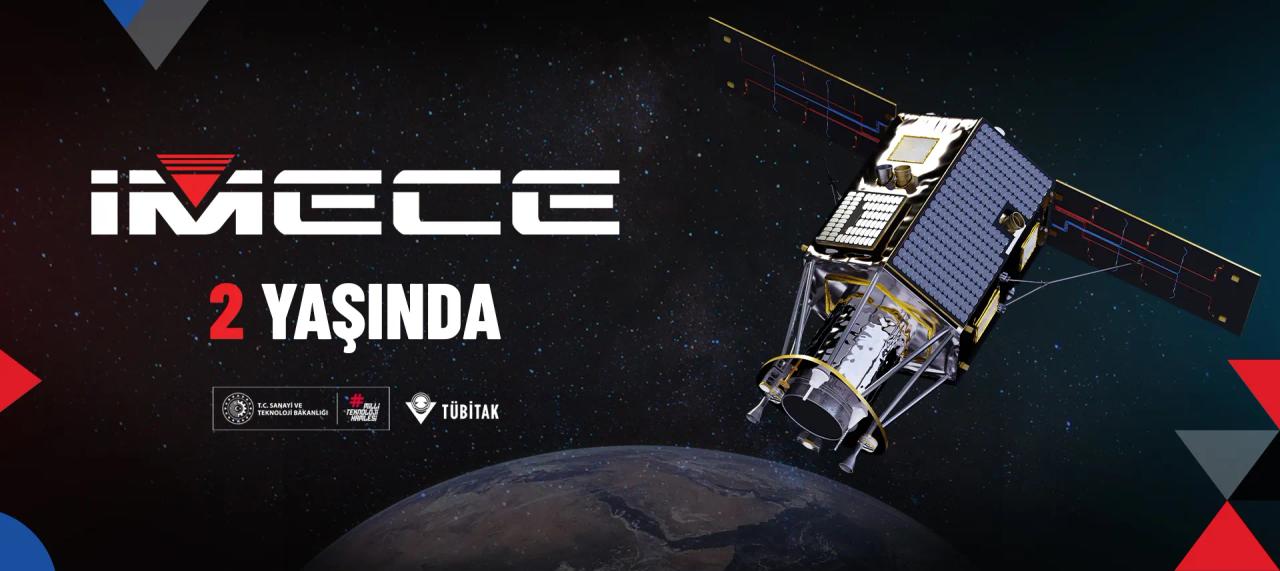
Visual announcing the completion of İMECE's second year in space. (TÜBİTAK)
But these figures have a mathematical context. İMECE is a single satellite, not a constellation; therefore, it may need to wait days before it can revisit the same region. After an earthquake or flood image is processed, it can appear within minutes—but the satellite must pass over the area at precisely the right time and orbit. What happens in minutes is image processing, not real-time, continuous observation. That is precisely why the project does not stop at a single satellite: the experience gained forms the foundation for İMECE-2 and İMECE-3, planned for completion in 2027 and 2028, respectively, creating a true constellation.【17】
There is a practical side to owning Earth observation satellites that is often overlooked: when a country depends on a foreign commercial satellite company to image its own territory, the timing and recipients of those images are determined by that company’s decisions—exactly what happened on February 6. What İMECE provides is more than a technical success; it is partial decision-making autonomy: Türkiye can now decide, at least within the limits of its own imaging capacity, when to look at its own land. Academic reviews examining the role of diverse technologies—artificial intelligence, geographic information systems, satellite data—in disaster management also recognize this broader framework as part of their analysis.【18】
This capability extends across a wide range of applications—from monitoring agricultural land health to early detection of forest fires, from urban planning to border security. But perhaps its most compelling aspect is the human story behind it. İMECE is the product of years of collaborative labor by an engineering team at TÜBİTAK Space in Ankara, working together on the same cameras, the same lines of software, and the same test scenarios.【19】 Their collective effort gave its name to a lens now observing Earth from 680 kilometers above.
The National Space Program, prepared by the Türkiye Space Agency and published in 2021, outlines ten goals over a ten-year horizon: Türkiye’s first lunar landing by the Republic’s centenary, operation of a regional positioning and timing system, and establishment of a spaceport are among them.【20】 One goal of the program—sending a Turkish citizen to space on a scientific mission—is no longer a prediction: Alper Gezeravcı traveled to the International Space Station in January 2024 aboard Axiom Mission-3, becoming Türkiye’s first astronaut.【21】
Yet this realized milestone confirms the very lesson İMECE taught: Gezeravcı, too, reached space aboard an American SpaceX Falcon 9 rocket, using foreign launch infrastructure. Thus, the boundary drawn in the previous section holds here as well: Türkiye is making progress in production, education, and scientific missions, but launch capability remains external. The lesson of İMECE—that building is one thing, launching is another—remains valid on the path to the Moon; the growing goal is not a shrinking problem.
In the tradition of imece, the most important thing is that no single person bears the entire burden. Türkiye’s space program follows no different logic: from RASAT to Göktürk-2, then to İMECE, engineers at TÜBİTAK Space, universities, and public institutions have gradually expanded a decades-long goal, passing responsibility and knowledge from one generation to the next. İMECE is one of the most mature fruits of this effort; İMECE-2 and İMECE-3 will be its continuation. In the tradition of imece, a burden is not carried once, but in turn.
When the next major earthquake, flood, or forest fire strikes, Türkiye now has its own eye in the sky—a limited but self-determined eye. This eye, as its name reminds us, is not the work of a single hero, but of hundreds of hands that have quietly, in turn, shouldered the burden for over a decade. Perhaps Türkiye’s most national achievement in space lies not in the technology itself, but in reviving this ancient tradition: true strength lies in sharing the burden and accepting its limits.
AFAD (Disaster and Emergency Management Presidency). "Kahramanmaraş Depremleri Ön Değerlendirme Raporu." Accessed September 4, 2026.https://deprem.afad.gov.tr/assets/pdf/Kahramanmaras%20%20Depremleri_%20On%20Degerlendirme%20Raporu.pdf
Anadolu Ajansı. "Türkiye'nin İlk Yerli ve Millî Gözetleme Uydusu İMECE Uzaya Fırlatıldı." April 15, 2023. Accessed September 4, 2026.https://www.aa.com.tr/tr/bilim-teknoloji/turkiyenin-ilk-yerli-ve-milli-gozetleme-uydusu-imece-uzaya-firlatildi/2872639
Defensehere. "17 Ağustos 2011: Türkiye'nin İlk Yerli Yer Gözlem Uydusu RASAT Uzaya Fırlatıldı." Accessed September 4, 2026.https://defensehere.com/tr/17-agustos-2011-turkiyenin-ilk-yerli-yer-gozlem-uydusu-rasat-uzaya-firlatildi-2/
Habertürk. "ABD'li Uydu Şirketi Maxar Paylaştı: Türkiye'yi Sarsan Depremlerin Yarattığı Yıkım Uydudan Görüntülendi." February 9, 2023. Accessed September 4, 2026.https://www.haberturk.com/abd-li-uydu-sirketi-maxar-paylasti-turkiye-yi-sarsan-depremlerin-yarattigi-yikim-uydudan-goruntulendi-3563982
Hürriyet. "Son Dakika Haberi: Cumhurbaşkanı Erdoğan, Millî Uzay Programını Açıkladı! Cumhuriyet'in 100. Yılında Ay'a İlk Temas! Türk Vatandaşı Uzaya Gidecek." September 4, 2026.https://www.hurriyet.com.tr/gundem/son-dakika-haberi-cumhurbaskani-erdogan-milli-uzay-programini-acikladi-cumhuriyetin-100-yilinda-aya-ilk-temas-turk-vatandasi-uzaya-gidecek-41736601
Hürriyet. "Son Dakika: İMECE Uydusu Uzaya Fırlatıldı... İlk Sinyal Alındı! Erdoğan: Ülkemize Stratejik Kabiliyet Kazandıracak." April 15, 2023. Accessed September 4, 2026.
Sayan, Aysun, and Nevra Kazancı. "Gelişen Teknolojinin Afetlerde Kullanımı: Türkiye Bağlamındaki Kaynakların Sistematik Derlemesi." *Türkiye Coğrafi Bilgi Sistemleri Dergisi* 7, no. 2 (2025): 52-67. Accessed September 4, 2026.https://dergipark.org.tr/tr/pub/tucbis/article/1777598
TRT Haber. "Türkiye'nin Uzaydaki Gözleri: Rasat, Göktürk-1 ve Göktürk-2." April 11, 2019. Accessed September 4, 2026.https://www.trthaber.com/haber/bilim-teknoloji/turkiyenin-uzaydaki-gozleri-rasat-gokturk-1-ve-gokturk-2-411599.html
Telespazio. "The Göktürk-1 Satellite Launched Successfully." December 5, 2016. Accessed September 4, 2026.https://www.telespazio.com/en/press-release-detail/-/detail/051216-the-gokturk-1-satellite-launched-successfully
TÜBİTAK Uzay Technologies Research Institute. "İMECE." Accessed September 4, 2026.https://uzay.tubitak.gov.tr/en/imece/
TÜBİTAK Uzay Teknolojileri Araştırma Enstitüsü. "Our First Astronaut Alper Gezeravcı Started His Space Journey as Part of a Science Mission on January 19, 2024." Accessed September 4, 2026.https://uzay.tubitak.gov.tr/en/our-first-astronaut-alper-gezeravci-started-his-space-journey-as-part-of-a-science-mission-on-january-19-2024-00-49/
TÜBİTAK. "Metrealtı Çözünürlüklü Yer Gözlem Uydusu İMECE Uzayda İkinci Yılını Tamamladı." April 15, 2025. Accessed September 4, 2026.https://tubitak.gov.tr/tr/haber/metrealti-cozunurluklu-yer-gozlem-uydusu-imece-uzayda-ikinci-yilini-tamamladi
TÜBİTAK. "Türkiye'nin Yerli Uydu Üretim Gururu, Cumhuriyet'in 100. Yılında İMECE ve TÜRKSAT 6A ile Taçlanacak." October 7, 2022. Accessed September 4, 2026.https://tubitak.gov.tr/tr/haber/turkiyenin-yerli-uydu-uretim-gururu-cumhuriyetin-100-yilinda-imece-ve-turksat-6a-ile-taclanacak
TÜBİTAK. "İMECE Uydusu İçin Geri Sayım Başladı." April 25, 2022. Accessed September 4, 2026.https://tubitak.gov.tr/tr/haber/imece-uydusu-icin-geri-sayim-basladi
Türk Dil Kurumu. "İmece." Güncel Türkçe Sözlük. Accessed September 4, 2026.https://sozluk.gov.tr/kelime/imece
Türkiye Uzay Agency. "Millî Uzay Programı." Accessed September 4, 2026.https://tua.gov.tr/tr/milli-uzay-programi
[1]
Türk Dil Kurumu, "İmece," Güncel Türkçe Sözlük. Erişim tarihi: 4 Eylül 2026. https://sozluk.gov.tr/kelime/imece
[2]
Anadolu Ajansı, "Türkiye'nin İlk Yerli ve Millî Gözetleme Uydusu İMECE Uzaya Fırlatıldı," April 15, 2023. Accessed September 4, 2026. TÜBİTAK, "İMECE Uydusu İçin Geri Sayım Başladı," April 25, 2022. Accessed September 4, 2026.
[3]
Hürriyet, "Son Dakika: İMECE Uydusu Uzaya Fırlatıldı... İlk Sinyal Alındı! Erdoğan: Ülkemize Stratejik Kabiliyet Kazandıracak," 15 Nisan 2023. Erişim tarihi: 4 Eylül 2026. https://www.hurriyet.com.tr/gundem/son-dakika-imecede-gerim-sayim-uzay-yolculugu-basliyor-42251799
[4]
AFAD (Afet ve Acil Durum Yönetimi Başkanlığı), "Kahramanmaraş Depremleri Ön Değerlendirme Raporu." Erişim tarihi: 4 Eylül 2026. https://deprem.afad.gov.tr/assets/pdf/Kahramanmaras%20%20Depremleri_%20On%20Degerlendirme%20Raporu.pdf
[5]
Anadolu Ajansı. "Türkiye'nin İlk Yerli ve Millî Gözetleme Uydusu İMECE Uzaya Fırlatıldı." Accessed September 4, 2026.
[6]
Habertürk. "ABD'li Uydu Şirketi Maxar Paylaştı: Türkiye'yi Sarsan Depremlerin Yarattığı Yıkım Uydudan Görüntülendi." Accessed September 4, 2026.
[7]
TRT Haber. "Türkiye'nin Uzaydaki Gözleri: Rasat, Göktürk-1 ve Göktürk-2." Accessed September 4, 2026.
[8]
TRT Haber, "Türkiye'nin Uzaydaki Gözleri: Rasat, Göktürk-1 ve Göktürk-2," April 11, 2019. Accessed September 4, 2026. Defensehere, "17 Ağustos 2011: Türkiye'nin İlk Yerli Yer Gözlem Uydusu RASAT Uzaya Fırlatıldı." Accessed September 4, 2026.
[9]
TRT Haber, "Türkiye'nin Uzaydaki Gözleri: Rasat, Göktürk-1 ve Göktürk-2," April 11, 2019. Accessed September 4, 2026.
[10]
TRT Haber, "Türkiye'nin Uzaydaki Gözleri: Rasat, Göktürk-1 ve Göktürk-2," April 11, 2019. Accessed September 4, 2026.
[11]
Telespazio, "The Göktürk-1 Satellite Launched Successfully," 5 Aralık 2016. Erişim tarihi: 4 Eylül 2026. https://www.telespazio.com/en/press-release-detail/-/detail/051216-the-gokturk-1-satellite-launched-successfully
[12]
TÜBİTAK, "Metrealtı Çözünürlüklü Yer Gözlem Uydusu İMECE Uzayda İkinci Yılını Tamamladı," April 15, 2025. Accessed September 4, 2026. TÜBİTAK, "Türkiye'nin Yerli Uydu Üretim Gururu, Cumhuriyet'in 100. Yılında İMECE ve TÜRKSAT 6A ile Taçlanacak," October 7, 2022. Accessed September 4, 2026.
[13]
TÜBİTAK, "Metrealtı Çözünürlüklü Yer Gözlem Uydusu İMECE Uzayda İkinci Yılını Tamamladı," 15 Nisan 2025. Erişim tarihi: 4 Eylül 2026. https://tubitak.gov.tr/tr/haber/metrealti-cozunurluklu-yer-gozlem-uydusu-imece-uzayda-ikinci-yilini-tamamladi
[14]
Anadolu Ajansı. "Türkiye'nin İlk Yerli ve Millî Gözetleme Uydusu İMECE Uzaya Fırlatıldı." Accessed September 4, 2026.
[15]
TÜBİTAK, "İMECE Uydusu İçin Geri Sayım Başladı," 25 Nisan 2022. Erişim tarihi: 4 Eylül 2026. https://tubitak.gov.tr/tr/haber/imece-uydusu-icin-geri-sayim-basladi; TÜBİTAK, "Metrealtı Çözünürlüklü Yer Gözlem Uydusu İMECE Uzayda İkinci Yılını Tamamladı," 15 Nisan 2025. Erişim tarihi: 4 Eylül 2026. https://tubitak.gov.tr/tr/haber/metrealti-cozunurluklu-yer-gozlem-uydusu-imece-uzayda-ikinci-yilini-tamamladi
[16]
TÜBİTAK, "İMECE Uydusu İçin Geri Sayım Başladı," 25 Nisan 2022. Erişim tarihi: 4 Eylül 2026. https://tubitak.gov.tr/tr/haber/imece-uydusu-icin-geri-sayim-basladi; TÜBİTAK, "Metrealtı Çözünürlüklü Yer Gözlem Uydusu İMECE Uzayda İkinci Yılını Tamamladı," 15 Nisan 2025. Erişim tarihi: 4 Eylül 2026. https://tubitak.gov.tr/tr/haber/metrealti-cozunurluklu-yer-gozlem-uydusu-imece-uzayda-ikinci-yilini-tamamladi
[17]
TÜBİTAK, "Metrealtı Çözünürlüklü Yer Gözlem Uydusu İMECE Uzayda İkinci Yılını Tamamladı," April 15, 2025. Accessed September 4, 2026. TÜBİTAK, "Türkiye'nin Yerli Uydu Üretim Gururu, Cumhuriyet'in 100. Yılında İMECE ve TÜRKSAT 6A ile Taçlanacak," October 7, 2022. Accessed September 4, 2026.
[18]
Aysun Sayan ve Nevra Kazancı, "Gelişen Teknolojinin Afetlerde Kullanımı: Türkiye Bağlamındaki Kaynakların Sistematik Derlemesi," Türkiye Coğrafi Bilgi Sistemleri Dergisi 7, no. 2 (2025): 52. Erişim tarihi: 4 Eylül 2026. https://dergipark.org.tr/tr/pub/tucbis/article/1777598
[19]
TÜBİTAK, "Turkey's Native Satellite Production Pride Will Be Crowned with İMECE and TÜRKSAT 6A on the 100th Anniversary of the Republic," October 7, 2022. Accessed September 4, 2026.
[20]
Türkiye Space Agency. "Millî Uzay Programı." Accessed September 4, 2026. Hürriyet. "Son Dakika Haberi: Cumhurbaşkanı Erdoğan, Millî Uzay Programını Açıkladı! Cumhuriyet'in 100. Yılında Ay'a İlk Temas! Türk Vatandaşı Uzaya Gidecek," February 9, 2021. Accessed September 4, 2026.
[21]
TÜBİTAK Uzay Teknolojileri Araştırma Enstitüsü, "Our First Astronaut Alper Gezeravcı Started His Space Journey as Part of a Science Mission on January 19, 2024." Erişim tarihi: 4 Eylül 2026. https://uzay.tubitak.gov.tr/en/our-first-astronaut-alper-gezeravci-started-his-space-journey-as-part-of-a-science-mission-on-january-19-2024-00-49/
Does a Country Need Its Own Eyes?
A Brief History of Türkiye’s Eyes in Space
How Can a Satellite Be “Domestic and National”?
İMECE by the Numbers: What Can One Eye See?
Whose Eye in the Sky, Whose Decision?
The Future of Space: Same Boundaries, Greater Goals
Conclusion: The Orbit of Collective Effort