

This article was automatically translated from the original Turkish version.
General Notice Date | 18 August 2026 | ||||||||
|---|---|---|---|---|---|---|---|---|---|
Period | 2026-2030 | ||||||||
Scope / Area | National Technology Policy Digital Transformation Artificial Intelligence Ecosystem | ||||||||
Coordination Authority | Ministry of Industry and Technology of the Republic of Türkiye | ||||||||
Basic Axes | Notice Utilize Produce Manage | ||||||||
Number of Actions | 16 Priority Actions | ||||||||
Türkiye Artificial Intelligence Action Plan (2026–2030) is an official national policy document enacted to enhance Türkiye’s capacity in artificial intelligence technologies accelerate institutional transformation and establish the infrastructure human capital financing and regulatory mechanisms required by the ecosystem.
Türkiye Yapay Zekâ Eylem Planı (Yapay Zekâ ile Oluşturulmuştur)
Built upon the institutional experience and lessons learned during the implementation of the National Artificial Intelligence Strategy for 2021–2025 this plan was developed with contributions from public institutions private sector universities and civil society organizations under the coordination of the Ministry of Industry and Technology. The document outlines 16 priority actions structured around four main axes titled Recognize Utilize Produce and Govern five foundational layers of the AI ecosystem energy computing hardware infrastructure models/data applications and three intersecting components skills financing regulation and trust.【1】
The institutional policy development process for artificial intelligence in Türkiye began with the National Artificial Intelligence Strategy (NAIS) 2021–2025 jointly published by the Ministry of Industry and Technology and the Presidency of Digital Transformation. Following this strategy the NAIS 2024–2025 Action Plan was prepared in 2024 and public institutions simultaneously issued guideline documents on ethical conduct and personal data protection.
In preparing the new action plan for 2026–2030 key reference documents included the previous strategy documents the Turkish Grand National Assembly Artificial Intelligence Research Committee Report and the Presidency Council on Science Technology and Innovation Policy National Artificial Intelligence Policy Document. During the preparation phase workshops were held involving approximately 500 sector professionals from public private academic and civil society sectors and over 2200 action proposals were collected through a public opinion survey titled “Citizen Opinion Survey.” The plan was presented to the public at the Türkiye Artificial Intelligence Summit held in Istanbul on 1 July 2026 and officially entered into force through a Presidential Circular published in the Official Gazette on 18 August 2026.【2】
The action plan is structured around a matrix architecture that views national AI transformation through interdependent layers and intersecting components.
The vertical backbone of the plan consists of five core layers:
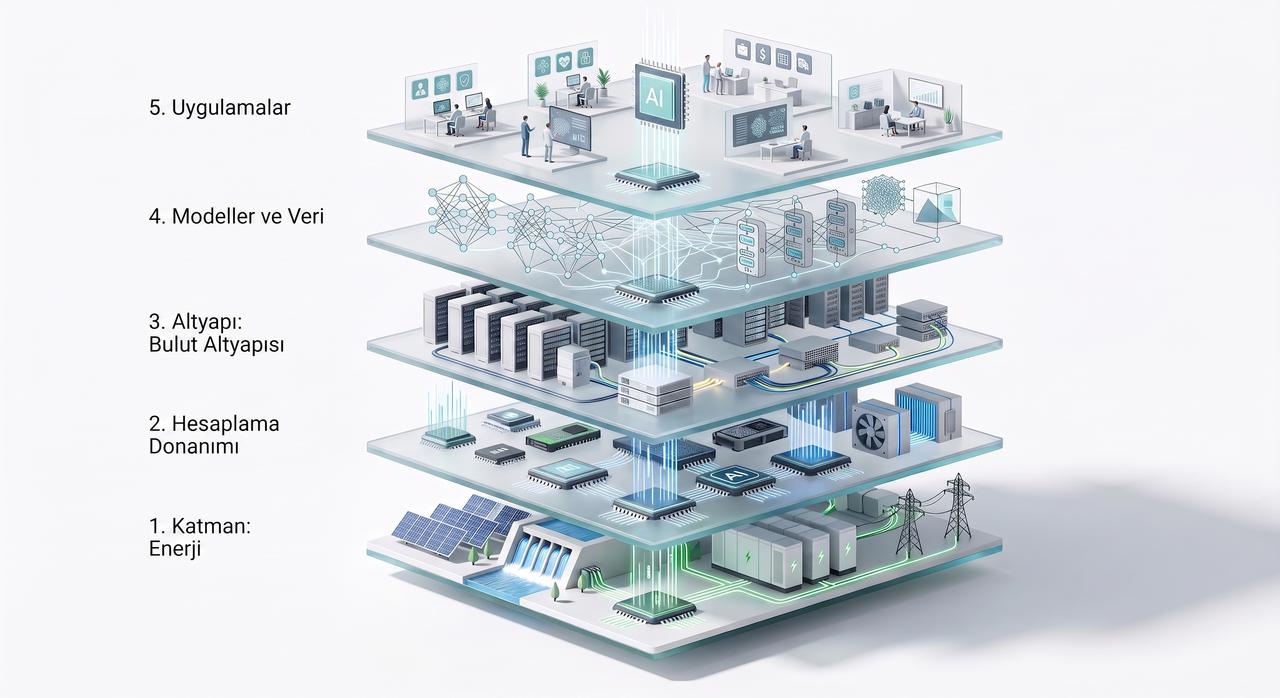
Temel Katmanlar Temsili (Yapay Zekâ ile Oluşturulmuştur)
Three intersecting components that horizontally support these layers are skills ranging from basic literacy to advanced research financing spanning from seed stage to commercialization and proportional risk-based regulation and trust.
Four principles have been adopted for implementing the measures under this plan:
The plan is implemented through four strategic axes each focusing on different dimensions of the ecosystem and encompassing 16 standardized actions.
Aims to raise public awareness cultivate qualified workforce make data ecosystems accessible and establish ethical and legal standards.
Yapay Zekâ Okuryazarlığı Eğitimi (HEMBA)
The Ministry of National Education (MEB) will provide free education via e-Government and EBA platforms. The target is to reach 1.5 million citizens within the first 12 months and 5 million by the end of 24 months through e-Government integrated level assessment and issue micro-certifications.【3】
By end of 2027 basic AI courses will be introduced at 50 universities with the goal of training 10000 advanced AI specialists and 100000 application professionals 1000 graduate scholarship recipients and implementing incentive mechanisms targeting international researchers.【4】
Publicly available data will be shared through the National Data Library secure data domains will be established for sensitive areas and “data product owners” will be appointed at institutional levels.
A regulatory framework based on the European Union’s proportional risk approach will be established. “Algorithmic impact assessment” and “model card” will be mandatory for high-risk systems and a multi-stakeholder National Artificial Intelligence Ethics Board will be created.
Encompasses the establishment of AI infrastructure and its operational adoption in public and private sectors.
Targets include at least 1 GW of AI/data center installed capacity 10 TWh of low-carbon electricity purchase agreements PPAs 1 EB of storage capacity and 100 Tb/s backbone bandwidth by 2030. Under the HIT-30 Program at least 10 billion USD in private sector investment for data center infrastructure will be mobilized.【5】
Resources from TÜBİTAK ULAKBİM TRUBA and domestic data centers will be integrated to allocate at least 10–20 million GPU-hours of computing credits annually to researchers entrepreneurs and SMEs.【6】
At least 2 percent of public investment budgets will be allocated to AI projects.【7】Successful pilots will be scaled within 6–12 months and local solutions will be integrated into the State Materials Office Techno Catalog through a “digital badge” system.
Pilot initiatives in healthcare agriculture energy and manufacturing will be supported and SME access to AI solutions will be facilitated through voucher mechanisms.
Targets the development commercialization and financing mechanisms for domestic models.
Investment campuses with ready infrastructure and energy supply will be established. The goal is to announce five growth zones and bring three into operation by end of 2028.
A 10 billion TL National Artificial Intelligence Research Fund will be established for basic research and a 15 billion TL AI Growth Fund will be created to scale startups.【8】
Sectoral foundational models and Turkish Large Language Models LLMs will be developed in fields such as healthcare defense disaster management and materials science.
Domestic production and software expertise gained in manufacturing and defense will be transferred to humanoid robots autonomous vehicles industrial automation and edge computing hardware.
Addresses global investment attraction international AI diplomacy and security oversight.
A single-window application mechanism will be introduced to facilitate the establishment of data centers and operational hubs by international hyperscalers and cloud providers in Türkiye.
Active participation will be ensured in standard-setting initiatives within OECD G20 UN ISO/IEC ITU and UNESCO platforms.
Joint initiatives will be carried out under the framework of the Organization of Turkic States OTS the Organization of Islamic Cooperation OIC and D-8. The first version of a “Common Turkic Languages Large Language Model” will be published under OTS by end of 2027.
Testing and security validation capacity will be enhanced at TÜBİTAK BİLGEM Artificial Intelligence Institute and regulatory sandbox environments will be established in finance healthcare and mobility sectors.
The governance model of the action plan is built on four core functions:
The plan’s implementation performance is periodically monitored and updated through the publicly accessible “National Artificial Intelligence Progress and Transparency Portal” using indicators for infrastructure data skills adoption trust investment and international impact.
Dijitalleşme ve Milli Teknoloji Hamlesi (Yapay Zekâ ile Oluşturulmuştur)
The Türkiye Artificial Intelligence Action Plan (2026–2030) is positioned as a direct extension of the National Technology Initiative vision which aims for complete technological independence in critical technologies and the advancement of high technology with a societal mobilization mindset.
In the official document artificial intelligence is defined as a fundamental “lever” for development security production capacity and social welfare enhancement with the goal of transferring engineering expertise gained from defense industry to civil domains.
The founding principles of the National Technology Initiative are rooted in overcoming past barriers encountered in Türkiye’s previous industrial and technological leaps and in overcoming historical “learned helplessness.” Within this framework the relationship established by the action plan materializes primarily along three key dimensions:
The principle adopted by the National Technology Initiative in the defense industry to minimize dependency on foreign sources and develop domestic solutions has been extended under the action plan to the levels of data centers national computing infrastructure GPUs/HPC and sectoral foundational models. Protecting national data sovereignty against global technology monopolies and external dependencies is considered a strategic imperative for the use of domestic systems in critical public services and defense.
The “culture of high technology production” and “societal bottom-up approach” promoted by the National Technology Initiative through structures such as TEKNOFEST Deneyap Technology Workshops and T3 Foundation form the foundation for the action plan’s first and second actions which target “National AI Literacy” for 5 million citizens and the training of “10000 Advanced AI Specialists.”
Domestic production and software expertise gained in unmanned aerial vehicles UAVs autonomous systems and battlefield technologies are being transferred under Action 12 “Physical AI and Robotics” to humanoid robots autonomous vehicles smart factories and civilian production lines.
Ak, Özlem. "Türkiye'nin Yapay Zekâ Vizyonu." TÜBİTAK Bilim ve Teknik, Accessed September 1, 2026.https://bilimteknik.tubitak.gov.tr/turkiyenin-yapay-zeka-vizyonu/.
Bayraktar, Selçuk. “Yediden Yetmişe Toplumsal Seferberlik: Milli Teknoloji Hamlesi.” *Millî Teknoloji Hamlesi*, edited by Mehmet Fatih Kacır, Muzaffer Şeker, and Mürsel Doğrul, Türkiye Bilimler Akademisi Yayınları, 2026. Accessed September 1, 2026.
Dinçer, Pelin. “Yapay Zekâ Etiği ve Kapsayıcılık: Türkiye’de Kurumsal Söylemin Sınırları.” *International Journal of Social Inquiry*, Volume 19, no. 1 (2026): 83–100. Accessed August 31, 2026.doi:10.37093/ijsi.1760924
Duyar, Zeynep. “Türkiye Yapay Zeka Eylem Planı’na İlişkin Cumhurbaşkanı Genelgesi Resmi Gazete’de.” *Anadolu Ajansı*, August 18, 2026. Accessed August 31, 2026.https://www.aa.com.tr/tr/bilim-teknoloji/turkiye-yapay-zeka-eylem-planina-iliskin-cumhurbaskani-genelgesi-resmi-gazetede/4030067
Ministry of Industry and Technology of the Republic of Turkey. *Türkiye Yapay Zekâ Eylem Planı.* Accessed August 31, 2026.https://www.sanayi.gov.tr/yapayzekaeylemplani.
Ministry of National Education. "Yapay Zekâ Okuryazarlığı." Halk Eğitimi Merkezleri Bilişim Ağı (HEMBA). Accessed August 31, 2026.https://www.hemba.gov.tr/egitim-detay/yapay-zeka-okuryazarligi-2188
Republic of Turkey Presidency. “Presidential Circular No. 2026/9 on the Turkey Artificial Intelligence Action Plan (2026–2030).” *Resmî Gazete*, no. 33344 (August 18, 2026). Accessed August 31, 2026.https://www.resmigazete.gov.tr/eskiler/2026/08/20260818-8.pdf
T.C. Ministry of Industry and Technology. "Türkiye Yapay Zekâ Eylem Planı Açıklandı." Press and Public Relations Advisorship, August 2026. Accessed August 31, 2026.https://www.sanayi.gov.tr/medya/haber/turkiye-yapay-zek%C3%A2-eylem-plani-aciklandi
[1]
T.C. Sanayi ve Teknoloji Bakanlığı. Türkiye Yapay Zekâ Eylem Planı. 3-6. Erişim tarihi: 31 Ağustos 2026. https://www.sanayi.gov.tr/yapayzekaeylemplani.
[2]
Türkiye Cumhuriyeti Cumhurbaşkanlığı. “Türkiye Yapay Zekâ Eylem Planı (2026-2030) ile İlgili 2026/9 Sayılı Cumhurbaşkanlığı Genelgesi.” Resmî Gazete, no. 33344 (18 Ağustos 2026). Erişim tarihi: 31 Ağustos 2026. https://www.resmigazete.gov.tr/eskiler/2026/08/20260818-8.pdf.
[3]
T.C. Sanayi ve Teknoloji Bakanlığı. Türkiye Yapay Zekâ Eylem Planı.12-13; Millî Eğitim Bakanlığı. “Yapay Zekâ Okuryazarlığı.” Halk Eğitimi Merkezleri Bilişim Ağı (HEMBA). Erişim tarihi: 31 Ağustos 2026. https://www.hemba.gov.tr/egitim-detay/yapay-zeka-okuryazarligi-2188.
[4]
T.C. Sanayi ve Teknoloji Bakanlığı. Türkiye Yapay Zekâ Eylem Planı. 13-14.
[5]
T.C. Sanayi ve Teknoloji Bakanlığı. Türkiye Yapay Zekâ Eylem Planı. 16-17.
[6]
T.C. Sanayi ve Teknoloji Bakanlığı. Türkiye Yapay Zekâ Eylem Planı. 18.
[7]
Ak, Özlem. "Türkiye'nin Yapay Zekâ Vizyonu." *Bilim ve Teknik*, TÜBİTAK, July 1, 2026.
[8]
T.C. Sanayi ve Teknoloji Bakanlığı. Türkiye Yapay Zekâ Eylem Planı. 21-22.

General Notice Date | 18 August 2026 | ||||||||
|---|---|---|---|---|---|---|---|---|---|
Period | 2026-2030 | ||||||||
Scope / Area | National Technology Policy Digital Transformation Artificial Intelligence Ecosystem | ||||||||
Coordination Authority | Ministry of Industry and Technology of the Republic of Türkiye | ||||||||
Basic Axes | Notice Utilize Produce Manage | ||||||||
Number of Actions | 16 Priority Actions | ||||||||
No Discussion Added Yet
Start discussion for "Türkiye Artificial Intelligence Action Plan (2026–2030)" article
Historical Development and Preparation Process
Architectural Structure and Implementation Principles
Core Layers and Intersecting Components
Implementation Principles
Strategic Axes and Priority Actions
Axis 1: Recognize
National Artificial Intelligence Literacy and Safe Usage Program (Action 1)
Advanced Research Competency Program (Action 2)
Data-Driven AI Leap (Action 3)
Regulatory Environment and Ethical Framework (Action 4)
Axis 2: Utilize
National Computing Backbone (Action 5)
GPU for Everyone Program (Action 6)
Public Sector AI Transformation and Public Procurements (Action 7)
Sectoral Pilot Programs and SME Vouchers (Action 8)
Axis 3: Produce
AI Growth Zones and Centers of Excellence (Action 9)
Financing Ladder (Action 10)
Sectoral AI Models and Exports (Action 11)
Physical AI and Robotics (Action 12)
Axis 4: Govern
Global Investment Attraction (Action 13)
International Cooperation and AI Diplomacy (Action 14)
Regional Partnerships (Action 15)
Security Assessment and Regulatory Sandboxes (Action 16)
Governance and Monitoring Architecture
Relationship with the National Technology Initiative
Technological Independence and Digital Sovereignty
Societal Mobilization and Talent Ecosystem
Transfer of Defense Experience to Physical AI