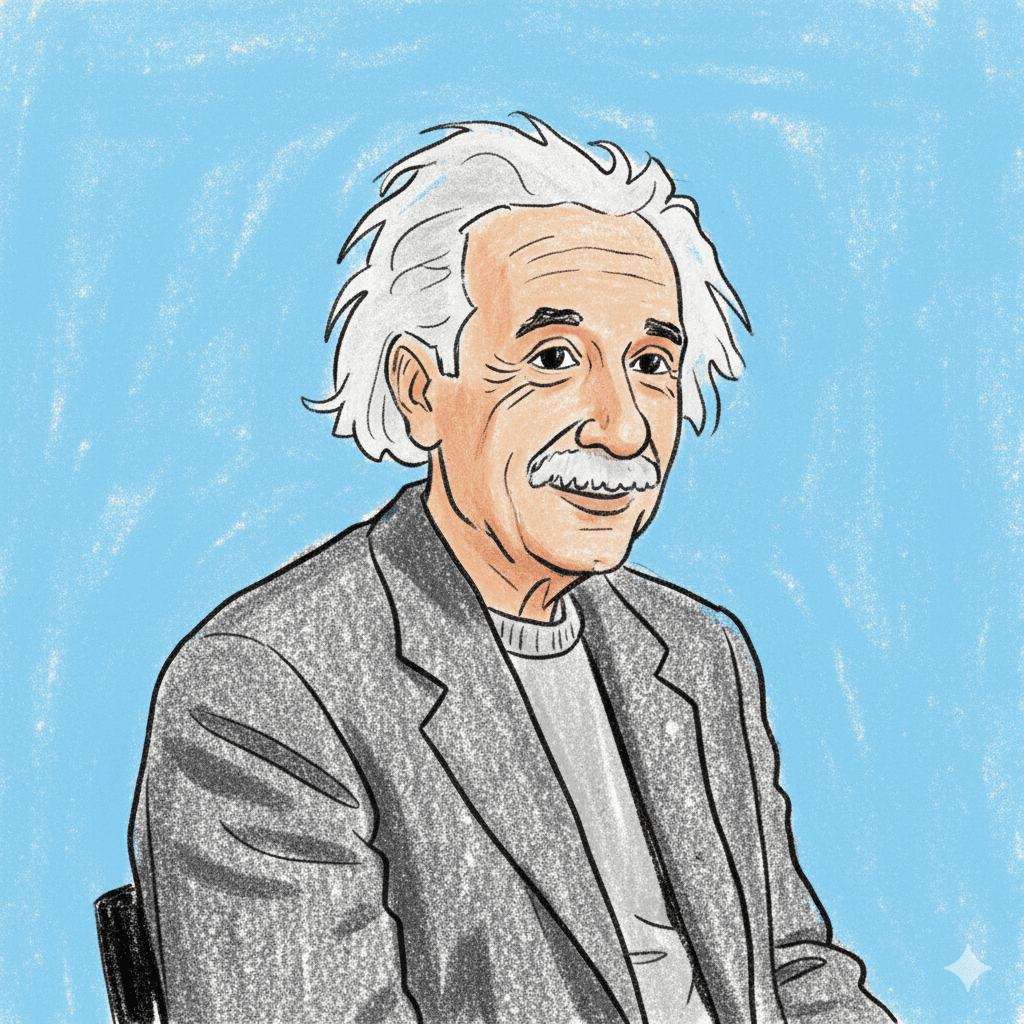




Albert Einstein
Albert Einstein developed theories that transformed the way humanity understands the universe. His theories of relativity are among the foundational pillars of modern physics and pioneered the opening of new research fields in physics.
Birth and Childhood Years
Albert Einstein was born on 14 March 1879 in the city of Ulm, Germany. His childhood was spent in Munich and Milan. From an early age he showed a strong interest in science. A compass and mathematical problems sparked his curiosity. He learned to play the violin and developed an appreciation for music.

Generated by Artificial Intelligence.
Educational Life
Einstein began his education in Germany. He later studied physics and mathematics at ETH Zurich, the Swiss Federal Institute of Technology in Zurich. He graduated in 1900. After university he worked for a time at the Swiss Patent Office and continued his scientific research there.
Scientific Work
In 1905 Einstein published four groundbreaking scientific papers in physics. This year is known in the history of science as “Einstein’s Annus Mirabilis” or “Miracle Year.” Through these works he:
- Explained that light consists of energy-carrying particles (photoelectric effect).
- Provided a theoretical explanation for Brownian motion related to molecules.
- Introduced the theory of special relativity.
- Formulated the equation E=mc² demonstrating the relationship between mass and energy.
In 1915 he developed the General Theory of Relativity, which explained gravity. This theory was supported by astronomical observations made during a solar eclipse in 1919.

Generated by Artificial Intelligence.
Awards and Academic Career
Einstein received the Nobel Prize in Physics in 1922. He held academic positions at universities in various countries and continued his scientific research. In 1933, due to political conditions in Germany, he settled in the United States of America. He continued his work in the city of Princeton.

Generated by Artificial Intelligence.
Even in his later years Einstein maintained his interest in science and continued his research. He died on 18 April 1955 in Princeton, United States of America.
Significance in Science
Albert Einstein developed theories that transformed the way humanity understands the universe. His theories of relativity are among the foundational pillars of modern physics and pioneered the opening of new research fields in physics.