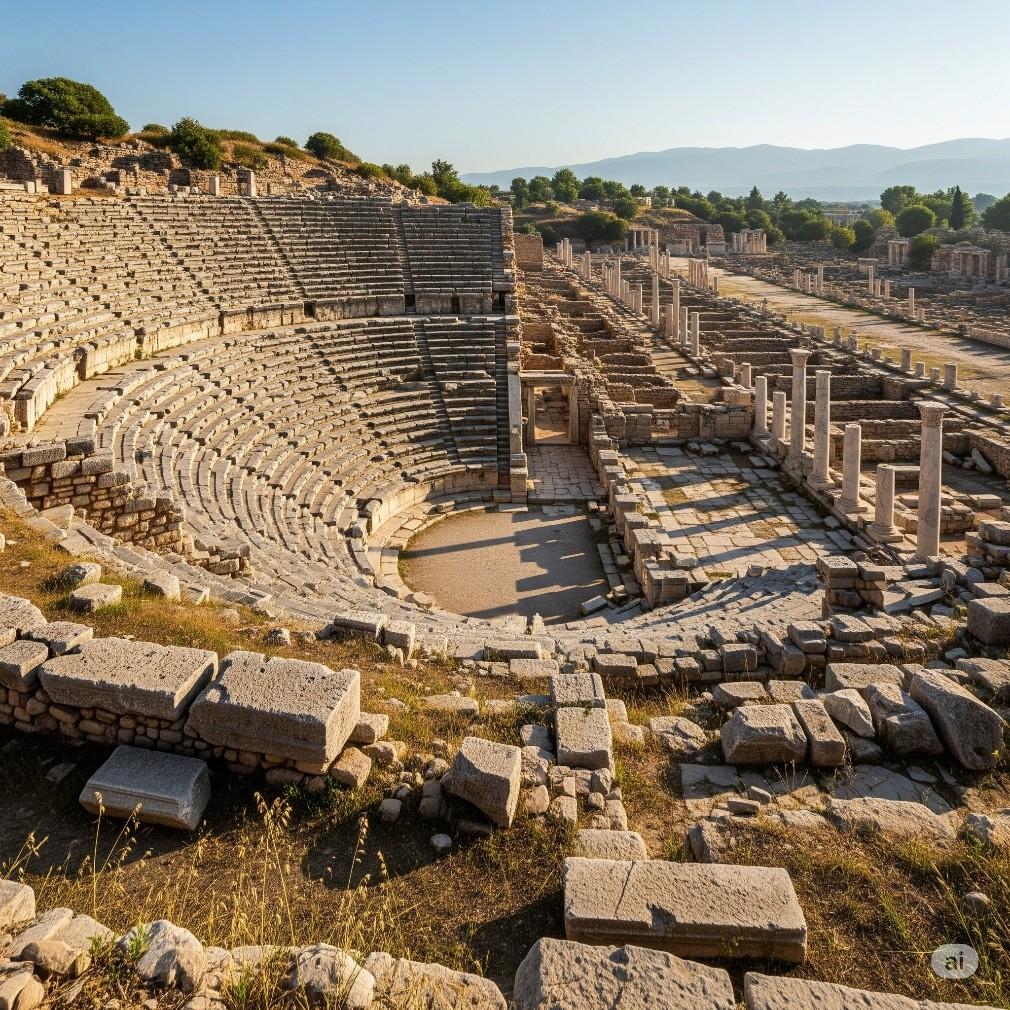




Ancient City of Miletus
Location and General Information
The Ancient City of Miletus is located near Balat Village in the Didim district of Aydın Province, at the point where the Büyük Menderes River flows into the sea. In antiquity, known as "Miletos," the city was a major port city opening onto the Aegean Sea. Thanks to its geographical position, suitability for maritime trade, and fertile soils, it has served as a home to numerous civilizations throughout history.

Ancient City of Miletus (Türkiye Culture Portal)
Historical Development
The earliest settlement traces in Miletus date back to the 30th century BCE. The city was founded in the 2nd millennium BCE by Minoan migrants and developed under Mycenaean and Achaean influence. In the 11th century BCE, it was rebuilt by Ionians under the leadership of Nekus, son of the Athenian king Kodros.
As the capital of the Ionian League, Miletus amassed great wealth during the 7th and 6th centuries BCE through its four harbors and colonies. The city came under the rule of the Hittites, Persians, Hellenes, Romans, and Byzantines. During the Byzantine period, its connection to the sea was severed due to alluvial deposits carried by the Büyük Menderes River. Subsequently, it passed under the control of the Seljuks, the Menteşe dynasty, and finally the Ottomans.
Culture, Science, and Art
Miletus was a center of philosophy and science in antiquity. Thales, Anaximander, and Anaximenes lived here; Hecataeus made significant contributions to geography. Hippodamus was the first in the world to implement the grid plan of urban design in this city.
Architecture and Ruins
Today, structures from various periods can be seen at the Miletus Archaeological Site. These include the Miletus Theater, Faustina Baths, agoras, monumental fountain, gymnasium, Temple of Athena, bouleuterion, harbor monument, churches, İlyas Bey Camii and külliyesi, Turkish baths, and caravanserai.

Generated by Artificial Intelligence
Archaeological Excavations
The first excavations at Miletus were initiated in 1899 by Theodor Wiegand and were interrupted during the wartime periods. Resumed in 1938, these excavations continue to the present day. Through these efforts, remains from various civilizations have been brought to light.