


+2 More

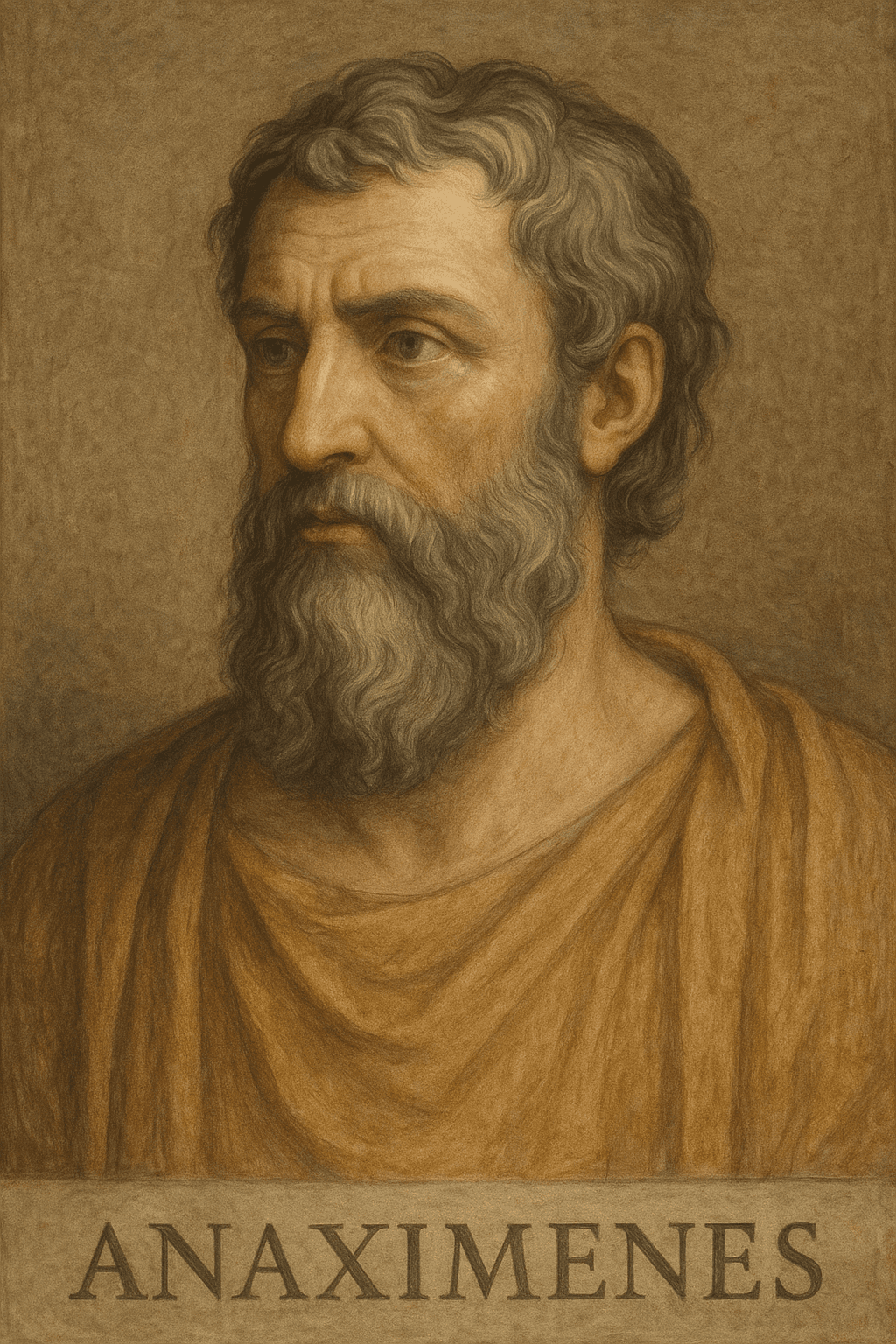
(Generated by Artificial Intelligence)
Year of Birth | Within the 6th century BCE | ||||||||
|---|---|---|---|---|---|---|---|---|---|
Place of Birth | Miletos (Didim, Aydın, Türkiye) | ||||||||
Philosophical Tradition Associated with | Miletus (Ionia) School | ||||||||
Anaximenes is regarded as the third major representative of the Milesian school, following Thales and Anaximander among the early natural philosophers centered in Miletus. His particular contribution to the problem of the arkhe stands out through his approach to material transformation via processes of condensation and rarefaction, and his effort to explain natural phenomena within a material-principled framework. Anaximenes’s work represents a significant stage in ancient Greek philosophy that associates the fundamental structure of being with a concrete substance.
He is believed to have been born in Miletus. It is known that he was part of the intellectual environment of Miletus, which had a tradition of natural inquiry. Miletus’s richness in trade, culture, and intellectual exchange provided a favorable foundation for Anaximenes’s early intellectual development.
Information about Anaximenes’s education is limited, but he is described as a student or intellectual successor of Anaximander. This indicates that his education was shaped within the methodological, cosmological, and natural investigative framework of the Milesian school. The central role of the arkhe debate within the Milesian tradition suggests that his formative studies likely focused on this issue.
Anaximenes conducted his philosophical activities in Miletus, advancing natural investigations based on systematic observation and explanatory principles. Sources refer to him as the third representative of the Milesian school, demonstrating both continuity with earlier thinkers and original contributions. Throughout his career, he engaged with fundamental questions concerning the primary principle, processes of material transformation, and cosmological structure.
Anaximenes’s work is primarily examined through his approach to the concept of the arkhe. Following Anaximander’s notion of the indeterminate first principle, apeiron, Anaximenes proposed that the arkhe is air. The observability of air, its capacity to change form according to varying degrees of density, and its direct association with life were decisive factors in his choice of this substance.
His explanation, grounded in the processes of condensation (pyknosis) and rarefaction (manosis), demonstrates that different manifestations of matter arise through quantitative changes. Air, when rarefied, becomes fire; when condensed, it transforms into wind, cloud, water, earth, and stone. This constitutes a prime example of Anaximenes’s attempt to explain the diversity of nature through a single material process. This approach is regarded as a major conceptual innovation that shaped the systematic character of Milesian natural philosophy.
There is no information in the sources regarding Anaximenes’s personal life. However, it is clear that he lived in Miletus, interacted with its intellectual environment, and was situated within the continuity of the Milesian school. His philosophical output appears to have been largely shaped by this intellectual context.
No direct information exists about Anaximenes’s later years or death. Nevertheless, it is accepted that he continued his philosophical activities in Miletus and spent his entire life within this intellectual tradition.
Anaximenes’s ideas completed the triadic structure of the Milesian school and offered an important universal explanatory model in early natural philosophy. His identification of air as the arkhe and his explanation of material transformations through changes in density influenced subsequent natural philosophers’ approaches to matter, change, and cosmology. Sources evaluate his contributions as a crucial stage in the systematic development of the Milesian tradition and regard his attempt to explain natural phenomena through material-principled processes as a distinctive innovation within ancient Greek thought.
Accessed November 26, 2025.
Görgeç, Oğulcan. "Thales ve Anaksimenes’in Günümüzde Unutulmuş Elementleri: Su ve Hava." Dokuz Eylül Üniversitesi Edebiyat Fakültesi Dergisi 6, no. 2 (2019): 511–526.
Yardımcı, Alper Bilgehan, and Fatma Güdücü. "Arkhe ve Töz Kavramı Üzerine: Thales, Anaksimandros ve Anaksimenes." Süleyman Demirel Üniversitesi Fen-Edebiyat Fakültesi Sosyal Bilimler Dergisi 57 (2022): 1–11.
Yardımcı, Alper Bilgehan. "Antik Yunan Felsefesinde Arkhe Kavramı ve Görünüş-Gerçeklik Ayrımı: Thales, Anaksimandros ve Anaksimenes’in Perspektifinden Bir İnceleme." FLSF (Felsefe ve Sosyal Bilimler Dergisi), no. 39 (2024): 1–18.

(Generated by Artificial Intelligence)
Year of Birth | Within the 6th century BCE | ||||||||
|---|---|---|---|---|---|---|---|---|---|
Place of Birth | Miletos (Didim, Aydın, Türkiye) | ||||||||
Philosophical Tradition Associated with | Miletus (Ionia) School | ||||||||
Childhood and Youth
Educational Life
Career
Key Works
Personal Life
Later Years and Death
Legacy and Influence