




Doğubayazıt (District)
Doğubayazıt is a historic city located in the far east of Türkiye, at the south-western foothills of Ağrı Dağı. The region, with a settlement history spanning thousands of years, is notable for its geological formations and architectural structures.
Historical Structures and Settlement Areas
The settlement history of Doğubayazıt is very ancient. The Doğubayazıt Kalesi, built atop steep cliffs, occupies a commanding position. The fortress was used during antiquity by the Urartians, who carved rooms and passageways directly into the rock.

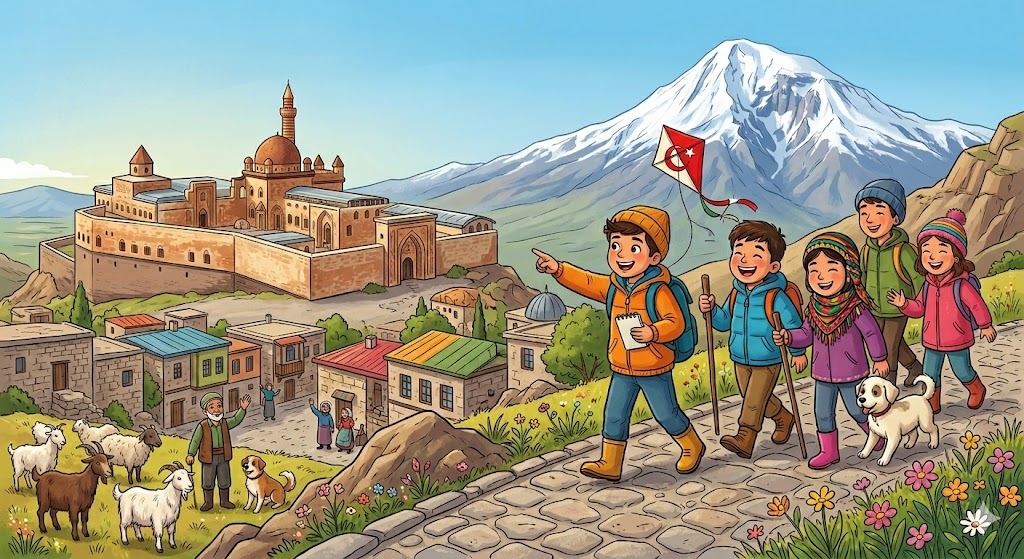
İshak Paşa Sarayı (Generated by Artificial Intelligence)
Adjacent to the fortress lies the Eski Bayazıt Camii, known for its stonework in different colors. The walls of the building feature red, yellow, and white stones arranged in a deliberate pattern. The fortress and its surroundings served as a strategic resting point for commercial caravans in past centuries.
Ahmed-i Hani and His Scientific Works
One of the region’s most significant historical figures is Ahmed-i Hani. Around 340 years ago, he authored the work titled “Nûbara Biçûkan” (The Fresh Spring of Children) for the education of children. Out of deep respect, he is commonly referred to as “Baba” by the local population.
Ahmed-i Hani was a scholar who conducted studies on the sky, astronomy, and natural sciences. Today, his tomb is one of the most visited sites in the region.

Ahmed-i Hani Türbesi (Generated by Artificial Intelligence)
Natural Formations: The Ice Cave and the Meteor Crater
Doğubayazıt is home to unique geological phenomena. The Buz Mağarası has warm temperatures in winter and low temperatures in summer. During the summer months, ice crystals and stalactites can be observed inside the cave. These formations reflect light, creating a brilliant visual effect.

Buz Mağarası (Generated by Artificial Intelligence)
Another notable feature in the city is the Meteor Çukuru. It is said to have been formed by a meteorite impact in 1892 (the date mentioned in the text as 1913 may vary in historical sources; the text has been preserved as is). This crater is considered the second largest meteor crater in the world after the one in Alaska.
Traces of Noah’s Ark
On the hills opposite Ağrı Dağı, a landform resembling a ship can be seen. There is a widespread belief that this formation is the site where Noah’s Ark came to rest after the great flood. This area, approximately 165 meters in length, is currently preserved as an open-air museum.

Noah’s Ark (Generated by Artificial Intelligence)