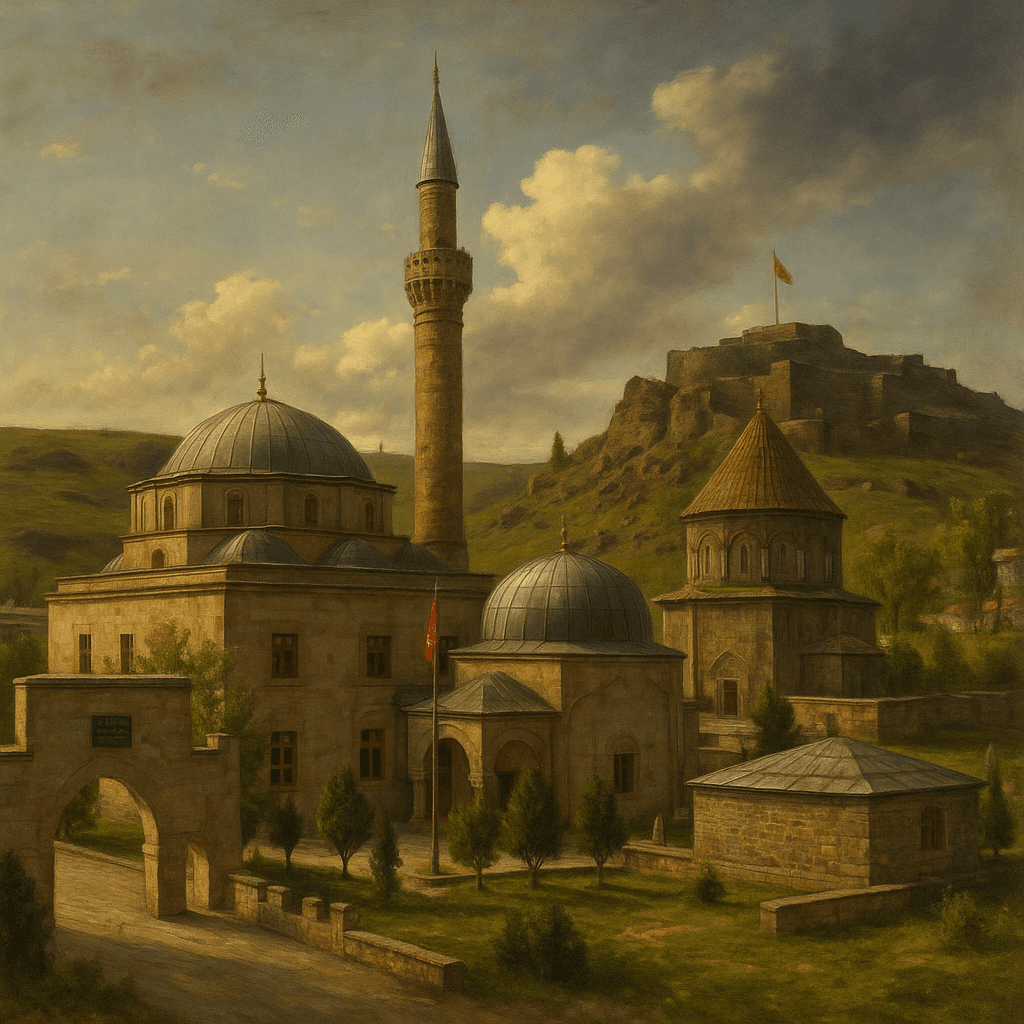




Ebû’l Hasan Harakânî Türbesi
Abu al-Hasan Harakani was born in 963 CE (Hijri 352) in the Khorasan region of present-day Iran. His real name was Ali ibn Ahmad Ja'far. In his youth, he worked as a shepherd, farmer, and caravan porter. After embracing the Sufi path, he made love for humanity and sharing the center of his life. One of his most famous sayings is: “Whoever comes to this dergah, give them bread without asking about their faith.” This attitude recalls Mevlana’s call: “Whoever you are, come again.”

(Generated by Artificial Intelligence)
Journey to Anatolia and Martyrdom
During the Seljuk incursions of the 11th century, Harakani arrived in Anatolia with his disciples. In 1033 CE (Hijri 425), he was martyred in a battle against the Byzantine army at the foot of Yahni Mountain near Kars. Thus, he became one of the first great Sufis to be martyred in Anatolia. His teachings later influenced important figures such as Ahmed Yesevi and Yunus Emre.
The History of the Tomb
In 1064, after Sultan Alp Arslan conquered Kars, a tomb was built in Harakani’s name in what is now the Kaleiçi neighborhood. However, due to wars and political events, this tomb remained forgotten for a long time. During the reign of Ottoman Sultan Murad III in 1579, the tomb was rediscovered and the Evliya Mosque was constructed, with Harakani’s grave moved into a tomb within the mosque courtyard.
At the entrance of the tomb is an Ottoman Turkish inscription dated 1617, which reads:
“By divine grace it was built, a new rose garden. This is the place where Sheikh Abu al-Hasan Harakani lies.”

(Generated by Artificial Intelligence)
The Tomb Today
Restorations carried out in 1998 renewed the tomb. The sarcophagus was surrounded by a wooden frame, and the tomb was covered with a domed structure. Around the tomb are 21 additional graves. One belongs to Kethüda Mehmet Pasha, governor of Kars in 1767, and another to Hafiz Kurban Efendi, who fought to protect the people during the 1877–78 Russo-Turkish War. Today, the tomb remains an important spiritual site visited by the public.