

KURE Kids Header Line
badge icon

This content was originally written in Turkish for children and is automatically translated into English using artificial intelligence.

article-image

Fasting

Last Updated: 06.04.2026

Fasting means abstaining from food and drink with the intention of worship from the break of dawn until sunset. In many parts of the world, people of various faiths observe fasting at specific times according to their beliefs. You may have seen people around you waking up for sahur during the month of Ramadan or eagerly waiting for the time of iftar.

What Is Fasting and How Is It Observed?

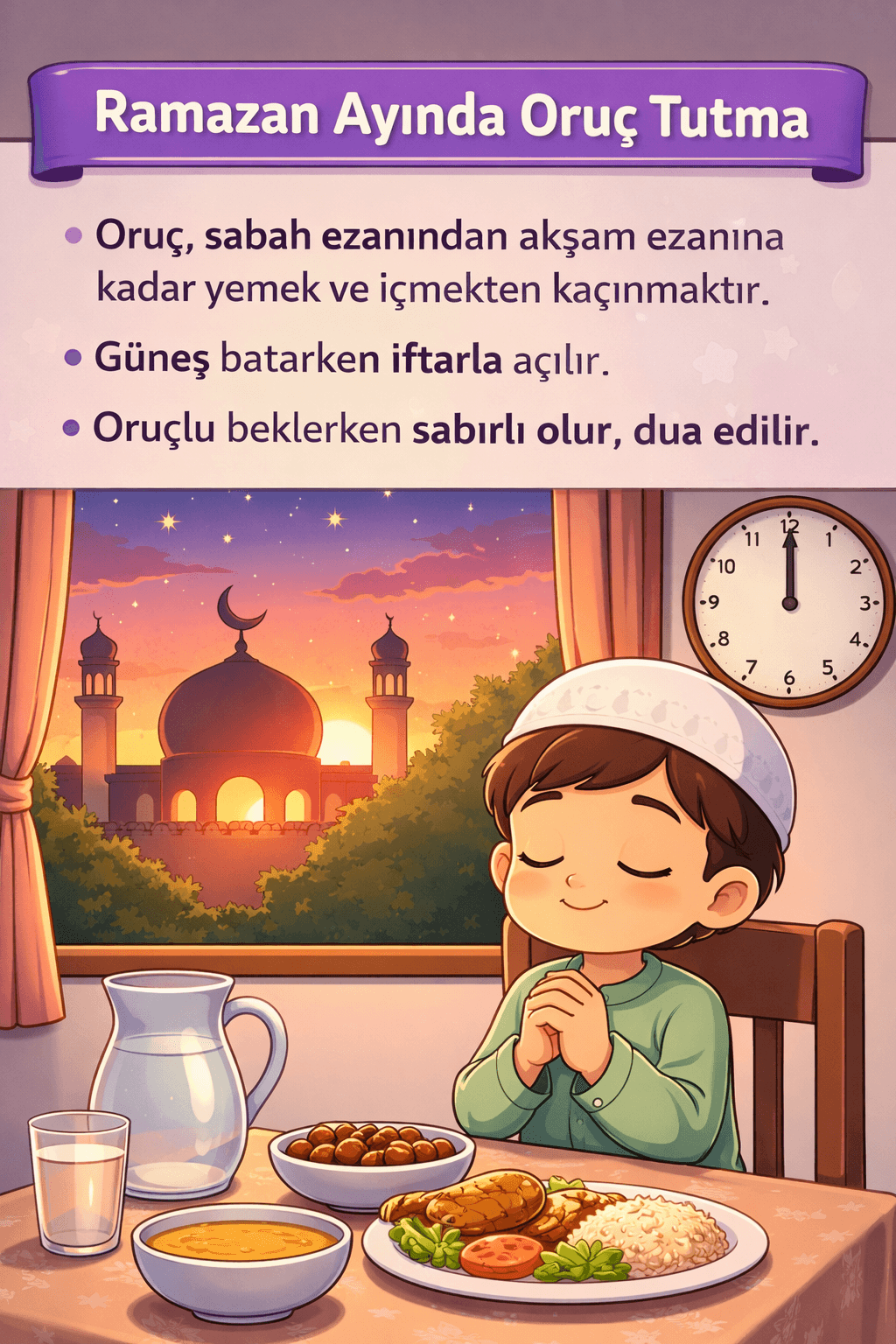
In Islam, fasting lasts from the pre-dawn time known as imsak until sunset. Those who fast do not eat or drink anything during this period. When the sun sets, they break their fast with iftar and have a meal.


Fasting is not merely about going without food; it is also about learning patience. Through fasting, people come to better appreciate the blessings they have and develop compassion for those in need. This act of worship helps individuals gain control over their desires.


Fasting - AA

Who Observes Fasting?

According to Islam, every healthy, mentally capable Muslim who has reached puberty is required to fast during the month of Ramadan. However, children, the very elderly, the ill, and travelers are not obligated to fast.


Children are not required to fast for the entire day because they are still growing. Nevertheless, many children try fasting for part of the day to emulate their elders and become accustomed to this cherished tradition.

Fasting in Other Religions

Fasting as an act of worship is found in nearly all religions. In Judaism, fasting is observed as a means of repentance and drawing closer to God. In Christianity, fasting is practiced in emulation of the fasts observed by Jesus and his apostles.


Fasting also exists in Eastern religions such as Buddhism and Hinduism. In some traditions, no food is consumed at all during the day, while in others, people abstain from specific foods such as meat or dairy products, observing what is called a "dietary restriction." Each culture has its own unique way and purpose for fasting, shaped by its beliefs.

Don't Forget to Look at These!
Science and Technology
cat img
Natural Sciences
cat img
Art and Literature
cat img
image
Most Read
Thomas Edison
arrow
image
Last Added
Kişisel Verileri Koruma Günü
arrow
ilham-notu-bg
INSPIRATION NOTE FOR CURIOUS KIDS!

Have you ever noticed how people who fast share their iftar meals with others? Can you imagine the joy of sharing something with the people around you?

Who Wrote?
Kids Writing
AuthorRabia ÇiftciApril 6, 2026
bottom-bg-effect-bottom
bottom-bg-effect-top

Fasting is an important act of worship that billions of people around the world observe to strengthen their feelings of patience, sharing, and mutual assistance, and to rejuvenate both body and mind.

Bibliographies

Accessed November 26, 2025. https://www.aa.com.tr/tr/kultur/ahlatta-acilan-kurslarla-geleneksel-tas-isciligi-yasatiliyor/3116279.

İnsana Değer Veren Dernekler Federasyonu (İDDEF). "Oruç Nedir? Faydaları Nelerdir?" Accessed March 15, 2026.

Kutsal Kitap. "Oruç Nedir?" Accessed March 15, 2026. https://www.kutsalkitap.org/oruc-nedir/

Mirasımız. "Oruç." Accessed March 15, 2026.

Sevilir, Emin Ferhat. “Üniversiteli Gönüllü Gençler, Evlerine Konuk Oldukları Yaşlılarla İftar Yapıyor.” Anadolu Ajansı, March 14, 2026. https://www.aa.com.tr/tr/yasam/universiteli-gonullu-gencler-evlerine-konuk-olduklari-yaslilarla-iftar-yapiyor/3864303

The provided text contains only an HTML snippet with a placeholder link and no actual citation content to translate. There is no Turkish text to translate — only a link reference structure. If you have the actual Turkish citation text (e.g., author, title, access date, URL, etc.), please provide it, and I will translate it according to the academic citation rules specified. For now, with only this snippet: ```html

https://www.iddef.org/oruc-nedir-faydalari-nelerdir

``` There is **nothing to translate**. The placeholders `https://www.iddef.org/oruc-nedir-faydalari-nelerdir` and `https://www.iddef.org/oruc-nedir-faydalari-nelerdir` must be replaced with actual content before translation can occur.

Türkiye Diyanet Vakfı İslam Ansiklopedisi. "Oruç." Accessed March 15, 2026. https://islamansiklopedisi.org.tr/oruc

ilham-notu-bg
ilham-notu-bg
ilham-notu-bg
HEYY!
Did You Know?
These?
Lamb
Lamb
Ask to Küre