
KURE Kids Header Line
badge icon

This content was originally written in Turkish for children and is automatically translated into English using artificial intelligence.

article-image

Fearless Explorer: The Honey Badger

Last Updated: 01.12.2025

Hello! Have you ever heard of an animal whose name means “honey” but isn’t a bee? Meet the honey badger! This fascinating creature gets its name from one of its favorite foods: honey. However, honey badgers are not only obsessed with sweets—they are also among the bravest animals in the animal kingdom. Let’s take a closer look at this fearless explorer!


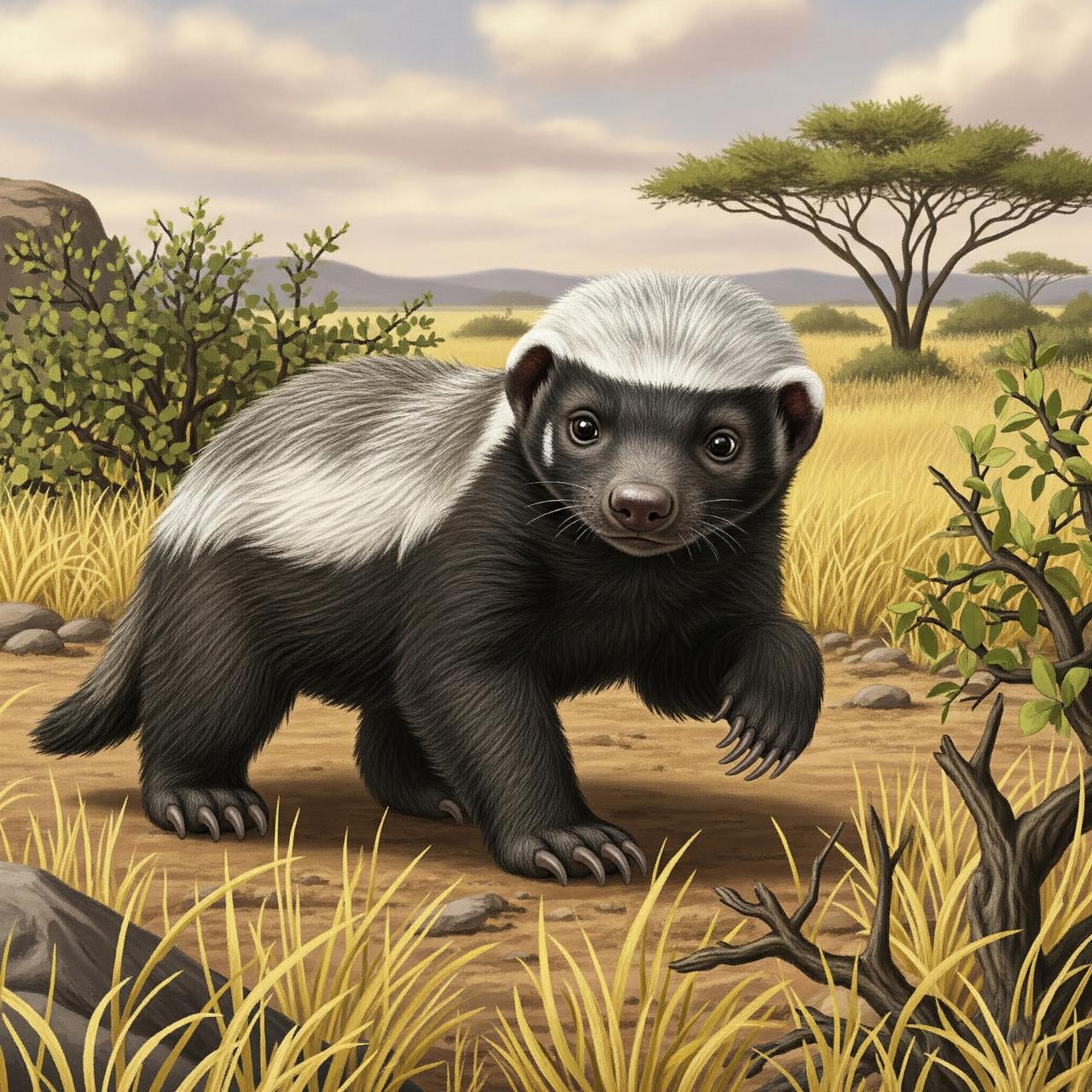
Honey Badger (Generated by Artificial Intelligence.)

Honey badgers belong to the weasel family, which also includes animals such as otters and water shrews.


Where Do They Live? 🗺️

Honey badgers inhabit a very wide geographic range. You can find them across much of Africa, the Middle East, and western Asia. They make their homes in forests, open grasslands, rocky terrain, and even arid deserts.


They are masters at digging their own burrows. Using their powerful front claws, they excavate tunnels and chambers underground. Sometimes, they prefer to take over abandoned dens made by other animals.


Honey Badger (Generated by Artificial Intelligence.)


What Do They Eat? 🍽️

The honey badger’s diet is incredibly diverse. Although classified as carnivores, they will eat almost anything. Among their favorite foods are honey and bee larvae found inside beehives. Thanks to their thick skin, they are largely unaffected by bee stings and can access hives with ease.


In addition to honey, they feed on snakes, scorpions, small rodents, birds, eggs, and insects. They can even hunt venomous snakes because their bodies are highly resistant to snake venom. A special physiological adaptation in their system reduces the impact of the poison.


Honey Badger (Generated by Artificial Intelligence.)


Why Are They So Brave? 💪

Honey badgers are famous for standing up to animals much larger than themselves—even lions or hyenas. So what makes them so fearless?


There are several reasons. First, their skin is thick and loose. When a predator bites them, they can twist around inside their skin and counterattack. They also have powerful jaws and sharp teeth, which they do not hesitate to use when defending themselves in dangerous situations.

Don't Forget to Look at These!
Science and Technology
cat img
History and Culture
cat img
Art and Literature
cat img
image
Most Read
Thomas Edison
arrow
image
Last Added
Kişisel Verileri Koruma Günü
arrow
ilham-notu-bg
INSPIRATION NOTE FOR CURIOUS KIDS!

So, why do you think a honey badger might love honey so much? Begin your research to find the answer and learn more about honey badgers!

Who Wrote?
Kids Writing
AuthorKasım Emre AnılDecember 1, 2025

What Did We Talk About?

bottom-bg-effect-bottom
bottom-bg-effect-top

The honey badger (Mellivora capensis) is a fearless animal belonging to the weasel family, found in various regions of Africa and Asia. It derives its name from its strong preference for honey and bee larvae, but its diet includes a wide range of prey, from snakes to small mammals. Thanks to its thick and loose skin, powerful claws, natural resistance to snake venom, and courageous nature, it can defend itself even against larger predators.

Bibliographies


Danielle H. Drabeck, Antony M. Dean, Sharon A. Jansa. “Why the honey badger don't care: Convergent evolution of venom-targeted nicotinic acetylcholine receptors in mammals that survive venomous snake bites.” *Toxicon* 99 (2015): 67–72. Accessed August 26, 2025. https://pubmed.ncbi.nlm.nih.gov/25796346/

Geçmiş, Gülnur. “Bal Porsuğu.” TÜBİTAK Bilim Çocuk. Accessed August 26, 2025. https://e-dergi.tubitak.gov.tr/edergi/yazi.pdf?dergiKodu=8&cilt=27&sayi=321&sayfa=32&yil=2024&ay=9&yaziid=49541

Gözcelioğlu, Bülent. “Bal Porsuğu.” *Bilim ve Teknik Dergisi*, (2022): 82–83. Accessed August 26, 2025. https://services.tubitak.gov.tr/edergi/yazi.pdf;jsessionid=7O5729fnbBfwGAAkNg0xJtPG?dergiKodu=4&cilt=55&sayi=1140&sayfa=82&yaziid=46962

Maximilian L. Allena, Brittany Petersona, Miha Krofel. “No respect for apex carnivores: Distribution and activity patterns of honey badgers in the Serengeti.” *Journal of Mammalogy* 89, no. 6 (2018): 90-94. Accessed August 26, 2025. https://maxallen.inhs.illinois.edu/files/2018/11/Allen-2018-Honey-Badger-Distribution.pdf

San Diego Zoo Wildlife Explorers. "Honey badger (ratel)." San Diego Zoo Wildlife Explorers. Accessed August 26, 2025. https://sdzwildlifeexplorers.org/animals/honey-badger-ratel

ilham-notu-bg
ilham-notu-bg
ilham-notu-bg
HEYY!
Did You Know?
These?
Lamb
Lamb
Ask to Küre