


This article was automatically translated from the original Turkish version.
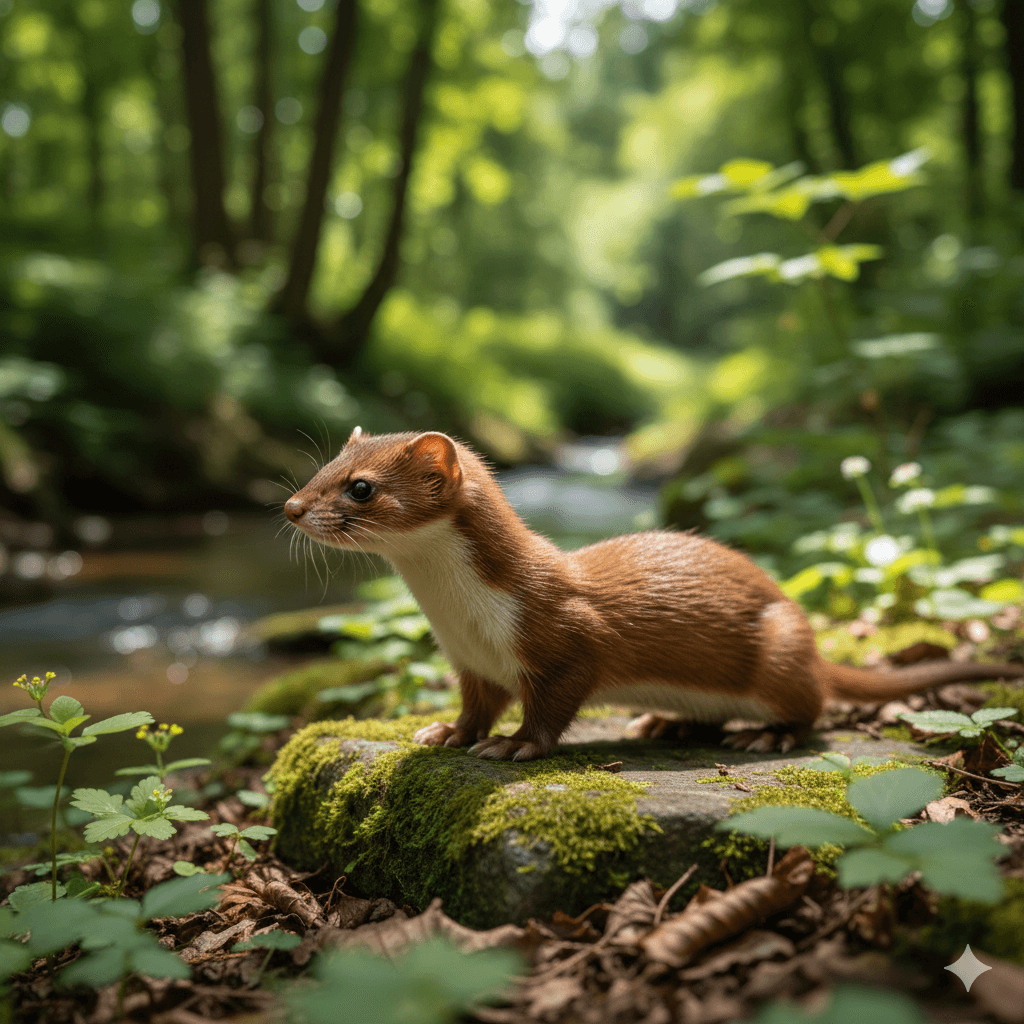
Weasel (Mustela nivalis) (Generated with Artificial Intelligence)
Scientific Name(s) | Mustela nivalis | ||||||||
|---|---|---|---|---|---|---|---|---|---|
Size(s) | The smallest carnivorous mammal in the world | ||||||||
Conservation Status | Endangered in Türkiye | ||||||||
Reproduction(s) | Gestation period approximately 35-37 days 1-9 young per litter | ||||||||
Diet(s) | eggs and small reptiles birds rodents Mice | ||||||||
Classification(s) | Mammal Mustelidae Carnivore | ||||||||
Habitat | cliffs and steppes agricultural lands Forest edges | ||||||||
Behavior | Does not hibernate or migrate | ||||||||
Senses | Sharp vision, hearing and sense of smell | ||||||||
Lifespan | Average lifespan in the wild of 2-3 years | ||||||||
Hunting Time | Generally nocturnal or crepuscular | ||||||||
Fur Color (Winter) | Completely white (in cold regions) | ||||||||
Fur Color (Summer) | Brown back, white/cream belly | ||||||||
Physical Structure | Long, flexible body; short legs and short tail | ||||||||
Weasel (Mustela nivalis) is a species classified within the family Mustelidae (weasels), order Carnivora (carnivores), class Mammalia (mammals), and phylum Chordata (chordates) of the kingdom Animalia (animals). Known in the literature as the "common weasel" or "least weasel," this animal is the smallest member of the Mustelidae family and holds the distinction of being the smallest carnivorous mammal on Earth. Although it exhibits strong morphological and behavioral similarities to its close relative, the stoat (Mustela erminea), it is taxonomically distinguished by its biometric measurements and the absence of a black-tipped tail in its winter coat.

White Weasel (Image Generated by Artificial Intelligence.)
The evolutionary process of this species has produced a specialized anatomy that enables it to pursue prey into their burrows. Its body is long, slender, and cylindrical, with legs and tail significantly shorter relative to its body length. Sexual dimorphism is pronounced: males typically reach 20 to 22 cm in length and weigh up to 115 grams, while females measure 15 to 18 cm in length and weigh approximately 59 grams. Average body mass varies between 40 and 130 grams.
The most distinctive physiological feature of the weasel is seasonal pelage change. During summer, the dorsal fur is reddish-brown and the ventral fur is cream-white. However, as day length decreases, hormonal changes trigger a transition to a winter coat. In winter, the weasel becomes entirely white, a key diagnostic feature distinguishing it from the stoat (Mustela erminea), whose tail retains a black tip.
The species has a broad geographic tolerance and is found across Eurasia, North Africa, and North America, as well as being introduced in New Zealand. In Türkiye, weasels are commonly observed in habitats such as forest edges, agricultural fields, shrublands, riparian woodlands, and stone walls, while avoiding dense forest interiors and areas above 3,000 meters in elevation.
The species exhibits territorial behavior. An individual’s home range varies depending on food availability and sex, typically spanning 4 to 8 hectares (approximately 10 to 20 dunams). Male territories are larger than those of females and often overlap with the ranges of multiple females. Rather than digging their own burrows, weasels occupy existing tunnels created by rodents, tree roots, or rock crevices, lining the interior with the fur and feathers of their prey to provide insulation.

Weasel (Mustela nivalis) (Image Generated by Artificial Intelligence.)
Due to their high surface-area-to-volume ratio, weasels struggle to maintain body heat and possess an extremely high metabolic rate. To maintain energy balance, they must consume 40 to 60 percent of their body weight in food each day. Their diet consists of 60 to 80 percent rodents, particularly mice (Mus), voles (Microtus), and other small rodents.
Their hunting strategy relies on a swift, lethal bite to the back of the prey’s neck (at the base of the skull). During periods of abundant prey, they have been documented to kill more than they can immediately consume, storing excess food in side chambers of their dens as caches. In literature, the complex, darting, and twisting movements weasels perform to confuse or hypnotize prey are referred to as the “war dance.”
Reproductive activity peaks between April and August. The reproductive physiology of weasels differs significantly from that of closely related mustelids such as the stoat and badger: Mustela nivalis does not exhibit delayed implantation; fertilized eggs implant immediately, resulting in a short gestation period of approximately five weeks (35 to 37 days). Females are induced ovulators, meaning ovulation is triggered solely by the act of mating.
Newborns are blind, hairless, and weigh between 1.1 and 1.7 grams, but develop rapidly: they are weaned at four weeks and capable of independent hunting by eight weeks. Female pups born early in the year can reach sexual maturity and reproduce during their first summer, a rare reproductive speed among mammals. In the wild, average lifespan is limited to 2 to 3 years.

Weasel (Mustela nivalis) (Image Generated by Artificial Intelligence.)
Occupying the ecological niche of a mesopredator, weasels play a critical role in controlling rodent populations, thereby protecting agricultural crops and natural vegetation. For this reason, they are often described as “farmer-friendly” in biological control contexts.
However, they are also potential prey for owls, hawks, foxes, and domestic cats. Globally, the species is not considered threatened (Least Concern – LC), but local populations face threats from agricultural pesticide use and habitat fragmentation. In Türkiye, the weasel is included among species under conservation protection.
Animal Corner. "Weasel - Facts, Diet & Habitat Information." Accessed February 11, 2026. https://animalcorner.org/animals/weasel/
Bilgin, Özkan. "Van'da nesli koruma altındaki beyaz gelincik görüntülendi." Anadolu Ajansı, November 11, 2025. Accessed February 11, 2026.
Gözcelioğlu, Bülent. "En Küçük Yırtıcımız Gelincik." *Bilim ve Teknik*, November 2009. Accessed February 11, 2026. https://services.tubitak.gov.tr/edergi/yazi.pdf;jsessionid=Y3mElwS+GkfUCaCqTNMeytY9?dergiKodu=4&cilt=43&sayi=695&sayfa=90&yaziid=29987
Internet Center for Wildlife Damage Management. "Weasel Biology." Internet Center for Wildlife Damage Management. Accessed February 11, 2026. https://icwdm.org/species/carnivores/weasels/weasel-biology/
Okatan, Ayşenur. "Türkiye’nin Gelinciği." TÜBİTAK Bilim Genç, May 8, 2023. Accessed February 11, 2026. https://bilimgenc.tubitak.gov.tr/makale/turkiyenin-gelincigi
Understanding Animal Research. "Ferrets in medical research." Understanding Animal Research. Accessed February 11, 2026.

Weasel (Mustela nivalis) (Generated with Artificial Intelligence)
Scientific Name(s) | Mustela nivalis | ||||||||
|---|---|---|---|---|---|---|---|---|---|
Size(s) | The smallest carnivorous mammal in the world | ||||||||
Conservation Status | Endangered in Türkiye | ||||||||
Reproduction(s) | Gestation period approximately 35-37 days 1-9 young per litter | ||||||||
Diet(s) | eggs and small reptiles birds rodents Mice | ||||||||
Classification(s) | Mammal Mustelidae Carnivore | ||||||||
Habitat | cliffs and steppes agricultural lands Forest edges | ||||||||
Behavior | Does not hibernate or migrate | ||||||||
Senses | Sharp vision, hearing and sense of smell | ||||||||
Lifespan | Average lifespan in the wild of 2-3 years | ||||||||
Hunting Time | Generally nocturnal or crepuscular | ||||||||
Fur Color (Winter) | Completely white (in cold regions) | ||||||||
Fur Color (Summer) | Brown back, white/cream belly | ||||||||
Physical Structure | Long, flexible body; short legs and short tail | ||||||||
No Discussion Added Yet
Start discussion for "Weasel (Mustela nivalis)" article
Morphological Characteristics and Physiology
Habitat Use, Territoriality, and Distribution
Feeding Ecology and Hunting Strategies
Reproductive Biology and Life Cycle
Ecological Importance and Conservation Status