



Galaxy
Have you ever looked up at the night sky and tried counting the stars? Did you know that all these stars live together like a giant family? We call these giant families galaxies! Let’s now learn what galaxies are, what they look like, and the adventures they have in the universe.

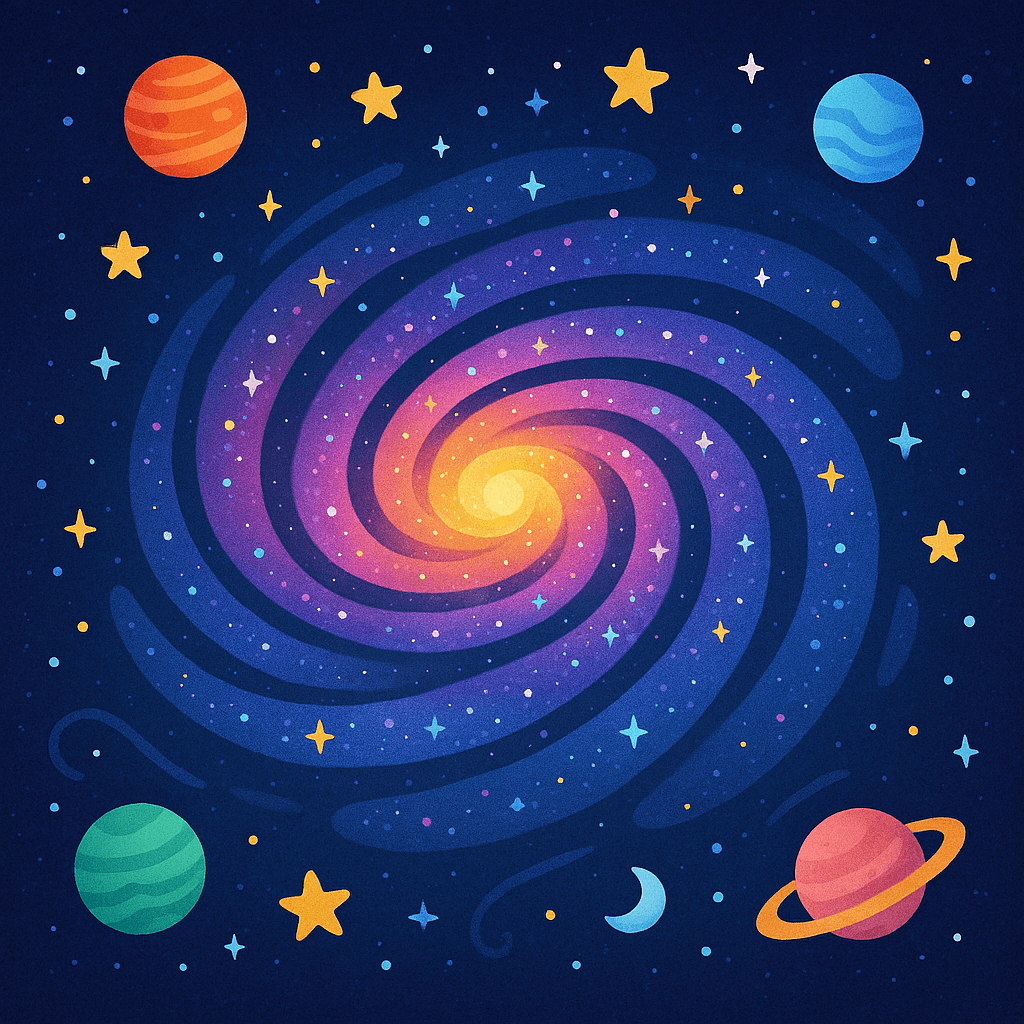
Galaxy (Generated by Artificial Intelligence)
What Is a Galaxy?
Galaxies are enormous collections of stars, planets, gas clouds, and dust particles that exist together in space. They are held together by an invisible force called gravity. This force binds stars, planets, and everything else, just like glue!
Our home, Earth, is part of the Solar System. But where is the Solar System located? It lies inside a very large galaxy called the Milky Way Galaxy. The Milky Way contains millions, even billions, of stars! Most of the stars you see in the night sky are our neighbors within the Milky Way.
What Do Galaxies Look Like?
Galaxies come in different shapes, just like different-shaped blocks in a toy box! There are three main types:
- Spiral Galaxies: These have twisted arms like a windmill. The Milky Way is a spiral galaxy! These arms are filled with stars, gas, and dust.
- Elliptical Galaxies: These are oval-shaped, like balls. They usually contain older stars and rarely form new ones.
- Irregular Galaxies: These are neither spiral nor oval. Their shapes are messy and can look like smudges!

Galaxy (Generated by Artificial Intelligence)
How Many Galaxies Are There in the Universe?
There are so many galaxies in the universe that counting them is nearly impossible! Scientists studied a tiny region of space using the Hubble Space Telescope and saw more than 10,000 galaxies. That was only a tiny part of space! When considering the entire universe, scientists estimate there may be about 200 billion galaxies. But this number could increase further with new telescopes.
Do Galaxies Collide?
Yes, galaxies sometimes move close to each other and collide! But don’t worry—these collisions are not frightening. Galaxies are so large and their stars are so far apart that during a collision, stars rarely hit each other. For example, in about five billion years, the Milky Way Galaxy will merge with our neighbor, the Andromeda Galaxy. In this merger, it is not the stars that collide, but gas clouds, which can trigger the birth of new stars!
Do Galaxies “Die”?
Galaxies are born, change, and sometimes become quiet. A galaxy’s “death” means it stops producing new stars. For instance, spiral galaxies like the Milky Way have plenty of gas and dust, so new stars form every year. But elliptical galaxies have little gas, so few new stars are born. These galaxies become calm, as if falling asleep. Still, some scientists believe even these “sleeping” galaxies might one day produce new stars again!
Why Are Galaxies Important?
Galaxies are like the giant cities of the universe. Each may hold unique stories, stars, and perhaps even life on other planets. Even at the center of the Milky Way lies a supermassive black hole!