


This article was automatically translated from the original Turkish version.
+1 More
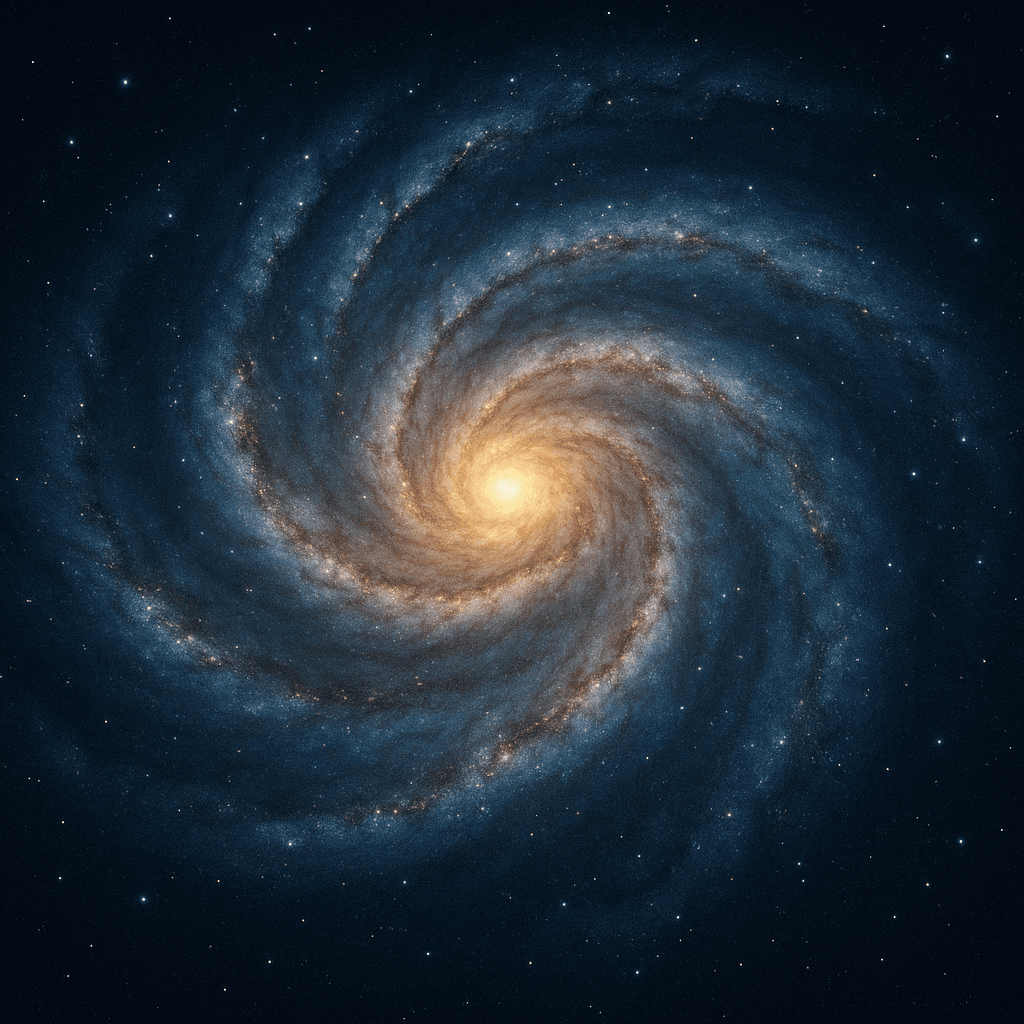
Milky Way Galaxy
Galaxy Type | Barred Spiral (SBbc) | ||||||||
|---|---|---|---|---|---|---|---|---|---|
Diameter | ~100,000 – 200,000 light years | ||||||||
Thickness | Center: ~10,000 light years / Outer disk: ~300 light years | ||||||||
Number of Stars | 200 – 400 billion | ||||||||
Total Mass | ~1.5 trillion solar masses | ||||||||
Galaxy Age | ~13.6 billion years | ||||||||
Galactic Year (Sun) | ~225 – 250 million years | ||||||||
The Milky Way Galaxy is a stellar system distinguished by its dynamic structure, rich components, and cosmic environment, as the product of an approximately 13.6 billion year evolution. It is a highly complex galaxy type characterized by its spiral structure, bar structure, spiral arms, the supermassive black hole at its galactic center, the surrounding globular halo, and interactions with dwarf galaxies.

The Milky Way Galaxy (NASA)
Galaxies form the fundamental building blocks of the universe. In this context, the Milky Way Galaxy holds a special position for humanity as the galaxy that hosts Earth and the Solar System.
Modern observational astronomy and theoretical astrophysics provide significant insights into the structure and evolution of the Milky Way. However, these insights are often derived not from direct observation but through indirect inferences.
Despite observational limitations, our knowledge of the galaxy continues to grow daily thanks to modern telescopes such as Gaia, Hubble, Chandra, Spitzer, and James Webb.

The Milky Way Galaxy (Generated by artificial intelligence.)
The disk component of the Milky Way consists of stars, gas, and dust. This disk contains young stars, interstellar gas, and star-forming regions. Due to dense interstellar dust obscuration, optical observations provide limited information. Infrared observations have played a major role in revealing the details of this structure.
Spiral arms are key structural features of the galactic disk. Observations indicate that the Milky Way has four major spiral arms:
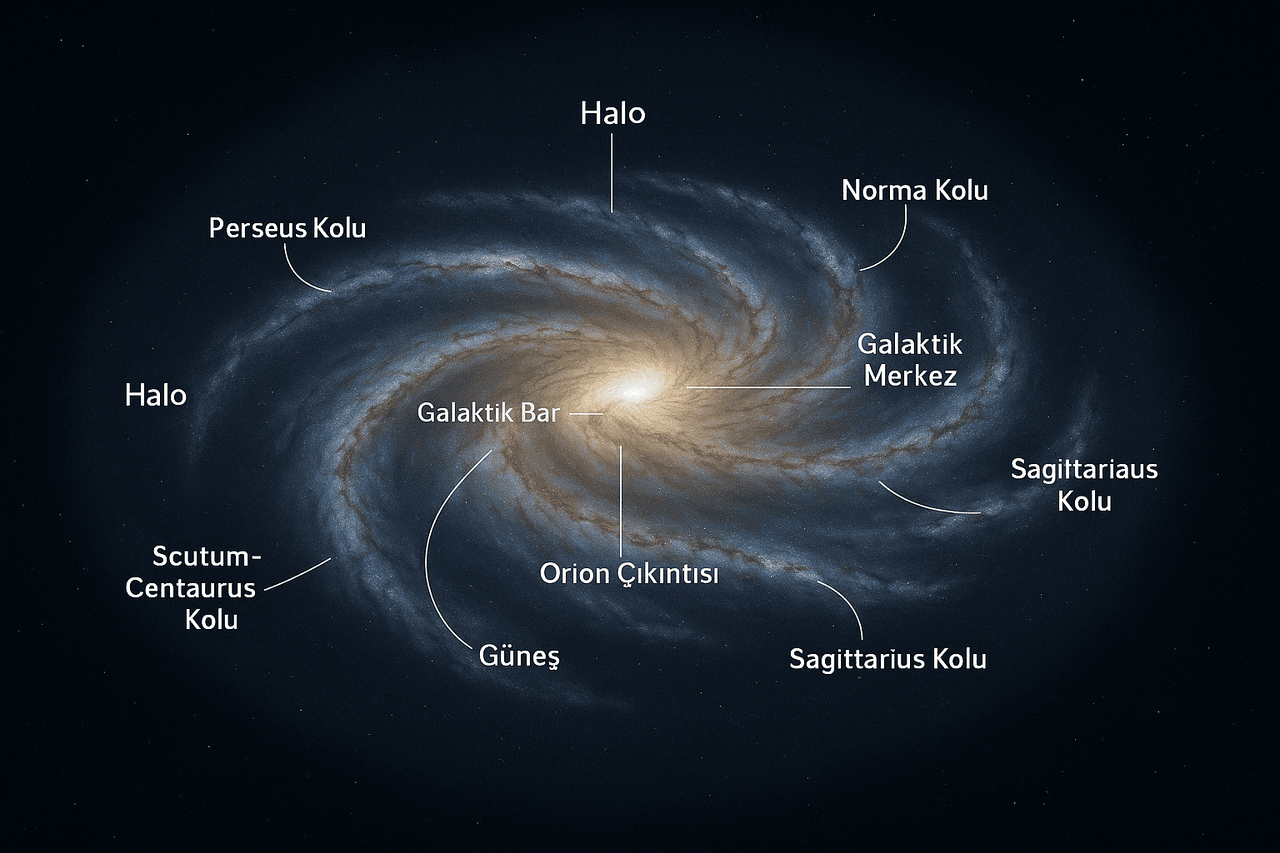
Spiral Arms of the Milky Way Galaxy (Generated by artificial intelligence.)
The Solar System is located within the Orion Spur (Orion Arm), a smaller structure situated between these major arms. Spiral arms are rich in star-forming regions and are populated by numerous hot, young OB-type stars.
At the center of the Milky Way lies a bar-shaped structure approximately 27,000 light years in length. This structure is one of the key factors determining the galaxy’s dynamics. The bar regulates the flow of matter within the galactic disk and triggers star formation.
The radio source named Sagittarius A* (Sgr A*) at the galactic center is a supermassive black hole with a mass of approximately four million solar masses. The existence of this object has been indirectly confirmed through observations of the orbital motions of stars surrounding it. The center also hosts a dense population of stars, hot gas, and molecular clouds.
The Milky Way is surrounded by a globular halo beyond the disk. This region contains:
The chemical composition of the halo is characterized by Population II stars with low metallicity.
The majority of the galaxy’s total mass consists of an invisible component known as dark matter. The existence of this matter is strongly supported by anomalies in the galaxy’s rotation curve. Observations reveal that stars in the outer regions of the galaxy rotate faster than predicted by Newtonian mechanics.
The Milky Way consists of stellar populations with different ages and metallicities. Generally, three main populations are defined:
Galactic chemical evolution is shaped by supernova explosions, stellar winds, and galaxy mergers.
The structural and dynamic properties of the Milky Way are studied using a variety of telescopes and space missions:
The Milky Way is part of a galaxy group known as the Local Group. The largest members of this group are the Milky Way and the Andromeda Galaxy. It is predicted that in approximately four billion years, the Andromeda Galaxy will collide and merge with the Milky Way, likely forming a new elliptical galaxy.
Our galaxy also interacts with numerous dwarf galaxies:
These galaxies contribute mass and material to the Milky Way.
The formation of the Milky Way dates back to the early epochs of the cosmic timeline. Today, stellar streams observed in the halo and outer regions of the galaxy are remnants of past merger events. Galactic archaeology aims to reconstruct this evolutionary history by analyzing the chemical compositions and orbital paths of stars.
The Milky Way Galaxy holds immense importance both observationally and theoretically in astronomy. Advanced observational technologies continue to reveal new information about it every day.
The structural properties, dynamics, and components of the galaxy allow cosmological models to be tested through comparison with other galaxies. In particular, data from the Gaia mission will enable deeper insights into our galaxy over the coming decades.
NASA. "Galaxies." *NASA Science*. Accessed April 19, 2025. https://science.nasa.gov/universe/galaxies/.
NASA. "Galaxy Types." *NASA Science*. Accessed April 19, 2025. https://science.nasa.gov/universe/galaxies/types/.
NASA. "Milky Way on the Horizon." NASA. Accessed April 19, 2025. https://www.nasa.gov/image-article/milky-way-on-the-horizon/.
NASA. "The Milky Way Galaxy." *NASA Science*. Accessed April 19, 2025. https://science.nasa.gov/resource/the-milky-way-galaxy/.
NASA. “Milky Way – Exoplanet Exploration: Planets Beyond our Solar System.” *NASA Exoplanet Exploration*. Accessed April 19, 2025. https://exoplanets.nasa.gov/milky-way-overlay/.

Milky Way Galaxy
Galaxy Type | Barred Spiral (SBbc) | ||||||||
|---|---|---|---|---|---|---|---|---|---|
Diameter | ~100,000 – 200,000 light years | ||||||||
Thickness | Center: ~10,000 light years / Outer disk: ~300 light years | ||||||||
Number of Stars | 200 – 400 billion | ||||||||
Total Mass | ~1.5 trillion solar masses | ||||||||
Galaxy Age | ~13.6 billion years | ||||||||
Galactic Year (Sun) | ~225 – 250 million years | ||||||||
Key Features of the Milky Way
Morphological Structure
Galactic Disk
Spiral Arms
Galactic Bar
Galactic Center and Sagittarius A*
Galactic Halo and Dark Matter
Halo
Dark Matter
Stellar Populations and Chemical Evolution
Astronomical Observations and Missions
Interactions with Other Galaxies
Galactic Evolution and Archaeology