



Milky Way Galaxy
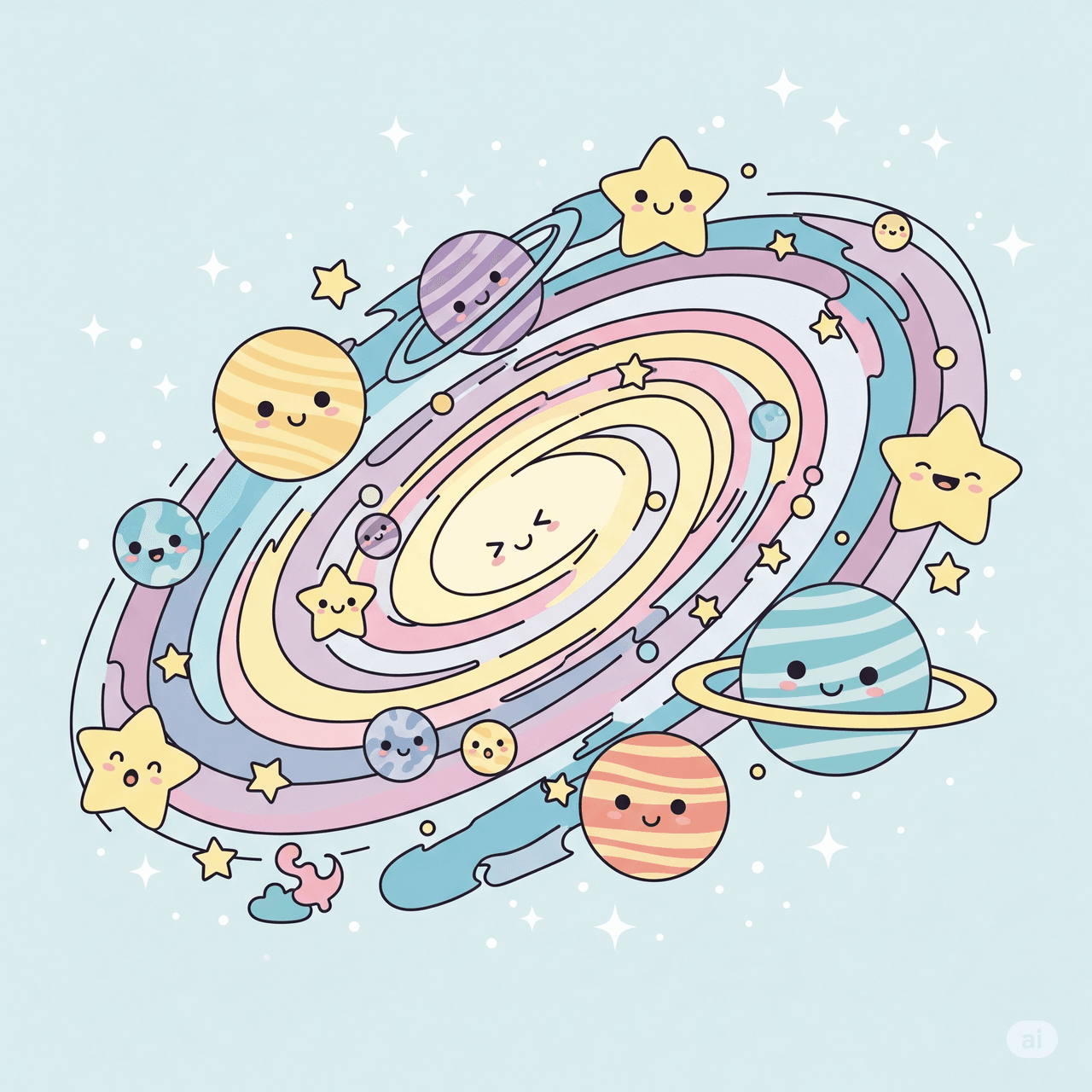
The Milky Way Galaxy is a vast collection of stars, within which our Solar System is also located. It contains hundreds of billions of stars, planets, dust clouds, and gas. It earned its name because, as seen from Earth, it appears as a white band stretching across the sky like milk. Under clear, dark night skies, this luminous band is clearly visible.

(Generated by Artificial Intelligence.)
Where Are We?
Earth orbits the Sun. The Sun, in turn, resides in a region far from the center of the Milky Way Galaxy. In other words, we are located in one of the outer neighborhoods of the galaxy. The Solar System revolves around the center of the Milky Way, but it takes approximately 225 million years to complete one full orbit!
How Big Is the Milky Way?
The Milky Way is so large that light itself takes about 100,000 years to travel from one end to the other. The size of a galaxy is measured in “light-years,” which is the distance light travels in one year. The Milky Way is not only immense but also a complex system containing billions of stars.

(Generated by Artificial Intelligence.)
What Is the Shape of the Milky Way?
The Milky Way is a spiral galaxy. It appears as a large disk with arms extending outward from its center. Because we are inside this galaxy, we cannot see its overall shape directly. However, scientists have modeled its structure using telescopes and space probes. The Solar System lies within one of these spiral arms.
The Milky Way Galaxy: The Vast Galaxy That Houses Our Home
The Milky Way Galaxy is a massive stellar system that includes our Solar System. A galaxy is a large structure composed of millions, even billions, of stars, planets, gas, and dust. The Milky Way is a spiral galaxy, meaning it has a central structure that rotates like a vortex, with arms spiraling outward around it.
The center of the Milky Way contains an extremely massive black hole that pulls all the matter in the galaxy toward itself. The diameter of the Milky Way is approximately 100,000 light-years, meaning it takes light 100,000 years to cross from one side to the other!
The Structure of the Milky Way
Structure and Arms
The Milky Way has a spiral galaxy structure with a massive black hole at its center. This black hole pulls all the matter in the galaxy toward itself. Stars and planets orbit in the outer regions of the galaxy. The spiral arms are filled with stars, gas, and dust clouds. Their rotational motion is influenced by the gravitational pull of the black hole at the galaxy’s center.
Center and Core
The center of the Milky Way is a dense region containing a supermassive black hole. This black hole affects everything surrounding it and is one of the primary forces guiding the entire galaxy. It possesses an immense gravitational pull due to its enormous mass.
The Milky Way Among Other Galaxies
The universe is not made up of the Milky Way alone. It contains billions of galaxies. The Milky Way is part of a small group of galaxies called the Local Group. Its largest neighbor is the Andromeda Galaxy, which is expected to collide with the Milky Way in the distant future—though this event will not occur for billions of years.
The Milky Way’s Place in the Universe
Comparison with Other Galaxies
The Milky Way is just one of many galaxies in the universe. While there are billions of galaxies in the cosmos, the Milky Way is our home. The Andromeda Galaxy is the nearest large galaxy to the Milky Way, and the two are expected to approach and eventually collide in several billion years.
The Infinite Scale of the Universe
Although the Milky Way is only one galaxy, it contains billions of stars, planets, and other cosmic objects. This helps us understand the immense scale of the universe and the vast number of galaxies it contains.
Are There Other Planets in the Milky Way?
Yes! Scientists have discovered thousands of exoplanets—planets outside our Solar System—in the Milky Way. Thanks to space telescopes, more planets are being found each year. Some of these planets may have conditions suitable for life. So perhaps one day we will learn whether life exists on other worlds!