


This article was automatically translated from the original Turkish version.
+1 More
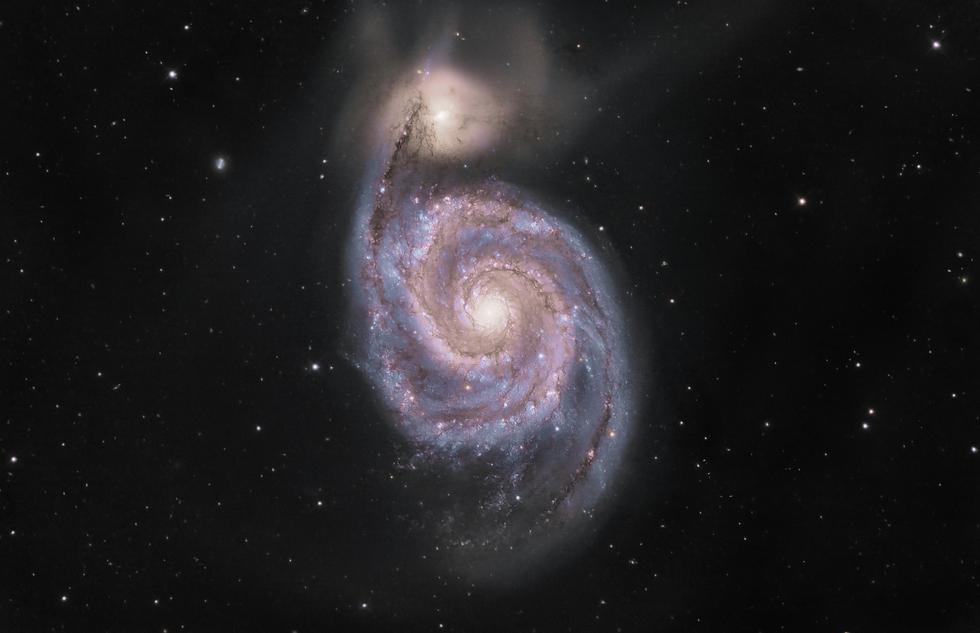
Messier 51
Name(s) | Girdap Gökadası | ||||||||
|---|---|---|---|---|---|---|---|---|---|
Catalog Name | Messier 51a | ||||||||
Location | Av Köpekleri Takımyıldızı | ||||||||
Satellite Galaxy | NGC 5195 | ||||||||
The Whirlpool Galaxy, also known as Messier 51a (M51a), is a prominent spiral galaxy. Although it resembles the Milky Way in building, it is one of the rare galaxies among external galaxies that can be relatively easily observed and whose structural features are clearly distinguishable.

NASA. "Messier 51 (The Whirlpool Galaxy)." NASA Science. Location of Messier 51.
First observed in 1773 by Charles Messier, M51 entered the history of astronomy as one of the earliest examples demonstrating the existence of spiral galaxies, particularly through drawings made by Lord Rosse in the 19th century science.
The Whirlpool Galaxy exhibits clearly symmetric spiral arms. These arms consist of stars, dust and gas, and contain regions of intense star formation. Due to differential Dönmə, the spiral arms gradually wind over time, causing the gas clouds within them to compress and transform into star-forming regions.

At the galaxy’s center lies a bright nucleus place, likely hosting a supermassive black black hole. Observations by the Hubble Space Telescope (HST) reveal weak signatures of active galactic nucleus (AGN)-like emission. However, M51a exhibits a lower level of activity compared to typical AGNs, making it a less active center system.
NGC 5195 (M51b), located northeast of M51, is physically interaction interacting with M51a. This interaction has strengthened the spiral arm structure and increased the star formation rate within the galaxy. Numerical simulations indicate that NGC 5195 has completed one orbit around M51a and is currently undergoing its second close passage.
The Whirlpool Galaxy is one of the most actively star-forming systems in the local universe. H-II regions are prominently observed along its spiral arms. These regions are defined by ionized hydrogen gas surrounding massive young stars.
Star formation has been triggered by the gravitational interaction between M51a and NGC 5195. This process has altered the galaxy’s evolutionary dynamics and made it a cosmologically significant important subject of study.
M51 has been observed across multiple electromagnetic spectrum bands:
The M51 system has frequently been used in numerical simulations of galaxy collisions and interactions on. In particular, simulations by Toomre classical have been instrumental in demonstrating the role of galaxy interactions in forming spiral structures. Recent models show that galaxy interactions have significant effects not only on morphological but also on chemical evolution evolution.
The Whirlpool Galaxy is a key lock example for understanding spiral galaxy structures and galactic interactions in the universe. It also serves as an accessible observational laboratory for studying star-forming regions, gas distribution, nuclear activity, and galactic evolution like. As such, it is a major target of interest for both amateur and professional astronomers amateur.
M51, the Whirlpool Galaxy, stands out as an important observation target for understanding astrophysical processes. Its symmetric spiral structure, interaction with its satellite galaxy, prominent star-forming regions, and multi-wavelength observational data make it a fundamental work object in the study of galactic evolution and morphology.
Bishop, Scotty. "Messier 51, The Whirlpool Galaxy." *Telescope Live*. Accessed April 13, 2025. https://telescope.live/gallery/messier-51-whirlpool-galaxy-0.
Chandra X-ray Observatory. "Messier 51 (M51)." *Chandra X-ray Observatory*. Accessed April 13, 2025. https://chandra.harvard.edu/graphics/resources/handouts/lithos/m51_lithos.pdf.
NASA. "Messier 51 (The Whirlpool Galaxy)." *NASA Science*. Accessed April 13, 2025. https://science.nasa.gov/mission/hubble/science/explore-the-night-sky/hubble-messier-catalog/messier-51/.
Plotner, Tammy. "Messier 51 – the Whirlpool Galaxy." *Universe Today*. Accessed April 13, 2025. https://www.universetoday.com/articles/messier-51.
Sarıgül, Tuba. "Girdap Gökadası." TÜBİTAK *Bilim ve Teknik Dergisi*, May 2018. Accessed April 13, 2025. https://bilimteknik.tubitak.gov.tr/system/files/makale/64_65_ayinfotografi_mayis_2018.pdf.
Spitzer Space Telescope. "The Whirlpool Galaxy in Visible Light." *Spitzer – Caltech*. Accessed April 13, 2025. https://www.spitzer.caltech.edu/image/ssc2019-11a-the-whirlpool-galaxy-in-visible-light.
İkizler, Uğur. "Girdap Gökadası – M51." *AstroBilgi*. Accessed April 13, 2025. https://astrobilgi.org/girdap-gokadasi-m51/.

Messier 51
Name(s) | Girdap Gökadası | ||||||||
|---|---|---|---|---|---|---|---|---|---|
Catalog Name | Messier 51a | ||||||||
Location | Av Köpekleri Takımyıldızı | ||||||||
Satellite Galaxy | NGC 5195 | ||||||||
General Properties
Structure and Components
Spiral Arms
Core and Central Region
Satellite Galaxy: NGC 5195
Star Formation and Galactic Evolution
Observational Studies
Numerical Simulations and Theoretical Models
Scientific and Cosmological Significance