


Solar System
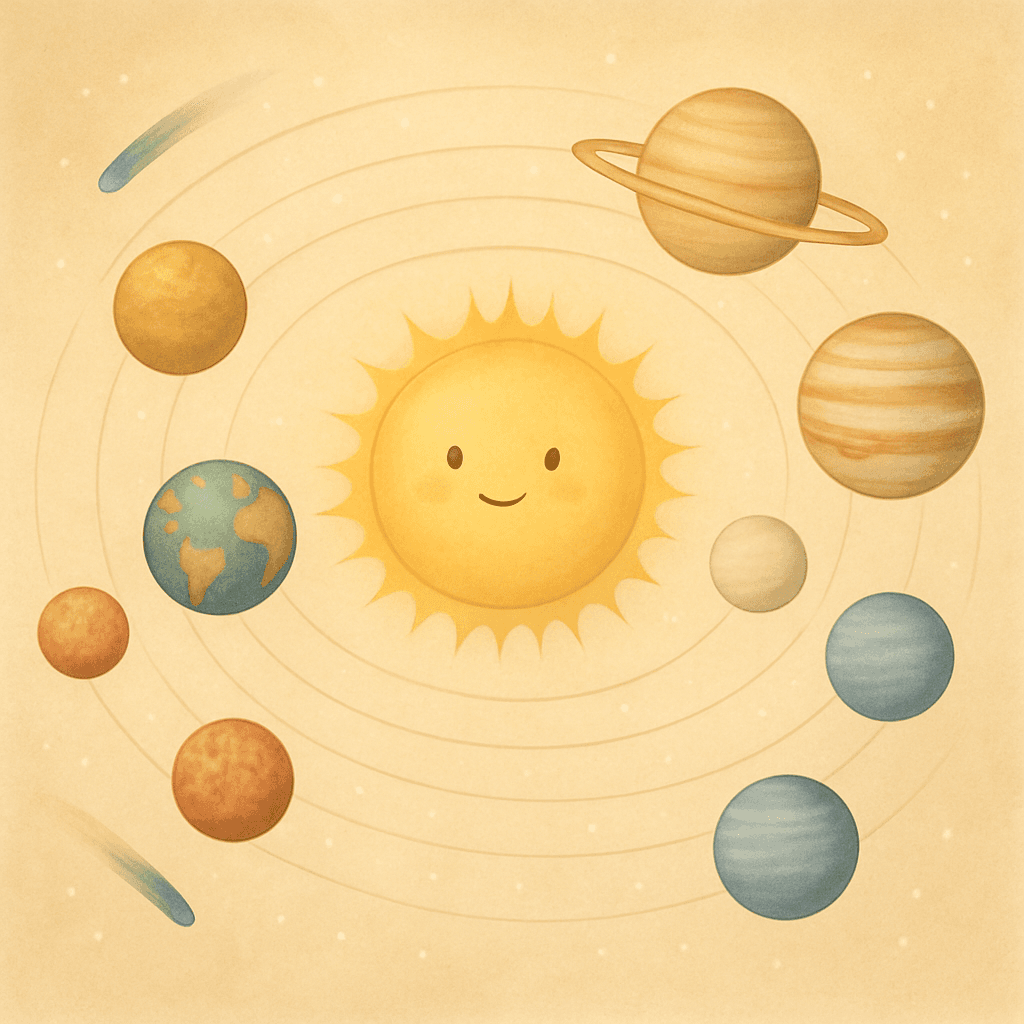
The Solar System is a large family in space. At its center is the Sun, which we all know well. The Sun causes the planets and other celestial bodies orbiting around it to revolve in its vicinity. Just as children revolve around their mother, the Sun sits at the heart of this great family and holds the system together.
The Sun: The Heart of This System
The Sun is a bright and extremely hot star. It is so large that one million Earths could fit inside it! By emitting heat and light, it illuminates and warms the planets. Without the Sun, life on Earth would not exist. Plants could not perform photosynthesis, humans could not stay warm, and there would be no day or night.

(Generated by artificial intelligence)
Planets from Closest to Farthest from the Sun
Mercury
It is the planet closest to the Sun. It is small but can be extremely hot and cold. Life is impossible on its surface.
Venus
It appears very bright in the sky, which is why it is also called the “Morning Star.” Its surface is extremely hot and covered in toxic gases.
Earth
Our home! So far, Earth is the only planet where life can exist. It has water, air, and life.
Mars
Known as the “Red Planet” due to its reddish color. It has mountains, valleys, and dust storms. Scientists are investigating whether life ever existed there.
Jupiter
It is the largest planet. It has a massive storm on its surface. This storm is so large that Earth could fit inside it.
Saturn
Famous for its large rings made of ice and rock fragments. Saturn is a visually stunning planet.
Uranus
It has a blue-green color. Unlike other planets, it rotates on its side. It is very cold.
Neptune
It is the farthest planet from the Sun. Its color is blue and it has extremely fast winds.
What Else Exists in the Solar System?
The Solar System is not made up of planets alone. Many other celestial bodies exist alongside them:
- Moons: Small celestial bodies that orbit planets. Earth’s moon is the Moon. Jupiter and Saturn each have dozens of moons!
- Asteroids: Small rocky and metallic bodies. They are mostly found in the region between Mars and Jupiter known as the “Asteroid Belt.”
- Comets: Made of ice, rock, and dust. When they approach the Sun, they develop a glowing tail, which is why they are called “comets.”
- Dwarf Planets: Some celestial bodies like Pluto were once classified as planets but are now called “dwarf planets” because they are not as large as the other planets.
Potential for Life
Currently, life is known to exist only on Earth. However, NASA is searching for signs of life both within the Solar System and in other star systems. In particular, bodies such as Mars, Europa (a moon of Jupiter), and Enceladus (a moon of Saturn), where the presence of water is likely, are the focus of these investigations.
Size and Distance
The Solar System is very large.
- Kuiper Belt: A region beyond Neptune composed of icy celestial bodies. Pluto is the most famous member of this belt.
- Oort Cloud: A vast shell of icy objects surrounding the Solar System far beyond the Kuiper Belt. Its diameter extends up to 100,000 astronomical units. One astronomical unit (AU) is the distance between Earth and the Sun: approximately 150 million kilometers. The Oort Cloud represents the outer boundary of the Sun’s gravitational influence.
- Heliopause: A giant bubble formed by solar winds streaming outward from the Sun in all directions. Its outer edge is called the “termination shock” and lies at a distance of 80 to 100 AU.

(Generated by artificial intelligence)
How Does the Solar System Work?
The Sun has an extremely strong gravitational pull. This force draws the planets toward it, yet they orbit around it without colliding. This motion is called an orbit. Each planet has its own path (orbit) around the Sun.
At the same time, planets rotate on their own axes. This rotation creates day and night. While Earth rotates on its axis, it also orbits the Sun, causing the occurrence of seasons.
How Do We Learn About Space?
Scientists use space telescopes, satellites, robots, and spacecraft to understand the Solar System. Astronauts travel to space to conduct experiments. Robots sent to Mars search for signs of life. Humans first landed on the Moon in 1969!
Spacecraft and Discoveries
- Voyager 1 and 2: Launched in 1977. Voyager 1 entered interstellar space in 2012; Voyager 2 did so in 2018. However, it will take thousands of years for them to exit the Oort Cloud.
- Mars Exploration: Robots such as Perseverance and Curiosity are searching for signs of life on Mars.
- Manned Mission to the Moon: In 1969, humans set foot on the Moon aboard Apollo 11.