



Mars
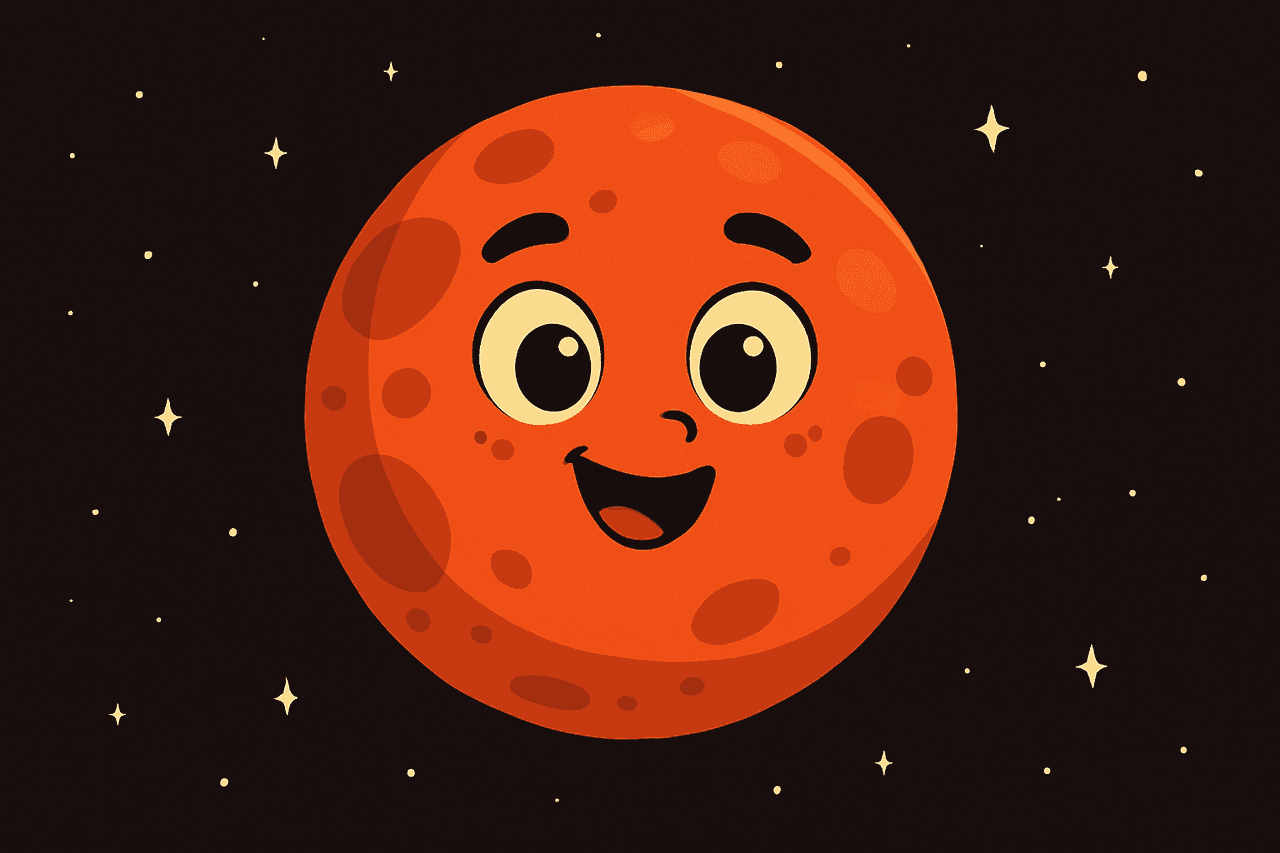
Mars is a planet about half the size of Earth. Its surface contains abundant iron. Over time, this iron rusts, giving Mars its famous red appearance. For this reason, it is called the “Red Planet”.

Mars (generated by artificial intelligence)
🏞️ Features on Mars’ Surface
- Mars has mountains, canyons, and ancient riverbeds.
- The tallest mountain, Olympus Mons, is 2.5 times higher than Earth’s Mount Everest!
- The longest canyon, Valles Marineris, is exactly 4,800 kilometers long.
- Ice composed of carbon dioxide and water is found in the polar regions.
🌬️ What Is Mars’ Atmosphere Like?
Mars has a very thin atmosphere, mostly composed of carbon dioxide.
- 95% Carbon dioxide
- 2.6% Nitrogen
- 1.9% Argon
Temperature variations are extreme: daytime temperatures can reach +20 ºC, while nighttime temperatures can drop to -150 ºC. Mars’ sky usually appears reddish, but at sunset, the Sun can appear bluish!

Mars and Earth (generated by artificial intelligence)
💧 Is There Water on Mars?
Scientists believe that lakes and rivers once existed on Mars.
- Water can be found on the surface in the form of ice.
- Polar ice caps expand and contract with the seasons.
🕓 How Does Time Pass on Mars?
A day on Mars is called a “sol”.
- One sol = 24 hours and 40 minutes
- One year = 687 Earth days
- Mars experiences four seasons, each lasting approximately six months.
🔭 Backward Motion in the Sky: Retrograde Motion
Sometimes Mars appears to move backward in the sky. This phenomenon is called retrograde motion. In reality, Mars does not change its direction of motion; the illusion is caused by Earth moving faster than Mars in its orbit.

Planets (generated by artificial intelligence)
🌍 Mars’ Internal Structure
Scientists are working to understand Mars’ interior:
- Crust: approximately 20–30 kilometers thick
- Mantle: approximately 1,500 kilometers thick
- Core: approximately 1,650 kilometers in diameter and composed of iron and nickel.
⚡ Mars’ Magnetic Field and Atmospheric Loss
- Mars lacks a strong magnetic field.
- As a result, particles from the Sun gradually strip away its atmosphere.
- Lighter gases, such as hydrogen, are especially prone to escaping into space.