


This article was automatically translated from the original Turkish version.
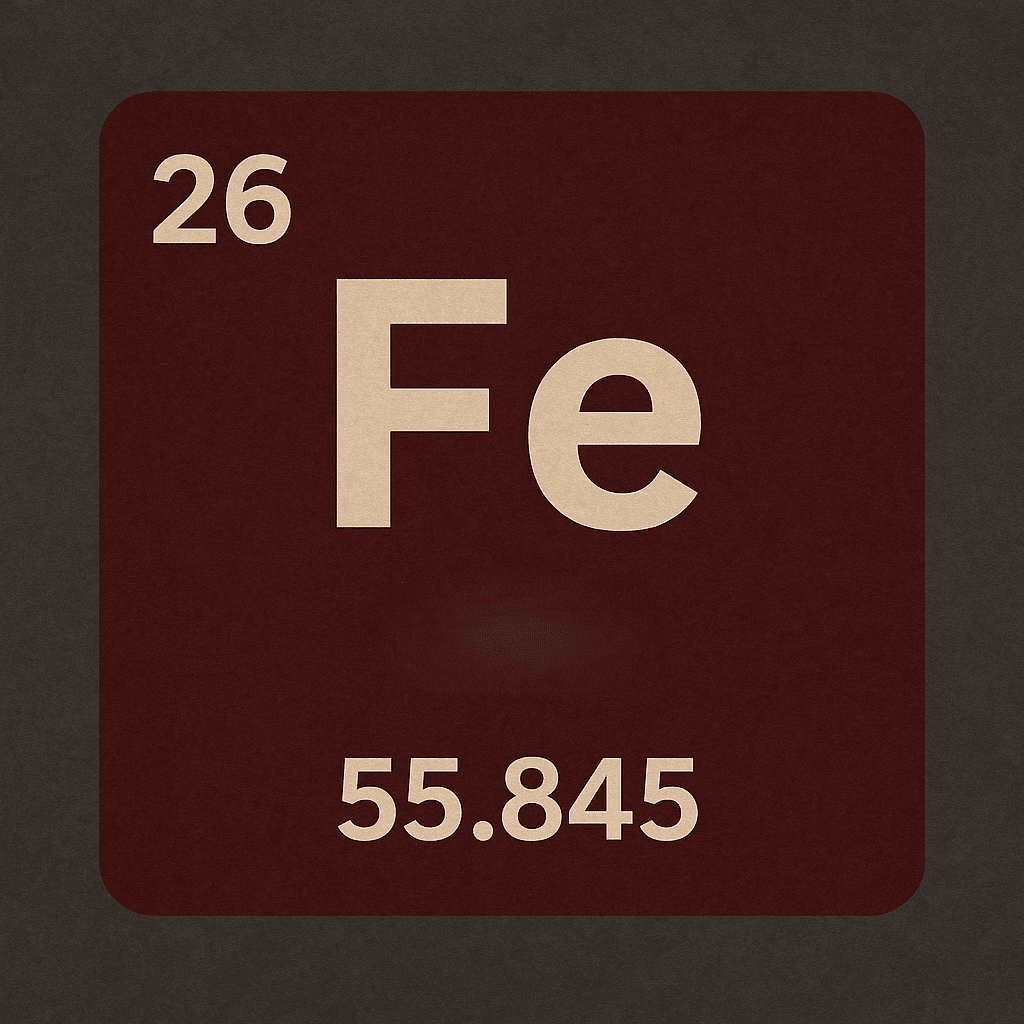
Iron (Fe) (Generated by Artificial Intelligence.)
Group / Period | Group 8 / Period 4 | ||||||||
|---|---|---|---|---|---|---|---|---|---|
Block | d-block | ||||||||
Element Type | Transition metal | ||||||||
Electron Configuration | [Ar] 3d⁶ 4s² | ||||||||
Melting Point | 1538 °C | ||||||||
Boiling Point | 2862 °C | ||||||||
Electronegativity | 1.83 (Pauling) | ||||||||
Area(s) of Use | Biotechnology Automotive Construction Steel | ||||||||
Iron (Fe) is a transition metal with an atomic number of 26 and is located in group 8 of the periodic table. Iron, one of the most abundant metals in the Earth’s crust, plays a fundamental role in both industrial and biological systems. Throughout history, iron has been an indispensable material for humanity and has acquired a wide range of applications through its alloys, compounds, and biological functions. With an electron configuration of [Ar] 3d⁶ 4s², iron exhibits chemical versatility through common oxidation states such as +2 and +3.
The discovery of iron dates back to prehistoric times. Archaeological evidence indicates that iron was processed in Mesopotamia and Egypt as early as 3000 BCE. The earliest uses were typically derived from meteoritic iron. For this reason, iron is recognized as one of the first metals known and worked by humans in its natural state. Historically, iron played a decisive role in the transition from the Bronze Age to the Iron Age.
Iron belongs to the class of transition metals and is a d-block element. It is located in the fourth period of the periodic table. With an atomic number of 26, iron is solid at room temperature and has a silvery-gray appearance. Its electron configuration is [Ar] 3d⁶ 4s². The most common oxidation states are +2 and +3, which enhance the variety of its compounds. Iron is one of the few elements that exhibit magnetic properties, a characteristic that is particularly important in alloys and electronic applications.
The density of iron is 7.87 g/cm³, its melting point is 1538 °C, and its boiling point is 2862 °C. These high temperature values increase its suitability for industrial processes. At room temperature, solid iron readily reacts with oxygen in moist environments to form iron oxide (rust). It also reacts with acids to release hydrogen gas. This reactivity defines both the advantages and disadvantages of iron.
Iron exhibits different crystal structures depending on temperature. At room temperature, α-iron (ferrite) has a body-centered cubic (BCC) structure and remains stable up to 912 °C. Above this temperature, it transforms into a face-centered cubic (FCC) structure known as γ-iron (austenite). Above 1394 °C, it reverts to a BCC structure as δ-iron. These phase transitions directly influence the mechanical properties and alloy behavior of iron.
The electronegativity of iron is approximately 1.83 on the Pauling scale, indicating a moderate tendency to attract electrons. It readily reacts with oxygen and moisture to form iron oxides, a process that constitutes the fundamental mechanism of corrosion. Iron reacts with acidic solutions to release hydrogen gas and thus plays an active role in reduction-oxidation reactions.
Naturally occurring iron has four stable isotopes: Fe-54, Fe-56, Fe-57, and Fe-58. Among these, Fe-56 is the most abundant, accounting for approximately 91.8 percent. The Fe-57 isotope is used in nuclear analytical techniques such as Mössbauer spectroscopy. The stability of these isotopes reflects the balanced nuclear structure of iron and underscores its significance in nuclear astrophysics.
Iron is the fourth most abundant element in the Earth’s crust. It is commonly found in oxide minerals. The most common iron ores include hematite (Fe₂O₃), magnetite (Fe₃O₄), siderite (FeCO₃), and limonite (FeO(OH)·nH₂O). These minerals are exploited as iron ores. Common iron compounds include iron(II) sulfate (FeSO₄), iron(III) chloride (FeCl₃), and iron(III) oxide (Fe₂O₃), all of which serve important functions in both industrial and biological systems.
Iron reacts with oxygen in moist environments to form iron oxides, a process known as corrosion, which significantly reduces the durability of structural materials. The most common corrosion product is iron(III) oxide (Fe₂O₃), which has a reddish-brown color. Magnetite (Fe₃O₄), which contains both iron(II) and iron(III) ions, exhibits magnetic properties. To prevent corrosion, alloys such as stainless steel have been developed.
Iron is essential for living organisms. It plays a critical role in oxygen transport through proteins such as hemoglobin and myoglobin. Through cytochromes, it acts as an electron carrier in cellular respiration. Iron deficiency can lead to health issues such as anemia. In plants, it participates in chlorophyll synthesis and enzymatic activities. The bioavailability of iron varies depending on its chemical form and the physiological condition of the organism.
Iron supplements are used to treat iron deficiency. The most commonly used form is iron(II) sulfate (FeSO₄). These supplements are recommended in conditions such as pregnancy, childhood, and iron-deficiency anemia. However, excessive iron intake can lead to toxic effects. Iron accumulation can cause damage to organs such as the liver and heart. Therefore, iron supplements must be used under medical supervision and in controlled doses.

Applications of the Iron Element (Generated by Artificial Intelligence.)
Iron is one of the most widely used metals in industry. Its primary applications include steel production, the construction sector, the automotive industry, and mechanical engineering. Steel, produced by alloying iron with carbon, offers a durable and moldable material. Iron compounds are used in the chemical industry as catalysts and reagents. In medicine and biotechnology, applications include iron supplements and magnetic nanoparticles.
National Center for Biotechnology Information. "Iron Compound." *PubChem*. Accessed August 16, 2025. https://pubchem.ncbi.nlm.nih.gov/compound/iron
National Center for Biotechnology Information. “Iron Element.” PubChem. Accessed August 16, 2025. https://pubchem.ncbi.nlm.nih.gov/element/Iron
TÜBİTAK Bilim Genç. "Demir." *Bilim Genç.* Accessed August 16, 2025. https://bilimgenc.tubitak.gov.tr/periyodik-tablo/demir
Yuanyuan Chen, Na Huang, Yingying Li, Yin Lu, Yilan Jiang, Zeng Zhou, and Dawei Wang. “Physical and chemical processes driven by natural iron minerals in aquatic environments.” *Water Cycle* 6 (2025): 36–48. Accessed August 16, 2025. https://www.sciencedirect.com/science/article/pii/S2666445324000321
İnce, Ceren, and Özlem Çağındı. “Demir Minerali: Fonksiyonları, Gıda İşlemenin Biyoyararlılığı Üzerine Etkileri ve Biyoaktif Bileşenler ile İnteraksiyonları.” *Çukurova Tarım ve Gıda Bilimleri Dergisi* 35, no. 2 (2020): 151–164. Accessed August 16, 2025. https://dergipark.org.tr/tr/download/article-file/1306313

Iron (Fe) (Generated by Artificial Intelligence.)
Group / Period | Group 8 / Period 4 | ||||||||
|---|---|---|---|---|---|---|---|---|---|
Block | d-block | ||||||||
Element Type | Transition metal | ||||||||
Electron Configuration | [Ar] 3d⁶ 4s² | ||||||||
Melting Point | 1538 °C | ||||||||
Boiling Point | 2862 °C | ||||||||
Electronegativity | 1.83 (Pauling) | ||||||||
Area(s) of Use | Biotechnology Automotive Construction Steel | ||||||||
Discovery
Classification and Fundamental Properties
Physical and Chemical Properties
Crystal Structure and Phase Transitions
Electronegativity and Reactivity
Isotopes
Natural Occurrence and Compounds
Iron Oxides and Corrosion
Biological Role and Importance to Living Organisms
Iron Supplements and Toxicity
Applications