



Saturn
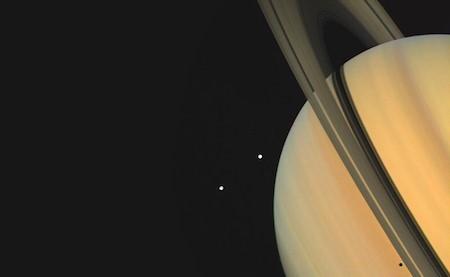
Saturn is the sixth planet from the Sun. By size, it is the second largest planet in the Solar System. It is composed mostly of gases and has no solid surface.

Saturn (Generated by Artificial Intelligence.)
Rings
Saturn is known for its rings. These rings are made of ice, dust, and rock fragments. There are seven main rings, designated as the A, B, C, D, E, F, and G rings. The gap between the A and B rings is called the Cassini Division. The rings are extremely wide but have a very thin structure.
Moons
Saturn has 274 moons. The most well-known are Titan and Enceladus. Titan has a thick atmosphere, while Enceladus may harbor an ocean beneath its icy surface. These moons are among the locations considered potential candidates for life.
Structure and Atmosphere
Saturn is composed mostly of hydrogen and helium gases. Powerful winds blow across its surface. A hexagonal weather pattern exists at its north pole. It is believed that deep inside the planet lies a large core made of rock and iron.
Size
Saturn’s diameter is nine times that of Earth. It could hold 763 Earths within its volume. However, its density is very low. It is so light that it would float in water.

Saturn in a Giant Bathtub (Generated by Artificial Intelligence.)
Orbit and Day Length
Saturn completes one orbit around the Sun in 29.4 Earth years. It rotates on its axis in 10 hours and 42 minutes. Therefore, a day on Saturn is very short.
How Can We Observe Saturn?
Saturn can be easily located in the night sky using a telescope. Even small telescopes can reveal its rings.

Children Observing Saturn Through a Telescope (Generated by Artificial Intelligence.)