This article was automatically translated from the original Turkish version.
+1 More
Alternative Names | Saturn VI | ||||||||
|---|---|---|---|---|---|---|---|---|---|
Planet | Saturn | ||||||||
Radius | 2,574.7 km | ||||||||
Gravity | 1,352 m/s² | ||||||||
Orbital Period | 6 | ||||||||
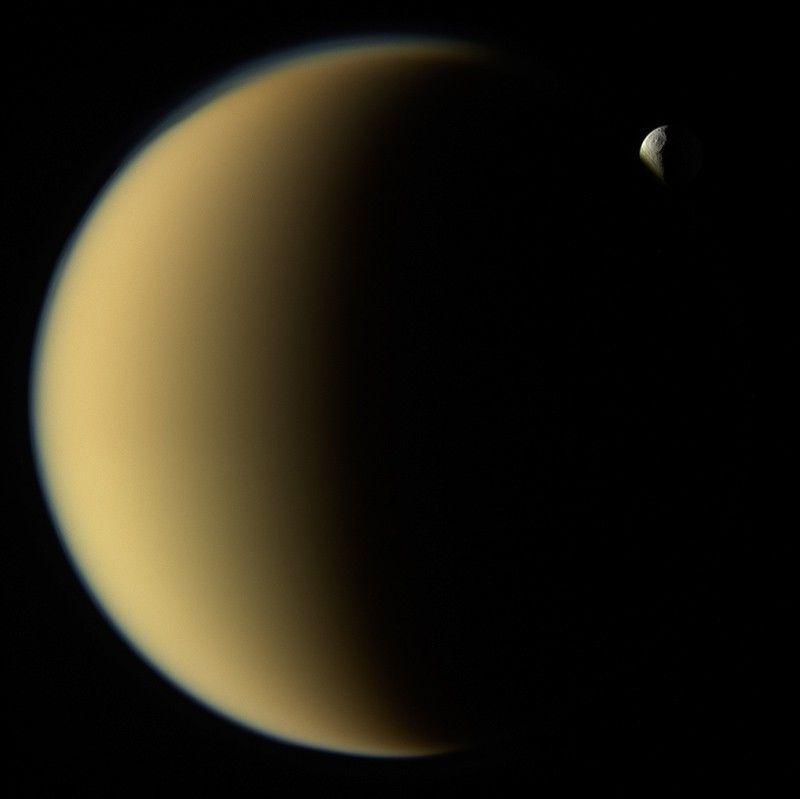
Titan, the largest moon of Saturn, is the only known celestial body in the Solar System besides the planets to possess a dense atmosphere. Roughly the size of the planet Mercury, Titan is considered the most Earth-like moon in the Solar System due to its complex geology, an active methane cycle, and even liquid methane lakes on its surface. These characteristics have made it a crucial research target both for assessing its astrobiological potential and for understanding the conditions of the early Solar System.
Titan's atmosphere is composed primarily of nitrogen (95%) and methane (5%), with trace amounts of ethane and other hydrocarbons. This dense atmosphere creates a greenhouse effect that maintains surface temperatures at approximately -179 °C. Atmospheric pressure is about 1.5 times that of Earth at sea level. This thick atmosphere hosts complex photochemical processes in which ultraviolet radiation breaks down methane, leading to the formation of more complex hydrocarbon aerosols. These aerosols form a haze layer in the upper atmosphere that prevents direct observation of the surface. Data from the Cassini spacecraft have revealed that Titan's atmosphere exhibits seasonal variations and that methane rainfall occurs at different latitudes depending on the season.

Titan Surface Images from the Cassini Spacecraft (NASA)
One of Titan's most striking features is its methane cycle, analogous to Earth's water cycle. Liquid methane and ethane lakes, rivers, and seas on the surface interact continuously with methane evaporation, cloud formation, and precipitation as rain. Radar observations have revealed large liquid hydrocarbon seas such as Kraken Mare, Ligeia Mare, and Punga Mare in Titan's north polar region. This cycle plays a key role in shaping Titan's surface features and erosion processes. For example, radar images from Cassini have shown complex drainage networks resembling river deltas on Earth.
Titan's surface has been observed through radar and infrared spectrometry and is known to host a variety of geological features. Ice sheets, dunes, mountain ranges, craters, and cryovolcanic structures stand out on its surface. Dunes, particularly widespread in Titan's equatorial regions, are composed of large grains of hydrocarbon sand formed by atmospheric winds. These dunes, like desert dunes on Earth, indicate prevailing wind directions. Cryovolcanism may be a significant geological process on Titan, in which volatile substances such as water-ammonia mixtures are erupted onto the surface. Such structures provide clues about Titan's internal dynamics and surface renewal mechanisms.

Surface Cross-Sections of Titan (NASA)
Gravity field measurements and Cassini data suggest that Titan may harbor a global subsurface ocean of liquid water beneath an icy crust. The existence of this ocean has been inferred from small variations in Titan's rotation caused by tidal forces deforming the icy shell. This ocean is a significant target in the search for extraterrestrial life, as liquid water is a fundamental requirement for life as we know it. Models propose that this ocean may contain antifreeze compounds such as ammonia or methane, allowing it to remain liquid despite the frigid temperatures.
Titan is a major target in astrobiology because it may possess the conditions necessary for the synthesis of complex organic molecules essential for the emergence of life. Surface liquid hydrocarbons and the potential subsurface water ocean offer environments where different forms of life could potentially exist. NASA's Dragonfly mission, a rotorcraft vehicle planned for launch in 2027 and arrival at Titan in 2034, will fly between different surface regions to conduct detailed investigations of surface composition, geology, and atmospheric conditions. This mission will provide critical data on Titan's astrobiological potential and search for possible signs of life.
Baland, Rose-Marie, Gabriel Tobie, Axel Lefèvre, and Tim Van Hoolst. ‘Titan’s Internal Structure Inferred from Its Gravity Field, Shape, and Rotation State’. *Icarus* 237 (July 2014): 29–41. Accessed July 7, 2025. https://doi.org/10.1016/j.icarus.2014.04.007.
Fortes, A.D. “Titan’s Internal Structure and the Evolutionary Consequences.” *Planetary and Space Science* 60, no. 1 (January 2012): 10–17. Accessed July 7, 2025. https://doi.org/10.1016/j.pss.2011.04.010.
Hayes, Alexander G. “The Lakes and Seas of Titan.” *Annual Review of Earth and Planetary Sciences* 44, no. 1 (2016): 57–83. Accessed July 7, 2025. https://doi.org/10.1146/annurev-earth-060115-012247.
Mitchell, Jonathan L., and Juan M. Lora. ‘The Climate of Titan’. *Annual Review of Earth and Planetary Sciences* 44, no. 1 (2016): 353–80. https://doi.org/10.1146/annurev-earth-060115-012428.
NASA. "PIA08119." Accessed July 16, 2025. https://science.nasa.gov/image-detail/amf-8edf0b53-f1ed-4737-8f29-47a0f5a0466d/
NASA. "PIA14948-800w." Accessed July 16, 2025. https://science.nasa.gov/image-detail/amf-9ddac0c9-edd7-460d-89f9-e1335d4b8eee/
NASA. "PIA21923_CassiniVIMSTitan_MAIN-1200w - NASA Science." July 7, 2025. https://science.nasa.gov/image-detail/amf-7c2a49e6-2a2d-4cac-ba34-9cdf257db3ec/.
Plainaki, Christina, Stefano Massetti, Xianzhe Jia, Alessandro Mura, Anna Milillo, Davide Grassi, Giuseppe Sindoni, Emiliano D’Aversa, and Gianrico Filacchione. “Kinetic Simulations of the Jovian Energetic Ion Circulation around Ganymede.” *The Astrophysical Journal* 900, no. 1 (September 1, 2020): 74. Accessed July 7, 2025. https://doi.org/10.3847/1538-4357/aba94c.
Radebaugh, Jani. “Dunes on Saturn’s Moon Titan as Revealed by the Cassini Mission.” *Aeolian Research* 11 (December 2013): 23–41. Accessed July 7, 2025. https://doi.org/10.1016/j.aeolia.2013.07.001.
Wang, Dun, Hitoshi Kawakatsu, Jiancang Zhuang, Jim Mori, Takuto Maeda, Hiroshi Tsuruoka, and Xu Zhao. “Automated Determination of Magnitude and Source Length of Large Earthquakes Using Backprojection and P Wave Amplitudes.” *Geophysical Research Letters* 44, no. 11 (June 16, 2017): 5447–56. Accessed July 7, 2025. https://doi.org/10.1002/2017GL073801.
Zebker, Howard A., Bryan Stiles, Scott Hensley, Ralph Lorenz, Randolph L. Kirk, and Jonathan Lunine. ‘Size and Shape of Saturn’s Moon Titan’. *Science* 324, no. 5929 (May 15, 2009): 921–23. Accessed July 7, 2025. https://doi.org/10.1126/science.1168905.

Alternative Names | Saturn VI | ||||||||
|---|---|---|---|---|---|---|---|---|---|
Planet | Saturn | ||||||||
Radius | 2,574.7 km | ||||||||
Gravity | 1,352 m/s² | ||||||||
Orbital Period | 6 | ||||||||
Atmosphere and Surface Conditions
Methane Cycle
Surface Geology
Internal Structure and Potential Ocean
Future Missions and Astrobiological Significance