



Mercury
Are you ready to discover the planet closest to the Sun? Tiny yet incredibly mysterious, Mercury holds some of space’s hottest secrets. Let’s embark on a journey into the depths of space to explore this small and swift planet!
When Can You See Mercury?
Because Mercury is so close to the Sun, it always appears near the Sun in the sky. Therefore, we cannot see it during the day. However, for a brief moment just after sunset or just before sunrise, it can be spotted as a small point of light along the horizon. This means the best times to observe Mercury are in the very early hours of the morning or immediately after the Sun has set in the evening.
The Size of Mercury
Mercury is the smallest planet in the Solar System. It is so small that it is only about one-third the size of Earth! In fact, it is only slightly larger than our own Moon. Despite its small size, Mercury is very dense and its interior is almost entirely composed of metals. This makes it unique and fascinating.

Mercury (NASA)
Is There Ice on Mercury?
It may be hard to believe, but yes! Ice has been found in certain regions of Mercury, the planet closest to the Sun. This ice is located in the shadowed craters at the planet’s poles, where sunlight never reaches and temperatures remain extremely low. Scientists are studying these icy regions to gather information about the planet’s history.
What Does Mercury’s Surface Look Like?
Mercury’s surface resembles that of the Moon. It is covered with craters, cracks, and mountain ridges. These craters were formed over millions of years by meteorites striking the planet. The surface also features long, winding elevated ridges called “wrinkle ridges.” These structures formed as the planet cooled and shrank over time. In addition, the surface is rich in dust and rock.
A “Metal” Planet?
Yes, a large portion of Mercury’s interior is composed of metal. In particular, its iron core is exceptionally large and makes up a significant fraction of the planet’s total volume. For this reason, Mercury is sometimes called a “metal planet”. Its surface also consists of a mixture of rock and metal. This gives Mercury a distinctive position among the rocky planets like Earth.

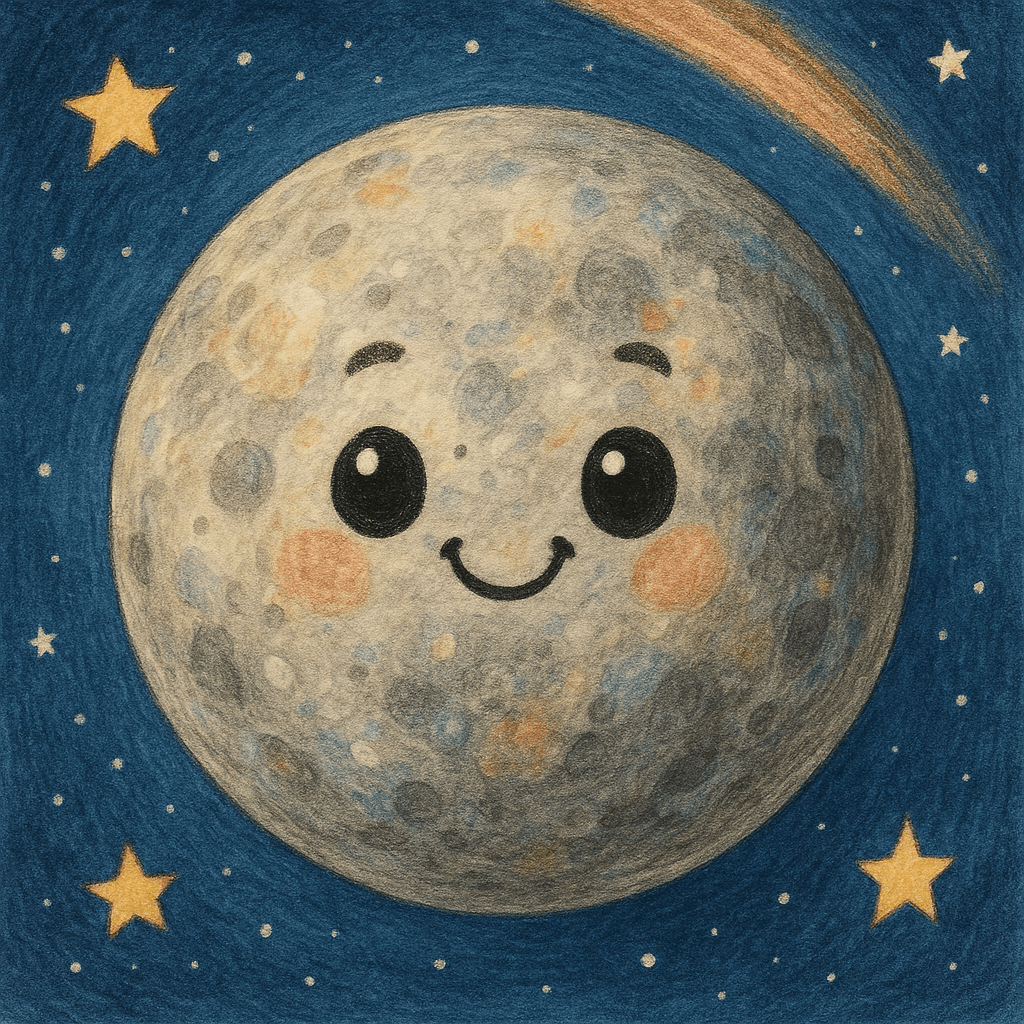
Mercury (Generated by Artificial Intelligence.)