


This article was automatically translated from the original Turkish version.

Mercury
Type(s) | Terrestrial Planet | ||||||||
|---|---|---|---|---|---|---|---|---|---|
Distance from the Sun | 0.39 AU (~58 million km) | ||||||||
Orbital Period | 88 Earth days | ||||||||
Rotation Period | 59 Earth days | ||||||||
Number of Satellites | 0 | ||||||||
Sun system's closest to the Sun and least massive planet, Mercury, constitutes a unique subject of study in orbital and physical characteristics within the fields of astronomy and planet science.
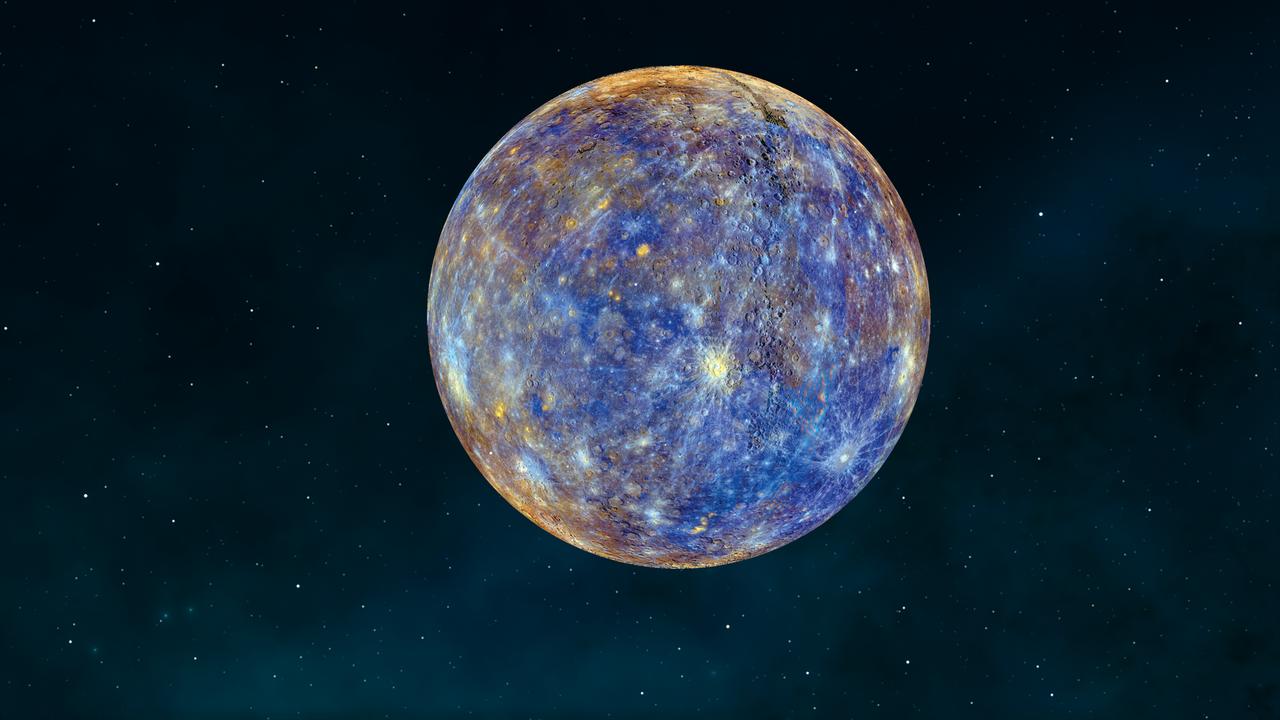
Mercury orbits the Sun at an average distance of 0.39 astronomical units (AU) 【1】. Its orbital period is approximately 88 World days, indicating a relatively rapid orbital motion compared to other planets in the Solar System. However, Mercury's rotation around its own axis is comparatively slow. The planet's synodic rotation period【2】
Moon. This suggests that the planet experienced intense meteorite bombardment during its early history and has had relatively low geological activity since. Dominant surface features include impact craters of various sizes, crater basins, and plains. The Caloris Basin, with a diameter of approximately 1550 kilometers, is Mercury's largest impact structure; its formation triggered significant tectonic effects across the planet's surface. Variations in crater density between regions imply that the surface has different ages and that some areas have been reshaped by volcanic like processes. Data from the MESSENGER spacecraft have revealed the presence of extensive volcanic plains on Mercury's surface and demonstrated that this volcanism played a key role in the planet's thermal evolution.
Mercury's high density (approximately 5.4 g/cm³) indicates a proportionally large metallic core compared to other terrestrial planets in the Solar System. Although seismic data have not been obtained, models derived from parameters such as mass and moment of inertia suggest that the core constitutes a significant fraction of the planet's total mass and extends up to approximately 85% of its radius. Part of this large core may be liquid, which could explain Mercury's weak but distinct magnetic field. This field, about 1% the strength of Earth's, partially shields the planet from the effects of the solar wind and is linked to convective motions within the core under the dynamo theory.
Mercury does not possess a dense atmosphere like Earth or Venus. Instead, it has a tenuous layer of gas known as an exosphere. This exosphere consists of atoms released from the surface or scattered into space by solar wind and micrometeoroid impacts. Its primary components include sodium (Na), potassium (K), calcium (Ca), and magnesium (Mg). The MESSENGER mission showed that the exosphere has a dynamic structure and that its composition and density vary with solar activity. Furthermore, spectroscopic observations have confirmed the presence of water ice and some volatile organic compounds in permanently shadowed craters at Mercury's polar regions. This discovery offers important implications for understanding the planet's evolution and the distribution of water in the Solar System.
Mercury is a member of the Solar System characterized by its proximity to the Sun, slow rotation, cratered surface, proportionally large metallic core, and thin exosphere. Data from Past and ongoing space missions have provided significant insights into the planet's geological history, internal structure, and the presence of volatiles on its surface. However, many questions remain unanswered, including the origin of Mercury's magnetic field, the precise structure of its core, and the dynamics of its exosphere. Future planetary science research will continue to deepen our understanding of Mercury's formation and evolution.
Anderson, J. D., et al. (1988). Mercury's mass and density. Icarus, 73(3), 431-443.
Byrne, C. J., et al. (2016). Evidence for widespread effusive volcanism on Mercury. Nature Geoscience, 9(6), 441-448.
Christensen, U. R., et al. (2009). A numerical dynamo model for Mercury's magnetic field. Nature, 457(7226), 167-170.
Hunten, D. M., et al. (1988). The atmosphere of Mercury. In Mercury (pp. 562-620). University of Arizona Press.
Lawrence, D. J., et al. (2013). Evidence for water ice near Mercury's north pole from MESSENGER neutron spectrometer measurements. Science, 339(6117), 1292-296.
McClintock, W. E., et al. (2009). MESSENGER observations of Mercury's exosphere: Detection of magnesium and a highly variable sodium component. Science, 324(5927), 610-613.
Williams, D. R. (2018). Mercury Fact Sheet. NASA/National Space Science Data Center. Accessed April 10, 2025. https://nssdc.gsfc.nasa.gov/planetary/factsheet/mercuryfact.html
[1]
Williams, 2018
[2]
The time between one sunrise and the next is 【2】 is about 176 Earth days. This results in day-night cycles on Mercury

Mercury
Type(s) | Terrestrial Planet | ||||||||
|---|---|---|---|---|---|---|---|---|---|
Distance from the Sun | 0.39 AU (~58 million km) | ||||||||
Orbital Period | 88 Earth days | ||||||||
Rotation Period | 59 Earth days | ||||||||
Number of Satellites | 0 | ||||||||
Orbital and Rotational Characteristics
Internal Structure and Magnetic Field
Atmosphere (Exosphere)
Conclusion