


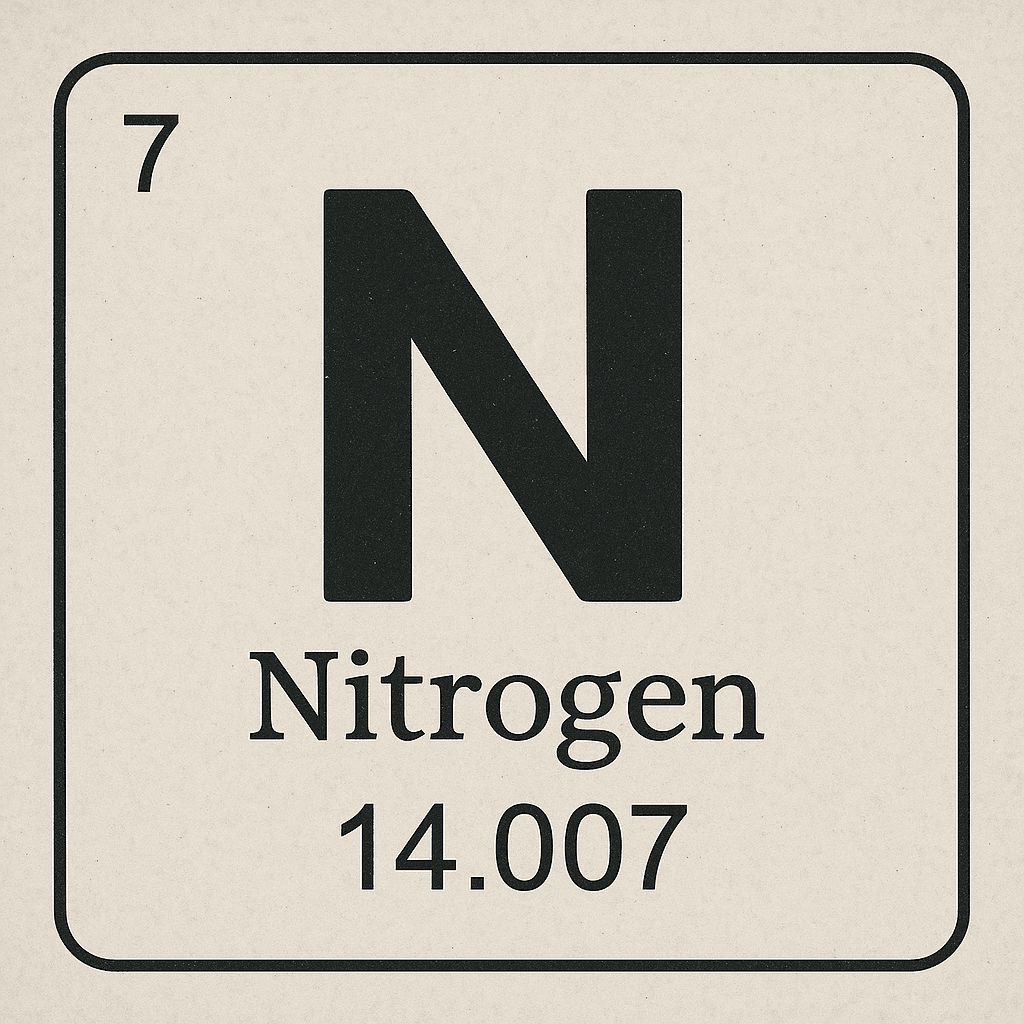
Nitrogen (N)
(Generated by Artificial Intelligence)
Atomic Mass | 14.00674 g/mol | ||||||||
|---|---|---|---|---|---|---|---|---|---|
Periodic Table Group/ Period | Group 15 (5A) / 2 | ||||||||
Element Classification | Nonmetal | ||||||||
Physical State (At 25 °C) | Gas | ||||||||
Electron Configuration | 1s² 2s² 2p³ | ||||||||
Electronegativity | 3.04 | ||||||||
Melting Point | –210 °C | ||||||||
Boiling Point | –195.8 °C | ||||||||
Isotopes | ¹⁵N (0.37%) ¹⁴N (99.63%) | ||||||||
Discovery(ies) | 1772 Daniel Rutherford | ||||||||
Applications | Electronics Industries Pharmaceutical Providing İnert Atmospheres in Food Cryogenic Applications Using Liquid Nitrogen Production of Fertilizers and Ammonia | ||||||||
Nitrogen, also known as dinitrogen, is a nonmetallic element in Group 15 of the periodic table, with an atomic number of 7. Its atomic mass is approximately 14.00674 g/mol. Under standard conditions, nitrogen exists as a diatomic gas (N₂) that is colorless, odorless, and tasteless. It constitutes about 78% of the Earth’s atmosphere by volume. Nitrogen is an essential component of fundamental biomolecules such as DNA, RNA, and proteins, playing a critical role in the structure and function of living organisms.
Nitrogen was discovered in 1772 by the Scottish chemist Daniel Rutherford. Through his experiments, Rutherford observed that a certain component of air neither supported combustion nor sustained animal life. He identified this substance as distinct from other atmospheric constituents, laying the groundwork for the recognition and characterization of nitrogen.
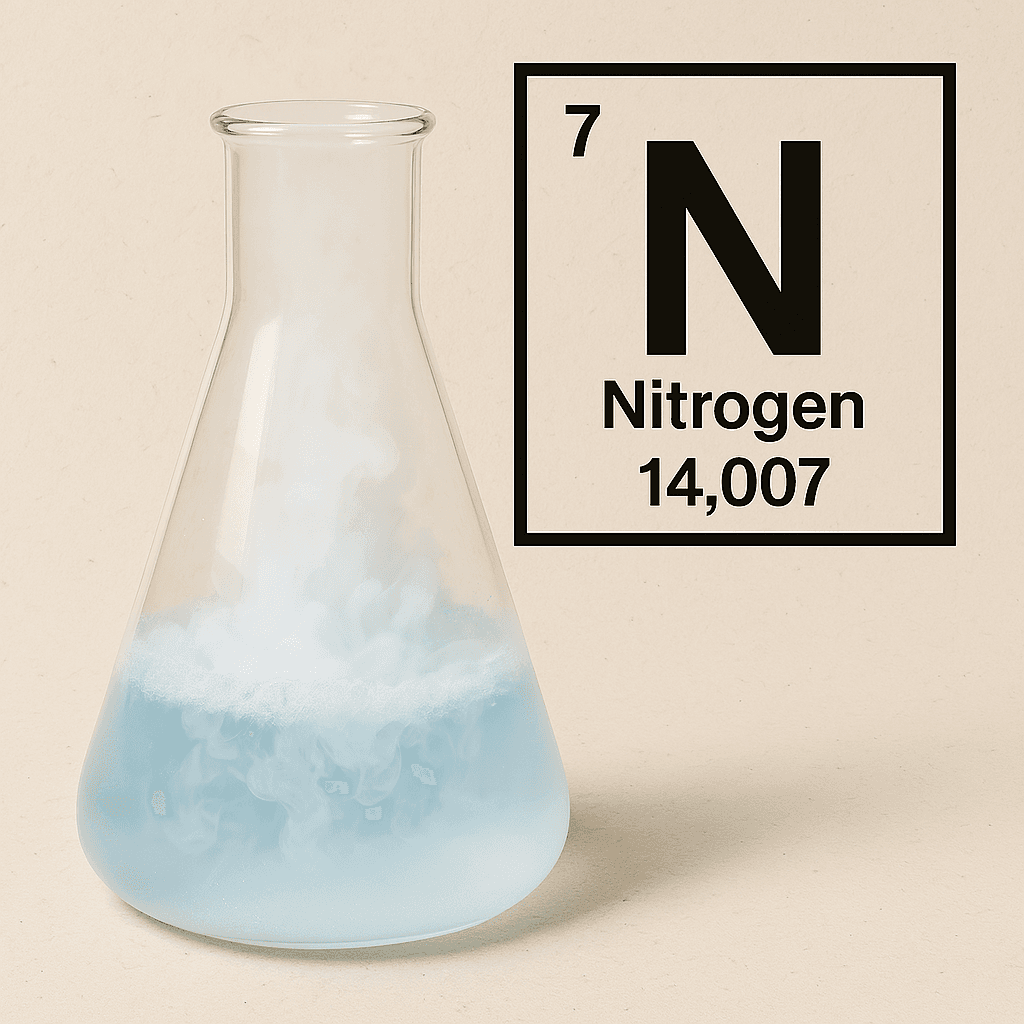
Nitrogen (Generated by Artificial Intelligence)
Nitrogen has the electron configuration 1s² 2s² 2p³. Under standard conditions, it exists as a diatomic gas (N₂) that is colorless, odorless, and tasteless. It constitutes approximately 78% of the Earth’s atmosphere by volume. Nitrogen is known for its stable structure and low reactivity. As a fundamental component of vital biomolecules, including DNA, RNA, and proteins, it plays a crucial role at both the biospheric and atmospheric levels.
The term azot derives from the Greek words a (absence) and zoe (life), reflecting the element’s inability to sustain life. The English word nitrogen originates from the French term nitrogène, which itself is derived from niter (potassium nitrate) and gène (producer), referring to its association with nitrate compounds.
The nitrogen molecule (N₂) is highly stable due to the presence of a triple covalent bond between the two nitrogen atoms. This bond is among the strongest chemical bonds found in nature in terms of bond energy. Nitrogen has a melting point of –210 °C and a boiling point of –195.8 °C. Its electronegativity is 3.04, enabling it to react with hydrogen, oxygen, and certain metals to form a variety of compounds. Notable nitrogen compounds include ammonia (NH₃), nitrogen oxides (NO, NO₂), nitric acid (HNO₃), and nitrates (NO₃⁻).
When compared to fluorine, nitrogen has a lower electronegativity. On the Pauling scale, fluorine has an electronegativity of 3.98, while nitrogen’s is 3.04. Fluorine tends to form compounds with single bonds, whereas nitrogen frequently forms multiple bonds, particularly triple bonds. This bonding characteristic accounts for the stability and inert nature of diatomic nitrogen (N₂). However, under suitable conditions, nitrogen can form highly reactive compounds.
Naturally occurring nitrogen consists of two stable isotopes: ¹⁴N (99.63%) and ¹⁵N (0.37%). These isotopes are utilized in biological research for tracing and analytical purposes. In particular, the isotope ¹⁵N is employed in isotopic labeling to investigate the activity of microorganisms involved in the nitrogen cycle. Additionally, nitrogen flux within the plant-food chain can be monitored using this method.
In nature, nitrogen is predominantly present in the atmosphere in its molecular form (N₂). It is also found in soil and water as inorganic forms such as ammonia, nitrites, and nitrates, as well as within organisms as proteins and nucleic acids. Compounds such as ammonia (NH₃), nitric acid (HNO₃), nitrous oxide (N₂O), and nitrogen dioxide (NO₂) are of significant environmental and biological importance. Soil nitrogen compounds are widely used as agricultural fertilizers, which influence various ecological processes.
The nitrogen cycle is a complex and dynamic process that regulates the circulation of nitrogen between the atmosphere, soil, water, and living organisms. It ensures the availability of nitrogen reserves in forms usable by organisms and maintains ecosystem productivity. Atmospheric nitrogen gas (N₂), which constitutes 78.8% of the atmosphere by volume, represents the largest nitrogen reservoir in nature. However, in its gaseous form, nitrogen cannot be directly assimilated by plants or most organisms.
The conversion of free nitrogen gas (N₂) into forms usable by plants is known as nitrogen fixation, which occurs via two principal pathways:
Organic nitrogen compounds (proteins, nucleic acids) are decomposed by heterotrophic microorganisms into ammonia (NH₃) or ammonium ions (NH₄⁺). This process, known as ammonification, converts organic matter into mineral nitrogen forms. Microorganisms involved include Bacillus, Clostridium, Arthrobacter species, as well as fungi such as Aspergillus and Penicillium.
Nitrification is the two-step oxidation of ammonium ions, first into nitrites (NO₂⁻) and subsequently into nitrates (NO₃⁻). In this process:
Nitrification typically occurs in well-aerated, moist soils with a near-neutral pH.
In anaerobic conditions, denitrifying bacteria (such as Pseudomonas and Paracoccus) convert soil nitrates into nitrogen gas (N₂) or nitrogen oxides (NO, N₂O), which are then released into the atmosphere. This process completes the nitrogen cycle by replenishing atmospheric nitrogen reserves.

Nitrogen Cycle (Generated by Artificial Intelligence)
The environmental effects of nitrogen primarily arise from the excessive and uncontrolled use of agricultural fertilizers. Elevated nitrate accumulation in groundwater reduces drinking water quality. Additionally, nitrogen oxide compounds (NO, NO₂) contribute to the greenhouse effect and acid rain formation in the atmosphere. Nitrous oxide (N₂O) is recognized as the second most potent greenhouse gas after carbon dioxide. Therefore, nitrogen-related pollution is significant for both ecological systems and climatic processes.
Industrial uses of nitrogen predominantly involve liquid nitrogen in cryogenic freezing, metal processing, food preservation, pharmaceutical manufacturing, and providing an inert atmosphere in electronics production. Nitrogen is also widely employed in the production of fertilizers, plastics, paints, and explosives through ammonia synthesis. Furthermore, in medicine, liquid nitrogen is utilized for tissue freezing and cryotherapy applications.
Nitrogen is an element of vital biological importance. It constitutes the structural basis of fundamental biomolecules such as DNA, RNA, and proteins, thereby facilitating the transmission of genetic information, cellular structure formation, and the execution of metabolic functions. Additionally, nitrogen forms an essential component of amino acids and certain hormones, which are necessary for the growth, development, and reproduction of living organisms. Nitrogen deficiency can lead to developmental disorders in plants and impair protein synthesis in animals.
Haktanır, Koray, and Sevinç Arcak. Nitrogen Cycle. Ankara University Open Course Materials, 2018. Accessed July 17, 2025. https://acikders.ankara.edu.tr/pluginfile.php/81391/mod_resource/content/0/10-11.%20N%20d%C3%B6ng%C3%BCs%C3%BC.pdf.
PubChem. "Nitrogen." National Center for Biotechnology Information. Accessed July 17, 2025. https://pubchem.ncbi.nlm.nih.gov/element/Nitrogen.
Müftüoğlu, N. Mücella, and Tuncay Demirer. "Nitrogen Balance in Soil." Atatürk University Journal of Agricultural Faculty 29, no. 1 (2013): 175–185. Accessed July 17, 2025. https://dergipark.org.tr/tr/pub/ataunizfd/issue/3020/41920.
TÜBİTAK Bilim Genç. "Nitrogen." Bilim Genç. Accessed July 17, 2025. https://bilimgenc.tubitak.gov.tr/periyodik-tablo/azot.

Nitrogen (N)
(Generated by Artificial Intelligence)
Atomic Mass | 14.00674 g/mol | ||||||||
|---|---|---|---|---|---|---|---|---|---|
Periodic Table Group/ Period | Group 15 (5A) / 2 | ||||||||
Element Classification | Nonmetal | ||||||||
Physical State (At 25 °C) | Gas | ||||||||
Electron Configuration | 1s² 2s² 2p³ | ||||||||
Electronegativity | 3.04 | ||||||||
Melting Point | –210 °C | ||||||||
Boiling Point | –195.8 °C | ||||||||
Isotopes | ¹⁵N (0.37%) ¹⁴N (99.63%) | ||||||||
Discovery(ies) | 1772 Daniel Rutherford | ||||||||
Applications | Electronics Industries Pharmaceutical Providing İnert Atmospheres in Food Cryogenic Applications Using Liquid Nitrogen Production of Fertilizers and Ammonia | ||||||||
Discovery
Classification and Fundamental Properties
Etymology
Physical and Chemical Properties
Electronegativity and Reactivity of Nitrogen
Isotopes and Biological Role
Occurrence in Nature and Nitrogen Compounds
Nitrogen Cycle
Nitrogen Fixation
Ammonification
Nitrification
Denitrification
Environmental Impacts of Nitrogen
Applications
Biological Role
This article was created with the support of artificial intelligence.


