


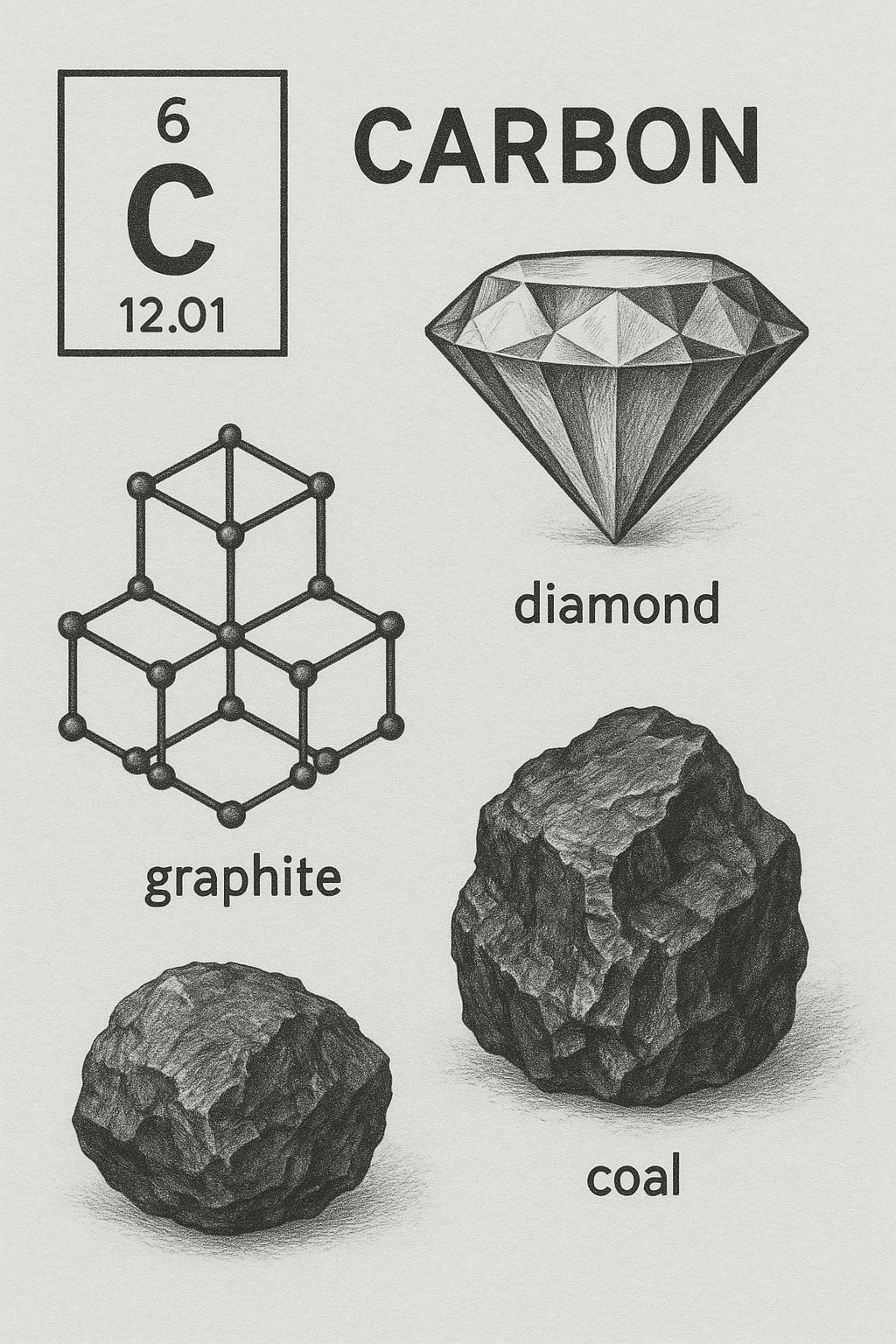
Carbon Element
Fundamental Properties of Carbon | Can form four covalent bonds (through sp sp² sp³ hybridizations) Electron Configuration: 1s² 2s² 2p² Atomic number: 6 | ||||||||
|---|---|---|---|---|---|---|---|---|---|
Main Allotropes | Nanotubes (technological applications) Graphene Nanostructures: Fullerene Amorphous carbon: Lacks a distinct crystalline structure Graphite: Soft conductive layered structure Diamond: Hard three-dimensional crystalline structure | ||||||||
Carbon Cycle | Living organisms and oceans Carbon cycles among the atmosphere Processes: Photosynthesis/ respiration/ combustion/ decomposition | ||||||||
Role in Organic Chemistry | Building block of biomolecules such as proteins/ carbohydrates/ lipids and DNA Fundamental to all organic compounds. | ||||||||
Carbon is an element that occurs in nature in various allotropes and forms the foundation of organic compounds in chemistry. This element, which has a wide range of applications from the building blocks of living organisms to industrial products, also plays a significant role in environmental cycles and energy transformations.

The Element Carbon (Created by Artificial Intelligence)
The carbon atom contains 6 protons and typically 6 neutrons, with an atomic number of 6. Its electron configuration is 1s² 2s² 2p². Due to its four valence electrons, carbon can form four covalent bonds. These bonds allow carbon to adopt various molecular geometries through different types of hybridization (sp, sp², sp³). This characteristic provides the basis for the formation of millions of distinct compounds.
The primary allotropes of carbon found in nature include diamond, graphite, amorphous carbon, and more recently discovered nanostructures such as fullerenes, graphene, and carbon nanotubes.
Carbon continuously cycles among the atmosphere, oceans, terrestrial environments, and living organisms. This cycle occurs through processes such as photosynthesis, respiration, decomposition, and combustion. Atmospheric carbon dioxide is converted into organic molecules by photosynthetic organisms, which are then metabolized by living beings and eventually released back into the atmosphere as carbon dioxide.
Carbon is fundamental to organic chemistry. The bonds formed between carbon atoms and other elements lead to a vast array of structures. Compounds such as hydrocarbons, alcohols, acids, esters, and amino acids are examples of carbon-based organic molecules. These compounds serve as the building blocks for biological macromolecules, including proteins, carbohydrates, lipids, and nucleic acids.
Different allotropes of carbon are utilized across various industrial sectors:
Carbon-based fossil fuels (coal, petroleum, natural gas) remain primary energy sources today. However, the combustion of these fuels increases carbon dioxide emissions, contributing to the greenhouse effect. Consequently, reducing carbon emissions and developing carbon capture technologies are prioritized areas in environmental science.
The use of carbon-based materials in nanotechnology is expanding. Graphene, a two-dimensional material composed of a single layer of carbon atoms, is distinguished by its exceptional electrical conductivity and mechanical strength. Fullerenes and carbon nanotubes are applied in electronics, biomedical fields, and composite material technologies.
The element carbon, with its flexible chemical bonding, allotropic diversity, and role in environmental processes, remains a significant subject of research in both fundamental sciences and applied disciplines. Its presence in natural cycles and industrial applications underscores the multifaceted and continuously evolving nature of carbon-related studies.
Bilim Genç. “Carbon.” TÜBİTAK. https://bilimgenc.tubitak.gov.tr/periyodik-tablo/karbon.
Yılmaz, Bülent. “The Future of the Energy Sector: Carbon Trading.” Kara Harp Okulu Science Journal 29, no. 1 (2019): 65–91. https://dergipark.org.tr/tr/pub/khobilim/issue/46508/584379.
Erik, Nazan Yalçın. “The Effect of Coal Properties on Clean Coal Technologies (Gasification, Liquefaction, Carbon Fiber, and Coke Production): A Review.” UMÜFED International Journal of Western Black Sea Engineering and Science 4, no. 2 (2022): 22–56. https://dergipark.org.tr/en/download/article-file/2089140.

Carbon Element
Fundamental Properties of Carbon | Can form four covalent bonds (through sp sp² sp³ hybridizations) Electron Configuration: 1s² 2s² 2p² Atomic number: 6 | ||||||||
|---|---|---|---|---|---|---|---|---|---|
Main Allotropes | Nanotubes (technological applications) Graphene Nanostructures: Fullerene Amorphous carbon: Lacks a distinct crystalline structure Graphite: Soft conductive layered structure Diamond: Hard three-dimensional crystalline structure | ||||||||
Carbon Cycle | Living organisms and oceans Carbon cycles among the atmosphere Processes: Photosynthesis/ respiration/ combustion/ decomposition | ||||||||
Role in Organic Chemistry | Building block of biomolecules such as proteins/ carbohydrates/ lipids and DNA Fundamental to all organic compounds. | ||||||||
Henüz Tartışma Girilmemiştir
"Carbon Element" maddesi için tartışma başlatın
Atomic Structure and Electron Configuration
Allotropic Forms
Carbon Cycle in Nature
Role in Organic Compounds
Industrial Applications
Role in Energy and Fuel Technologies
Carbon in Modern Materials Science
Bu madde yapay zeka desteği ile üretilmiştir.