


This article was automatically translated from the original Turkish version.
+4 More
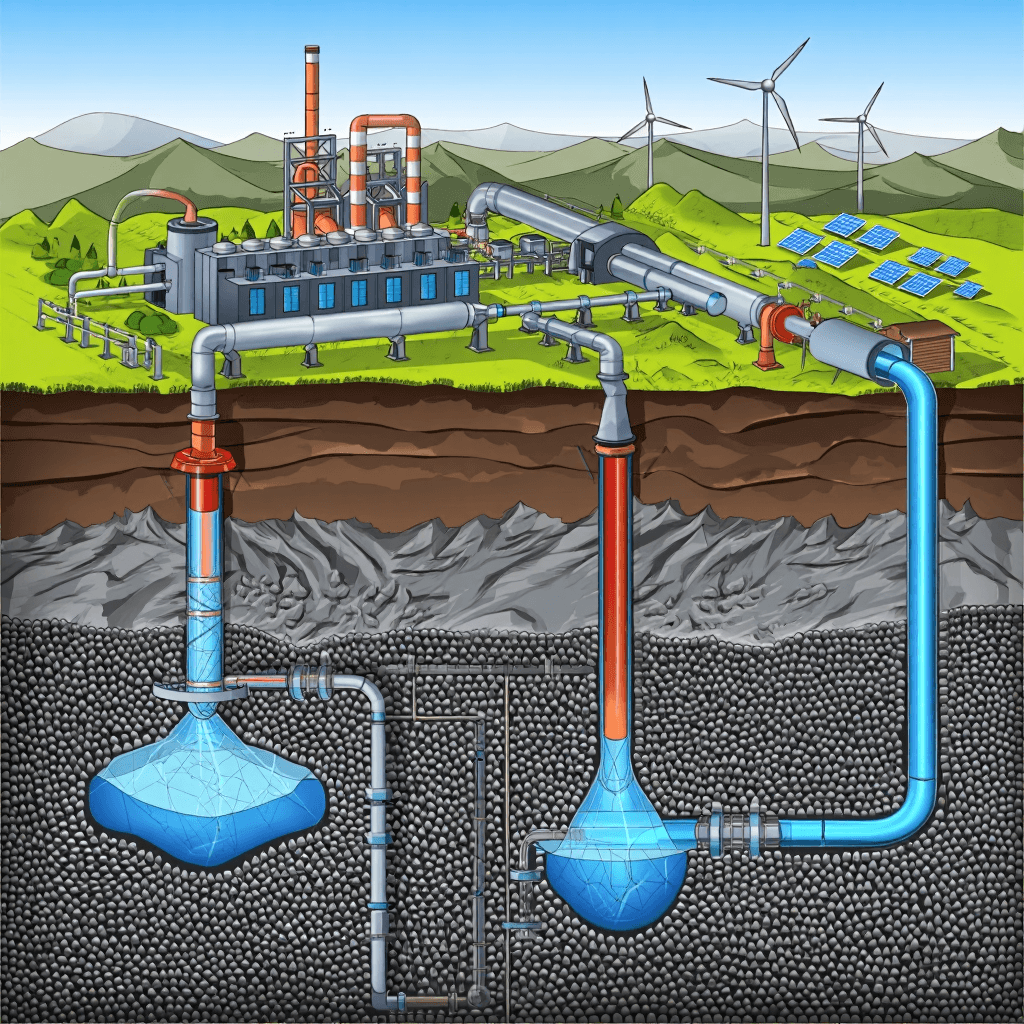
Carbon Capture and Storage (CCS) Representative (Generated by Artificial Intelligence)
Main Objective | Reduce atmospheric CO₂ emissions | ||||||||
|---|---|---|---|---|---|---|---|---|---|
Main Stages | Capture, Transport, Storage | ||||||||
Capture Methods | Pre-combustion, Post-combustion, Oxy-fuel Combustion | ||||||||
Storage Areas | Depleted Oil/Gas Reservoirs, Deep Saline Aquifers, Salt Caverns | ||||||||
Related Technologies | CCU, CCUS, DAC, BECCS | ||||||||
Key Challenges | High Cost, Energy Intensity, Technological Maturity, Storage Security | ||||||||
Historical Use | Enhanced Oil Recovery (EOR) | ||||||||
Carbon Capture and Storage (CCS), a technological framework based on the separation of carbon dioxide (CO₂) emissions from large industrial sources such as energy production facilities, steel, cement, and chemical industries before they reach the atmosphere, followed by their transportation under high pressure and long-term storage in suitable underground geological formations. Its primary objective is to reduce greenhouse gas emissions by lowering atmospheric CO₂ concentrations, thereby limiting the adverse effects of global warming and climate change. CCS is regarded as a transitional solution for reducing carbon emissions in the short and medium term, particularly in countries with high fossil fuel use in energy production, and plays a complementary role during the transition to renewable energy.
The foundations of carbon capture technologies date back to the 1970s. The primary motivation for early applications was not climate change mitigation but economic benefit. During this period, oil crises—particularly the supply shortages and price spikes triggered by the Iranian Islamic Revolution and the Iran-Iraq War—pushed oil companies to adopt methods capable of extracting more production from existing reserves. The captured CO₂ was injected into depleting oil fields using the Enhanced Oil Recovery (EOR) method, increasing reservoir pressure to force oil to the surface. Thus, gas producers generated additional revenue by selling captured CO₂, while oil producers increased output. This approach remained the dominant application of the technology for many years, and it is estimated that approximately 80% to 90% of all CO₂ captured since the 1970s has been used for EOR.
From the 1990s onward, strengthening scientific evidence of global climate change and the entry into force of international agreements such as the United Nations Framework Convention on Climate Change brought to the forefront the potential role of CCS technology in combating the climate crisis. During this period, CO₂ began to be recognized not merely as a commercial resource but also as a strategic climate policy instrument capable of preventing its release into the atmosphere through long-term storage.
Carbon capture technologies are classified according to how the captured CO₂ is used or stored. Each technology involves distinct engineering applications, economic models, and environmental outcomes.
CCS is based on the principle of storing captured CO₂ permanently and without any commercial use in underground geological formations. This process is typically carried out by injecting CO₂ into porous structures such as depleted oil and gas reservoirs, deep saline aquifers, or basalt formations. Storage sites must possess an impermeable cap rock layer to prevent CO₂ from migrating back to the surface. It is reported that CCS accounts for approximately 27% of global carbon capture activities.
In CCU technologies, captured CO₂ is used as an industrial feedstock rather than being stored. This approach encompasses converting CO₂ through various chemical and biological processes into products such as methanol, urea, synthetic fuels, plastics, carbonates, or cement. CCU currently accounts for less than 1% of carbon capture applications. Although it holds potential for producing high-value goods, its long-term climate impact is debated, as most of these products eventually release CO₂ back into the atmosphere at the end of their lifecycle.
CCUS involves first utilizing captured CO₂ for a specific purpose and then subjecting it to permanent storage. The most common application is Enhanced Oil Recovery (EOR), in which CO₂ is injected into oil reservoirs to enhance oil production. After the utilization phase, the CO₂ remains permanently stored within the reservoir. Approximately 73% of global carbon capture activities are conducted under CCUS. However, this method is criticized for potentially encouraging further fossil fuel production and generating additional emissions.
DAC systems capture CO₂ directly from the general atmosphere, rather than from point sources such as smokestacks or industrial facilities. CO₂ molecules are separated using chemical solutions or solid sorbents and then compressed to high purity for storage (DACCS) or industrial use. DAC holds a significant place in long-term climate strategies due to its potential to reduce existing atmospheric CO₂ levels.
BECCS is the process of capturing and storing CO₂ generated during the combustion of biomass—for example, wood, agricultural residues, or energy crops—for energy production. Since biomass absorbs CO₂ from the atmosphere during its growth, BECCS applications theoretically have the potential to achieve “net negative emissions.” However, implementing this method without considering the biomass supply chain, land use, and ecosystem impacts may pose environmental and social risks.
The Carbon Capture and Storage (CCS) process consists of three interlinked stages designed to reduce atmospheric carbon dioxide (CO₂) emissions: capture, transport, and storage. Each stage involves distinct engineering solutions, infrastructure, and safety requirements.
The capture stage, where CO₂ is separated from other gases, is typically the most expensive step in the process. Capture can be achieved through different technological approaches:
Before transport to the storage site, captured CO₂ is compressed under high pressure to become a liquid or supercritical fluid. This reduces the volume to be transported and increases transmission efficiency. The main transport methods are:
In the storage phase, CO₂ is injected into porous rock formations hundreds to thousands of meters below the surface. Storage security depends on geological characteristics. Suitable storage environments include:
The long-term security of storage is ensured by three main mechanisms: structural trapping (the cap rock layer), solubility trapping (dissolution of CO₂ into underground water), and mineral trapping (reaction of CO₂ with rock minerals to form carbonate minerals).
The Intergovernmental Panel on Climate Change (IPCC) and the International Energy Agency (IEA) emphasize that CCS technology is critical to achieving the Paris Agreement’s goals of limiting global temperature rise to 1.5°C or 2°C. In particular, CCS holds significant potential for reducing emissions in sectors that are technically difficult to decarbonize, such as cement, iron and steel, and chemical industries.
A significant gap exists between current capacity and required targets. As of 2022, the annual CO₂ capture capacity of large-scale facilities worldwide stood at approximately 45 million tons.【1】 According to the IEA’s Net Zero Emissions Scenario, this capacity must exceed 1.2 billion tons per year by 2030.【2】 Bridging this gap necessitates the rapid implementation of large-scale investments, financing models, and long-term policy support to enable widespread adoption of the technology.
There are numerous technical, economic, and political factors hindering the large-scale deployment of Carbon Capture and Storage (CCS) technologies. These factors highlight key issues that must be addressed for the technology to deliver its expected impact in combating climate change.
CCS projects require substantial capital and operational expenditures. The capture stage is particularly energy-intensive, reducing the net energy output of the facility. This increases the unit cost of carbon capture and challenges its economic viability. Most projects rely on carbon pricing mechanisms, government subsidies, or direct financial incentives to become financially feasible. For instance, it is estimated that planned CCS projects in Europe could impose a cost burden of approximately 140 billion euros on taxpayers.
Historical implementations of large-scale CCS projects have frequently reported failures to meet targeted capture rates, technical malfunctions, budget overruns, and schedule delays. Some assessments indicate that up to 90% of such projects have either remained incomplete or failed to achieve their intended performance. This raises questions about the reliability and long-term scalability of the technology.
When applied in the form of Carbon Capture, Utilization, and Storage (CCUS), CCS is criticized for potentially extending the lifespan of the fossil fuel industry. A significant portion of captured CO₂ is used in Enhanced Oil Recovery (EOR) processes, which sustain carbon-intensive production systems and may lead to additional emissions.
Ensuring that stored CO₂ remains securely underground for hundreds of thousands of years is a critical factor in the environmental reliability of the technology. Key criteria for selecting storage sites include geological suitability, the presence of an impermeable cap rock, and low leakage risk. However, potential leaks could cause serious adverse effects on local ecosystems and groundwater resources. Consequently, long-term monitoring, maintenance, and management of storage facilities are required, increasing both additional costs and legal liability burdens.
The safe and effective implementation of CCS depends on clear and binding legal regulations. The European Union (EU) has developed an “Industrial Carbon Management Strategy” as part of its 2050 net-zero target. This strategy aims to promote the widespread adoption of carbon capture technologies, enhance technical capacity, and ensure sectoral integration.
The EU has also established a “Carbon Removal Certification System” to ensure the accuracy and transparency of carbon removal activities. This system requires that projects be measurable, deliver additional benefits, provide long-term storage, and align with broader sustainability goals. This approach seeks to prevent greenwashing risks and foster a secure environment for private sector investment.
Bui, Mai, Claire S. Adjiman, André Bardow, Edward J. Anthony, Andy Boston, Solomon Brown, Paul S. Fennell, Sabine Fuss, Amparo Galindo, Leigh A. Hackett, Jason P. Hallett, Howard J. Herzog, George Jackson, Jasmin Kemper, Samuel Krevor, Geoffrey C. Maitland, Michael Matuszewski, Ian S. Metcalfe, Camille Petit, Graeme Puxty, Jeffrey Reimer, David M. Reiner, Edward S. Rubin, Stuart A. Scott, Nilay Shah, Berend Smit, J. P. Martin Trusler, Paul Webley, Jennifer Wilcox, and Niall Mac Dowell. “Carbon Capture and Storage (CCS): The Way Forward.” *Energy & Environmental Science* 11, no. 5 (2018): 1062-1176. https://doi.org/10.1039/C7EE02342A.
Global CCS Institute. *Global Status of CCS 2022*. Accessed August 15, 2025. https://status22.globalccsinstitute.com/wp-content/uploads/2022/12/Global-Status-of-CCS-2022_Download_1222.pdf.
Grazia, Leonzio, and Nilay Shah. “Recent Advancements and Challenges in Carbon Capture, Utilization and Storage.” *Current Opinion in Green and Sustainable Chemistry* 46 (2024): 100895. https://doi.org/10.1016/j.cogsc.2024.100895.
Hasan, M. M., Manali Zantye, and Monzure-Khoda Kazi. “Challenges and Opportunities in Carbon Capture, Utilization and Storage: A Process Systems Engineering Perspective.” *Computers & Chemical Engineering* 166 (2022): 107925. https://doi.org/10.1016/j.compchemeng.2022.107925.
Haszeldine, R. Stuart. “Carbon Capture and Storage: How Green Can Black Be?” *Science* 325 (2009): 1647-1652. https://doi.org/10.1126/science.1172246.
International Energy Agency (IEA). “Carbon Capture, Utilisation and Storage.” Accessed August 15, 2025. https://www.iea.org/energy-system/carbon-capture-utilisation-and-storage.
Svendsen, Hallvard, Erik Hessen, and Thor Mejdell. “Carbon Dioxide Capture by Absorption, Challenges and Possibilities.” *Chemical Engineering Journal* 171 (2011): 718-724. https://doi.org/10.1016/j.cej.2011.01.014.
[1]
“Carbon Capture Technology.” World Resources Institute. Erişim Tarihi: 15 Ağustos 2025. https://www.wri.org/insights/carbon-capture-technology.
[2]
“CCUS Technical Annex.” Energy Transitions Commission. Erişim Tarihi: 15 Ağustos 2025. https://www.energy-transitions.org/wp-content/uploads/2022/07/ETC-CCUS-Technical-Annex.pdf.

Carbon Capture and Storage (CCS) Representative (Generated by Artificial Intelligence)
Main Objective | Reduce atmospheric CO₂ emissions | ||||||||
|---|---|---|---|---|---|---|---|---|---|
Main Stages | Capture, Transport, Storage | ||||||||
Capture Methods | Pre-combustion, Post-combustion, Oxy-fuel Combustion | ||||||||
Storage Areas | Depleted Oil/Gas Reservoirs, Deep Saline Aquifers, Salt Caverns | ||||||||
Related Technologies | CCU, CCUS, DAC, BECCS | ||||||||
Key Challenges | High Cost, Energy Intensity, Technological Maturity, Storage Security | ||||||||
Historical Use | Enhanced Oil Recovery (EOR) | ||||||||
No Discussion Added Yet
Start discussion for "Carbon Capture and Storage (CCS)" article
Historical Development and Purposes
Types of Carbon Capture Technologies
Carbon Capture and Storage (CCS)
Carbon Capture and Utilization (CCU)
Carbon Capture, Utilization, and Storage (CCUS)
Direct Air Capture (DAC)
Bioenergy with Carbon Capture and Storage (BECCS)
The Carbon Capture and Storage Process
Capture
Transport
Storage
Role and Expectations in Combating Climate Change
Challenges of Carbon Capture and Storage Technology
High Costs and Financial Risks
Technological Maturity and Performance Issues
Criticism of Prolonging Fossil Fuel Dependence
Storage Safety and Long-Term Liability
Policies and Legal Frameworks