


This article was automatically translated from the original Turkish version.
+2 More
Carbon Element (C)
Element Name | Carbon | ||||||||
|---|---|---|---|---|---|---|---|---|---|
Chemical Symbol | C | ||||||||
Atomic Number | 6 | ||||||||
Atomic Weight | 12.011 g/mol | ||||||||
Periodic Order | Period 2, Group 14 | ||||||||
Physical State | Solid | ||||||||
Carbon Allotropes | Diamond, Graphite, Amorphous Carbon, Fullerenes, Carbon Nanotubes | ||||||||
Electron Configuration | 1s² 2s² 2p² | ||||||||
Best Known Compounds | Carbon Dioxide (CO₂), Carbon Monoxide (CO), Methane (CH₄), Acids, Alcohols and Amino Acids | ||||||||
Carbon is a chemical element with atomic number 6, located in group 14 of the periodic table and represented by the symbol C. It is one of the most abundant elements in nature and forms the fundamental building block of all living organisms. Carbon atoms, with their four valence electrons, readily form bonds with many different atoms, enabling the creation of a vast array of complex molecules.
Under standard conditions, carbon exists in solid form. It has a high capacity for chemical bonding and can form single, double, and triple bonds. This versatility in bonding allows carbon to form a wide variety of compounds. Common carbon compounds include methane (CH₄), carbon dioxide (CO₂), and carbon monoxide (CO).
Carbon exhibits nonmetallic properties in the periodic table. With a melting point of 3550 °C and a boiling point of approximately 4827 °C, carbon can withstand extremely high temperatures. Its electrical conductivity varies depending on its crystalline structure; for example, graphite is a good conductor while diamond is an insulator. Carbon also forms carbide compounds with many metals, serving as the basis for abrasive and hard materials. The majority of carbon compounds are organic in nature and constitute one of the largest classes in chemistry.
The use of carbon dates back to prehistoric times. The use of carbon forms such as coal and charcoal for fire-making began very early in human history. Ancient Egyptians and Greeks employed different forms of carbon as fuel, in metallurgy, and as antiseptics in medicine. Soot used in ink production in antiquity is also a form of amorphous carbon.
The chemical definition and classification of carbon as an element occurred at the end of the 18th century. Antoine Lavoisier described carbon as an element in his 1789 publication "Traité Élémentaire de Chimie". Lavoisier demonstrated that carbon combines with oxygen during combustion to form carbon dioxide, thereby proving it to be a simple substance. This discovery marked a significant milestone in the foundation of modern chemistry.
The fact that diamond consists of pure carbon was proven in 1796 through experiments by the English chemist Smithson Tennant. Tennant showed that when diamond burns in oxygen, it produces only carbon dioxide, thereby establishing that diamond is a form of pure carbon. Graphite was first identified as a mineral in England in the 16th century. Initially mistaken for lead, it was called "plumbago", but its chemical composition was analyzed in the 18th century and found to be carbon. These discoveries not only revealed the historical significance of carbon but also established its chemical identity scientifically.

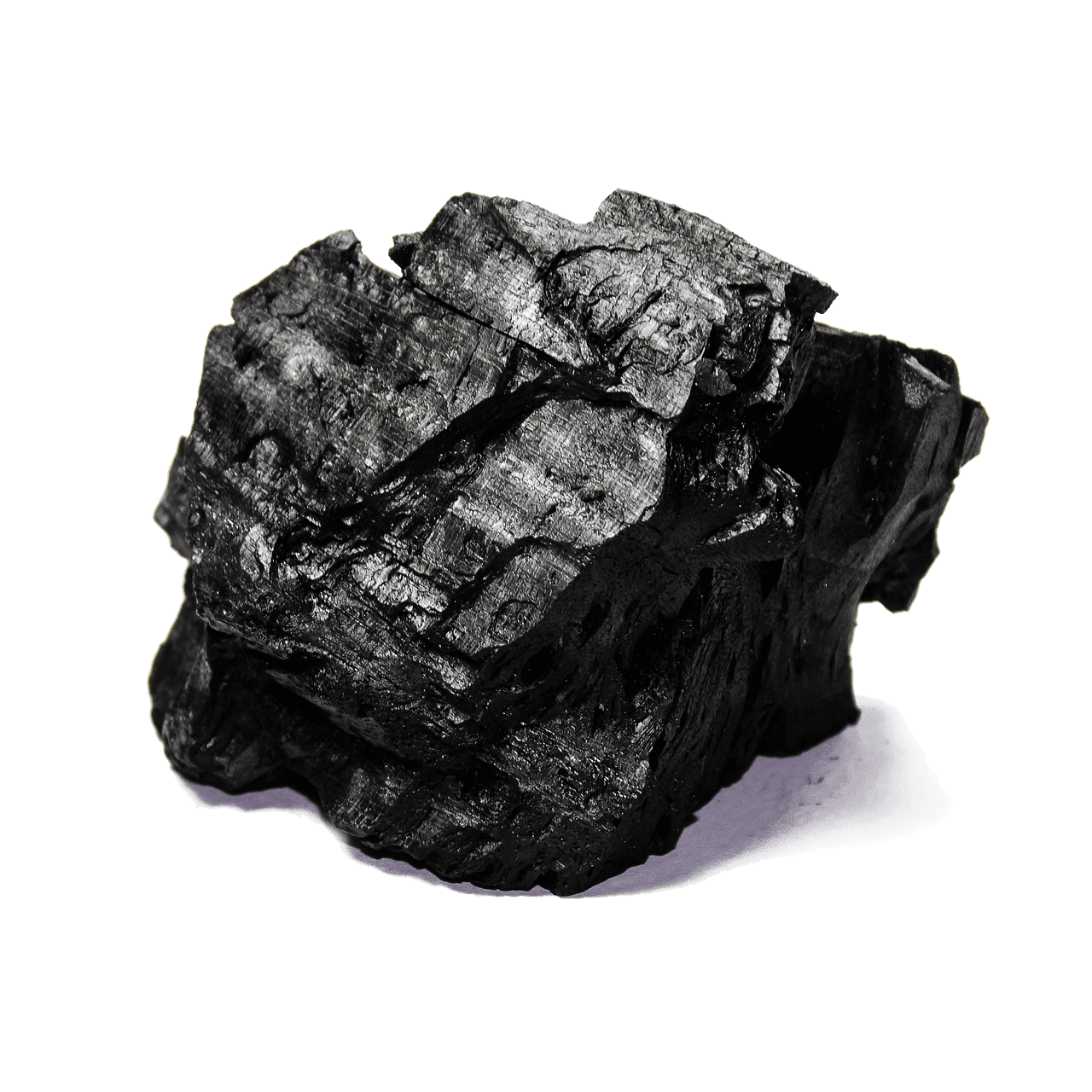
Coal (Pixabay)
Carbon can exist in different physical forms known as allotropes. Allotropes are structures formed by the same element’s atoms arranged in different patterns, resulting in distinct physical and chemical properties. The main allotropes of carbon are diamond, graphite, and amorphous carbon.
Diamond: Diamond consists of a three-dimensional crystalline structure in which each carbon atom is strongly bonded via covalent bonds to four other carbon atoms. This structure makes diamond the hardest known natural material.
Graphite: Graphite has a structure in which carbon atoms are arranged in hexagonal planar layers. Each carbon atom forms covalent bonds with three other carbon atoms; the weak Van der Waals forces between these layers make graphite soft, slippery, and electrically conductive. Due to these properties, graphite is widely used in pencil tips, lubricants, and electrical transmission systems.
Amorphous Carbon: Amorphous carbon has an irregular, non-crystalline structure. Materials such as coal, carbon black, and activated carbon belong to this group. Due to its low degree of order, amorphous carbon is less dense and softer than graphite and diamond. Coal is used in industrial energy production and activated carbon in water purification.

Diamond (Unsplash)
Carbon has a wide range of industrial applications. Fossil fuels are major carbon sources used for energy production. Coal is widely used globally for electricity generation, while petroleum and natural gas are preferred for transportation and heating needs.
Graphite is used in advanced technologies such as electric motors, batteries, and control rods in nuclear reactors. In steel production, carbon is alloyed with iron to enhance hardness and strength. Diamond plays a vital role in industrial applications requiring high durability, such as cutting tools, drill bits, and abrasive tips.
The health effects of elemental carbon are generally related to carbon compounds; pure elemental carbon has no toxic effects. Therefore, the health impacts of carbon must be evaluated in the context of its compounds.

Production Facility (Unsplash)
The carbon cycle describes the continuous movement of carbon between the atmosphere, biosphere, hydrosphere, and lithosphere. Plants convert atmospheric carbon dioxide into organic matter through photosynthesis. This organic matter is consumed by living organisms and returned to the atmosphere as carbon dioxide through respiration. Additionally, carbon can be stored long-term in fossil fuels and ocean sediments. Disruptions to the balance of the carbon cycle contribute to the greenhouse effect, which drives climate change.
Alexas_Fotos. "Charcoal Hardwood Pure JPG." Pixabay. Accessed May 11, 2025. https://pixabay.com/photos/charcoal-hardwood-pure-5000519/
Alexas_Fotos. “Charcoal Carbon Texture Pattern JPG.” Pixabay. Accessed May 11, 2025. https://pixabay.com/photos/charcoal-carbon-texture-pattern-5673897/
Harris, David L. Chemistry: A Molecular Approach. 4th ed. Pearson Education, 2017.
International Union of Pure and Applied Chemistry (IUPAC). "Genesis of the Periodic Table of Elements: From Atom to Adam." IUPAC 100th Anniversary. Accessed May 12, 2025.
Kenny Eliason. “A Diamond Bracelet on a Black Surface JPG.” Unsplash. Accessed May 11, 2025. https://unsplash.com/photos/a-diamond-bracelet-on-a-black-surface-2nAZaWAFkSo
Markus Spiske. “Smoke Billows from the Cooling Towers of a Power Plant JPG.” Unsplash. Accessed May 11, 2025. https://unsplash.com/photos/smoke-billows-from-the-cooling-towers-of-a-power-plant-MG_0AXIrphs
Saifuddin, N., Raziah, A. Z., and Junizah, A. R. “Carbon Nanotubes: A Review on Structure and Their Interaction with Proteins.” *Hindawi Publishing Corporation Journal of Chemistry,* (2013): 1-18. Accessed May 12, 2025. https://scispace.com/pdf/carbon-nanotubes-a-review-on-structure-and-their-interaction-2zia3n5116.pdf
Stryer, Lubert. Biochemistry. 8th ed. W. H. Freeman and Company, 2015.
U.S. Global Change Research Program. "Introduction to Carbon." *Carbon 2018*. Accessed May 12, 2025. https://carbon2018.globalchange.gov/report_section/1/1_1/

Carbon Element (C)
Element Name | Carbon | ||||||||
|---|---|---|---|---|---|---|---|---|---|
Chemical Symbol | C | ||||||||
Atomic Number | 6 | ||||||||
Atomic Weight | 12.011 g/mol | ||||||||
Periodic Order | Period 2, Group 14 | ||||||||
Physical State | Solid | ||||||||
Carbon Allotropes | Diamond, Graphite, Amorphous Carbon, Fullerenes, Carbon Nanotubes | ||||||||
Electron Configuration | 1s² 2s² 2p² | ||||||||
Best Known Compounds | Carbon Dioxide (CO₂), Carbon Monoxide (CO), Methane (CH₄), Acids, Alcohols and Amino Acids | ||||||||
Chemical and Physical Properties
History and Discovery
Allotropes of Carbon
Industrial Applications of Carbon
Carbon Cycle and Environmental Importance