+1 Daha

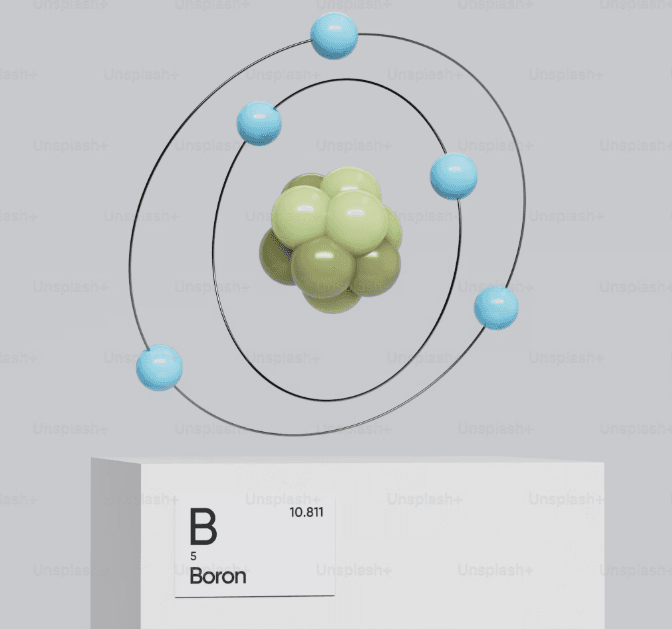
Boron Element
Symbol | B | ||||||||
|---|---|---|---|---|---|---|---|---|---|
Atomic Number | 5 | ||||||||
Element Classification | Nonmetal | ||||||||
Natural Occurrence | Not Occur in Free Form | ||||||||
Major Compounds | Boron Nitride (BN) Boron Carbide (B₄C) Borax (Na₂B₄O₇·10H₂O) Boric Acid (H₃BO₃) | ||||||||
Applications | Neutron Absorber in Nuclear Reactors Metallurgy and Alloy Technologies Detergents and Cleaning Products Micronutrient in Agriculture Glass and Ceramic Production | ||||||||
Türkiye’s Position | 73% of the World’s Reserves. | ||||||||
Boron is a chemical element classified among the nonmetals in the periodic table and is utilized in various industrial processes. It does not occur freely in nature but is instead found in the form of compounds, primarily in borate minerals.

Image Showing the Position of the Element Boron in the Periodic Table (Tenmak Boren)
Boron (B) is a nonmetal with the atomic number 5, exhibiting semiconducting properties. Physically, it can be found in either a brittle, crystalline form or in an amorphous structure. Due to its high thermal resistance, chemical stability, and neutron absorption capability, boron is valuable in advanced technological applications.
Boron is not found in its elemental form in nature; instead, it occurs primarily as borate minerals. Turkey holds the majority of the world’s boron reserves (approximately 73%), with major production centers located in Kırka, Emet, Bigadiç, and Bandırma.
Boron ores are refined through various physical and chemical processes. These include flotation, precipitation, filtration, and crystallization methods. Final products include boric acid, borax decahydrate, anhydrous borax, and sodium perborate. These processes are evaluated both in terms of chemical engineering and environmental sustainability.

Element Boron (Tenmak Boren)
Boron forms a wide range of compounds, among which the most common are:
These compounds share common characteristics such as high thermal resistance, varying electrical conductivity, and chemical inertness.
Boron, especially its isotope boron-10, has a high capacity for neutron absorption. This makes it a critical material in pressurized water reactors, where it functions as a control rod material or coolant additive. It is used in liquid systems in the form of boric acid, and in solid form as boron carbide. Its role is vital for nuclear safety.
Due to its industrial versatility and strategic uses such as in nuclear energy, boron is classified as a critical raw material. Institutions like the European Union and the United States have designated it a "strategic resource." Turkey’s leadership in boron reserves presents both economic and technological opportunities.
Although boron is considered to have low toxicity, high doses can be harmful to both humans and the environment. The World Health Organization (WHO) has set the limit for boron in drinking water at 2.4 mg/L. This threshold must be carefully observed in agricultural irrigation and aquatic ecosystems. The effects of boron compounds on human health, particularly in terms of reproductive health and kidney function, are subjects of ongoing research.
Akbay, Aslı. The Importance of Boron and Technological Boron Compounds. Advisor: Prof. Dr. Figen Kurtuluş. Department of Chemistry, Faculty of Science and Letters, Balıkesir University, Seminar Notes. Accessed May 31, 2025. https://kimya.balikesir.edu.tr/Seminerler/dokuman/201810105025AsliAkbay_2.pdf.
Tombal, Tuğba Deniz, Şafak Gökhan Özkan, İlgin Kurşun Ünver, and Ahmet Erdal Osmanlıoğlu. “Properties, Production, Usage, and Importance of Boron Compounds in Nuclear Reactor Technology.” Journal of Boron 1, no. 2 (2016). Academia.edu. Accessed May 31, 2025. .
Unsplash. “An Image of a Bunch of Balls in the Air.” Accessed June 11, 2025. https://unsplash.com/photos/an-image-of-a-bunch-of-balls-in-the-air-rZ7gbO4tX8A
Yiğitbaşıoğlu, Hakan. “An Important Ore for Turkey: Boron.” Department of Geography, Faculty of Language, History and Geography, Ankara University. Accessed May 31, 2025. https://dergipark.org.tr/tr/download/article-file/691571.
Özkan, Şafak Gökhan, Tuğba Deniz Tombal, İlgin Kurşun Ünver, and Ahmet Erdal Osmanlıoğlu. “Properties, Production, Usage, and Importance of Boron Compounds in Nuclear Reactor Technology.” Bor Dergisi 1, no. 2 (2016): 86–95. https://dergipark.org.tr/tr/pub/boron/issue/24508/259751.
“Boron Element.” Boron Institute - TENMAK. Accessed May 31, 2025. https://boren.tenmak.gov.tr/tr/bor-elementi.html.

Boron Element
Symbol | B | ||||||||
|---|---|---|---|---|---|---|---|---|---|
Atomic Number | 5 | ||||||||
Element Classification | Nonmetal | ||||||||
Natural Occurrence | Not Occur in Free Form | ||||||||
Major Compounds | Boron Nitride (BN) Boron Carbide (B₄C) Borax (Na₂B₄O₇·10H₂O) Boric Acid (H₃BO₃) | ||||||||
Applications | Neutron Absorber in Nuclear Reactors Metallurgy and Alloy Technologies Detergents and Cleaning Products Micronutrient in Agriculture Glass and Ceramic Production | ||||||||
Türkiye’s Position | 73% of the World’s Reserves. | ||||||||
Henüz Tartışma Girilmemiştir
"Boron Element" maddesi için tartışma başlatın
Definition and General Properties
Occurrence and Reserves
Production Technologies
Chemical Compounds and Structures
Industrial Applications
Use in Nuclear Reactor Technology
Strategic Importance and Economic Value
Toxicological and Ecological Assessments
Bu madde yapay zeka desteği ile üretilmiştir.