This article was automatically translated from the original Turkish version.
Discovery(ies) | In 1789 by William Herschel | ||||||||
|---|---|---|---|---|---|---|---|---|---|
Type(s) | Natural satellite | ||||||||
Name(s) | Enceladus | ||||||||
Parent Planet | Saturn | ||||||||
Diameter | Approximately 504 km | ||||||||
Enceladus is one of Saturn’s natural satellites. Observations and analyses have suggested that this celestial body's icy surface may conceal an internal structure containing liquid water. Water vapor and ice particles ejected from the south polar region have revealed that Enceladus is a geologically active satellite, making it a focal point of scientific research.
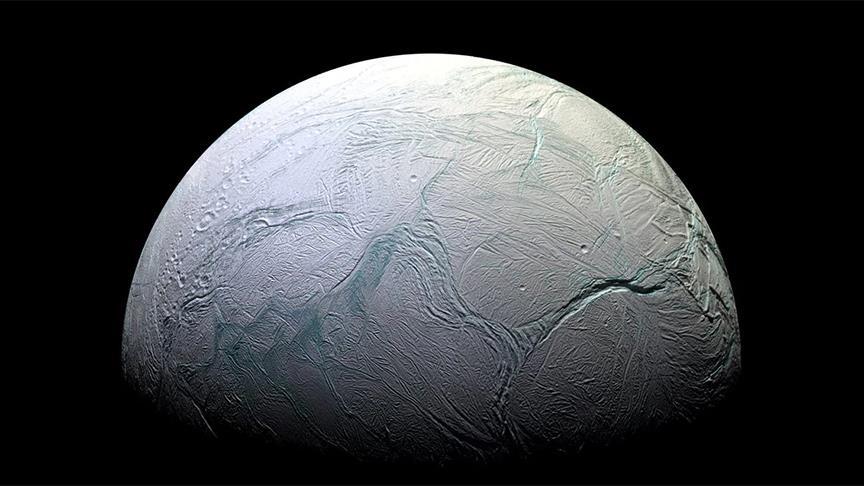
Enceladus is among Saturn’s medium-sized moons. Its surface is largely covered by ice and exhibits high reflectivity. Its orbital motion subjects it to Saturn’s gravitational forces, which are linked to processes that generate internal heating within the moon.
The satellite’s surface features both cratered regions and areas that are younger and less cratered. Linear fractures, particularly observed around the south pole, have been seen to emit material into space. These plumes are considered among the primary evidence indicating the presence of liquid water beneath Enceladus’s surface.

Enceladus (Anadolu Agency)
Scientific studies have revealed the possible existence of a global or regional subsurface ocean beneath Enceladus’s icy crust. Analysis of the chemical composition of the ejected material has detected the presence of key chemical constituents considered essential for life. These findings have enabled detailed investigation of the moon’s physical and chemical conditions.
Enceladus has been studied in detail, particularly through data provided by the Cassini spacecraft. The results demonstrate that this moon is not only significant in terms of planetary science but also represents an important target for the study of extraterrestrial life possibilities. Research has shown that Enceladus possesses the characteristics of a natural laboratory capable of contributing to our understanding of the conditions necessary for the emergence of life.
Anadolu Ajansı. “Enceladus’ta yaşam için gereken koşullara dair kanıtlar bulundu.” Accessed January 14, 2026. https://www.aa.com.tr/tr/bilim-teknoloji/enceladusta-yasam-icin-gereken-kosullara-dair-kanitlar-bulundu/1193801
Ocak, Mahir E. “Satürn’ün uydusu Enceladus’ta yaşam.” Bilim Genç (TÜBİTAK). Accessed January 14, 2026. https://bilimgenc.tubitak.gov.tr/makale/saturnun-uydusu-enceladusta-yasam
TRT Haber. “Dünya dışı yaşam arayışında hedef Satürn’ün Enceladus uydusu.” TRT Haber. Accessed January 14, 2026. https://www.trthaber.com/haber/dunya-disi/dunya-disi-yasam-arayisinda-hedef-saturnun-enceladus-uydusu-710867.html
Usta, Bora, and Ayşe Arslan. "Astronomide Gök Cisimlerini Adlandırma: Mitolojilerden Modern Adlandırmaya." *Anadolu Öğretmen Dergisi* 7, no. 1 (June 2023): 96–115.

Discovery(ies) | In 1789 by William Herschel | ||||||||
|---|---|---|---|---|---|---|---|---|---|
Type(s) | Natural satellite | ||||||||
Name(s) | Enceladus | ||||||||
Parent Planet | Saturn | ||||||||
Diameter | Approximately 504 km | ||||||||
Physical and Orbital Characteristics
Geological Structure and Surface Activity
Subsurface Ocean and Chemical Findings
Scientific Research and Astrobiological Context