



How Was the Periodic Table Discovered?
Throughout history, humans have examined the materials around them and attempted to classify them. Although in ancient times substances such as water, air, earth, and fire were considered “classical elements,” the discovery of true elements began only after the 1600s. An element is a pure substance that cannot be broken down into smaller components.

(Periodic Table: Türkiye Kimya Derneği)
Organizing the Elements
In the 1700s and 1800s many new elements were discovered. However, arranging these elements in a meaningful way proved difficult. A system revealing patterns in the properties of elements was sought.
Mendeleev and the First Periodic Table
In 1869 the Russian chemist Dmitri Mendeleev arranged the elements according to their atomic masses. He noticed that certain properties repeated periodically in this ordering. To illustrate this pattern he created the first periodic table. Mendeleev left gaps in the table for elements that had not yet been discovered. When these elements were later found, it became clear that his predictions were correct.

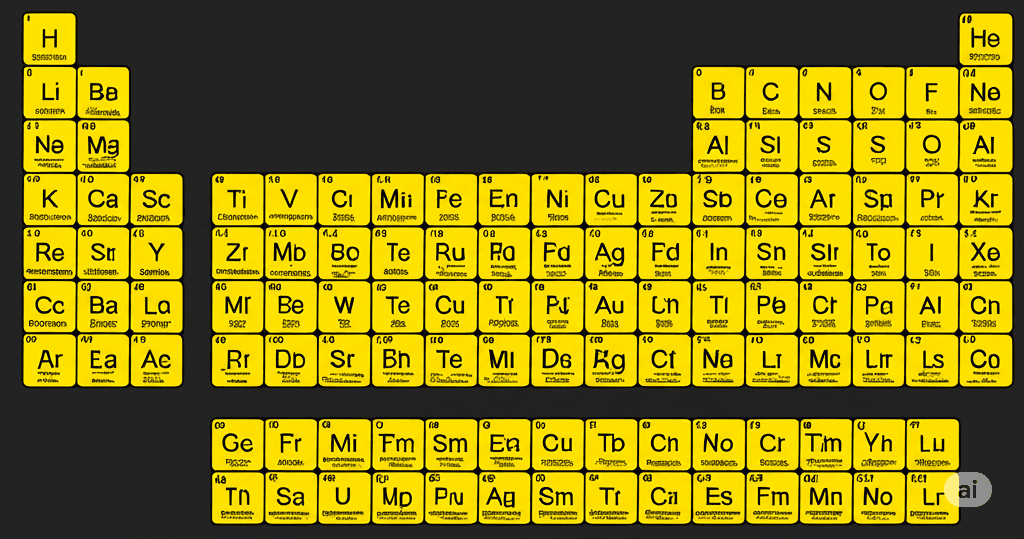
(Generated by Artificial Intelligence)
The Modern Periodic Table
During the 20th century, as the structure of the atom became better understood, elements were reorganized according to their atomic number—that is, the number of protons. This led to the development of the modern periodic table as it is known today.
How Many Elements Exist Today?
Scientists have now discovered 118 elements. Some of these occur naturally while others are produced in laboratories. The table may expand in the future with the discovery of new elements.
The periodic table is a fundamental scientific tool that organizes elements in a systematic manner. This classification, initiated by Mendeleev’s work, has evolved with modern science and now encompasses 118 elements.