



Ince Minareli Medrese
The İnce Minareli Medrese in Konya is a very old educational building. This medrese was constructed during the Seljuk period to teach religious knowledge known as hadith. The patron of the building was Sahip Ata Fahreddin Ali, a Seljuk vizier. The architect was Abdullah ibn Kelük. The medrese is both a place of learning and a work of art notable for its architectural decorations.

İnce Minareli Medrese (Generated by Artificial Intelligence)
What Was a Medrese?
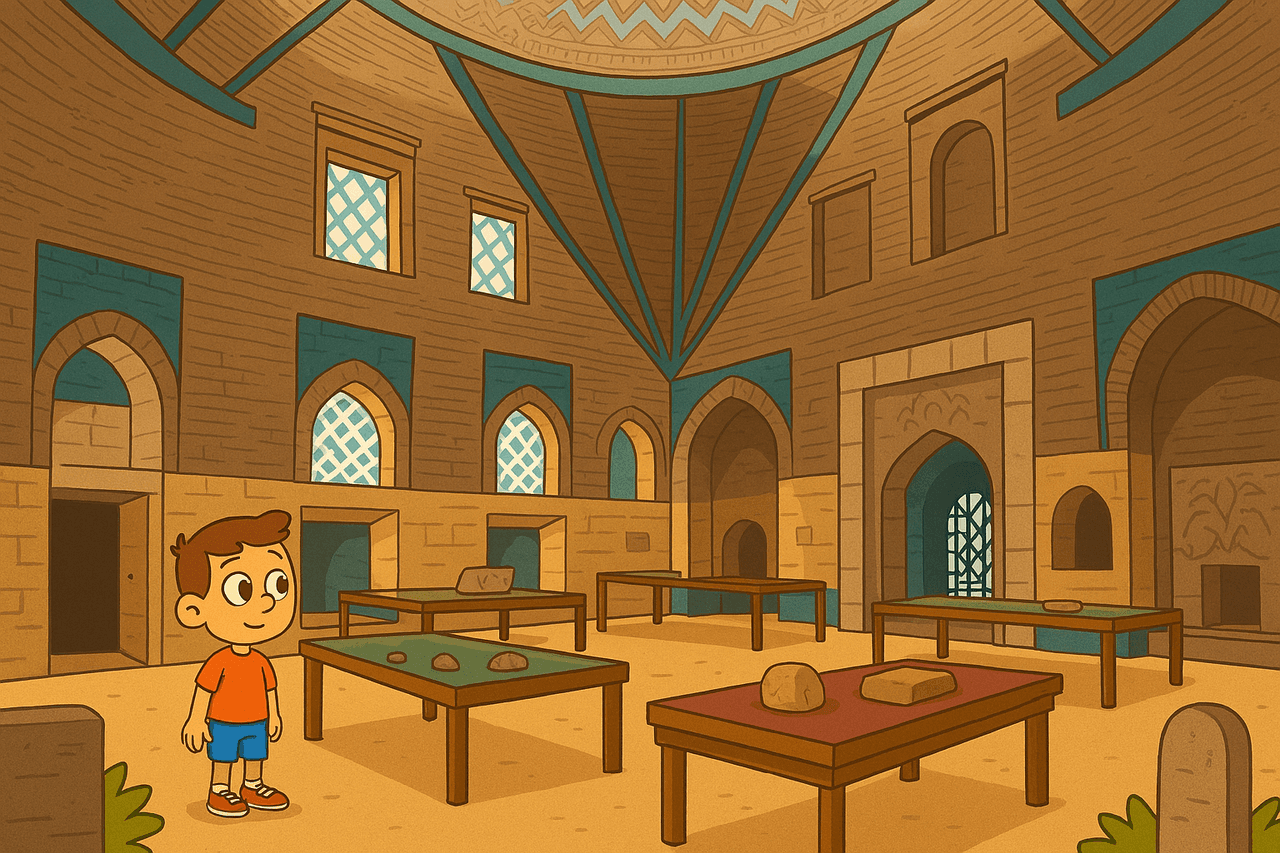
The medrese has a “closed courtyard” plan. This means it features a central courtyard covered by a dome. At the exact center of this courtyard is a small fountain (şadırvan). Surrounding the courtyard are student rooms, a large lecture hall (eyvan), and teachers’ chambers. The eyvan is the widest and tallest section of the medrese. On either side of the eyvan are square-plan chambers covered by domes, used by the instructors.
The transition to the dome covering the courtyard is achieved through special stone structures called pendentives. Around the dome, inscriptions in blue and turquoise tiles read “El-Mülkü Lillâh” meaning “Sovereignty belongs to God.” Above the doors and windows are decorative inscriptions of “Ayet-el Kürsi.” These inscriptions are combined with geometric and vegetal motifs. The interior decorations resemble kilim patterns and are colorful and orderly enough to capture children’s attention.

İnce Minareli Medrese (Generated by Artificial Intelligence)
Lighting in the building was provided by small windows, rectangular openings, and a lantern at the top of the dome. In the past, this lantern allowed daylight to enter and illuminate the medrese. Today, this section is covered with glass.
The Crown Gate
One of the most striking features of the medrese is the crown gate on its eastern façade. This grand entrance is among the finest examples of Seljuk stonework. The gate projects outward and is richly decorated. It features verses from the Surahs of Al-Fath and Ya-Sin, along with vegetal and geometric patterns. The inscriptions are written in a distinctive script known as Seljuk sülüs.
On either side of the gate are sculpted columns adorned with artichoke leaf and knot motifs. These decorations carry both religious and artistic significance. Above the gate are two medallions inscribed with the architect’s name. These details demonstrate that the gate was not merely an entrance but also a work of art.

Crown Gate (Generated by Artificial Intelligence)
Why Is It Called “İnce Minareli”?
The medrese derives its name from the slender minaret beside it. The minaret is constructed of brick and decorated with turquoise and purple tiles. This eight-sided minaret originally had two balconies (şerefeli). However, its upper section collapsed after being struck by lightning in 1901. Today, only the lower portion remains standing.
The base of the minaret, its lower section, is clad in cut stone. Its front façade features acanthus leaf decorations. The shaft is designed in a semi-pyramidal form with triangular elements and a 12-sided structure. These sections are adorned with turquoise-glazed bricks. The tiles on the minaret are arranged in zigzag and relief patterns. These designs are visually pleasing and reflect the elegance of Seljuk art.
The Mosque Adjacent to the Medrese
Originally, a mosque stood adjacent to the medrese. It is known to have had a square plan and a dome-covered roof. Its interior walls and mihrab were decorated with tiles. However, after the lightning strike in 1901 damaged the minaret, it also harmed the mosque. The mosque remained standing without repair for many years and was completely demolished in 1929. Today, only the qibla wall with the mihrab remains.

Minaret (Generated by Artificial Intelligence)
Use as a Museum
After serving for many years as an educational institution, the medrese was converted into a museum in 1956. Today, it displays stone and wooden artifacts from the Seljuk, Karamanid, and Ottoman periods. Among the museum’s collection are:
Stone and marble inscriptions decorated with carved calligraphy.
Relief stones from Konya Castle.
Wooden doors and window panels.
Ceiling decorations.
Gravestones and sarcophagi.
Additionally, the museum displays the double-headed eagle and winged angel figures, symbols of the Seljuks. These figures are carved in high relief on marble.
The Sıbyan Mektebi
Originally, a small elementary school (sıbyan mektebi) stood between the medrese and the minaret. This school had two rectangular windows on its façade and was accessed through the medrese’s courtyard. However, after the mosque’s demolition, this school was also removed.

Interior View of the Medrese (Generated by Artificial Intelligence)
Restorations and Preservation
The medrese was repaired in 1876 and 1899. During the Republican period, various restoration works were carried out starting in 1936. The most comprehensive restoration took place between 2001 and 2002. During this period, some parts of the demolished mosque were reconstructed in accordance with their original form.
Where Is It Located?
The İnce Minareli Medrese is located in the Selçuklu district of Konya. Today, it is open to visitors as the “Stone and Wooden Artifacts Museum.” It is an excellent place for children to see a historic structure and examine ancient artistic works.