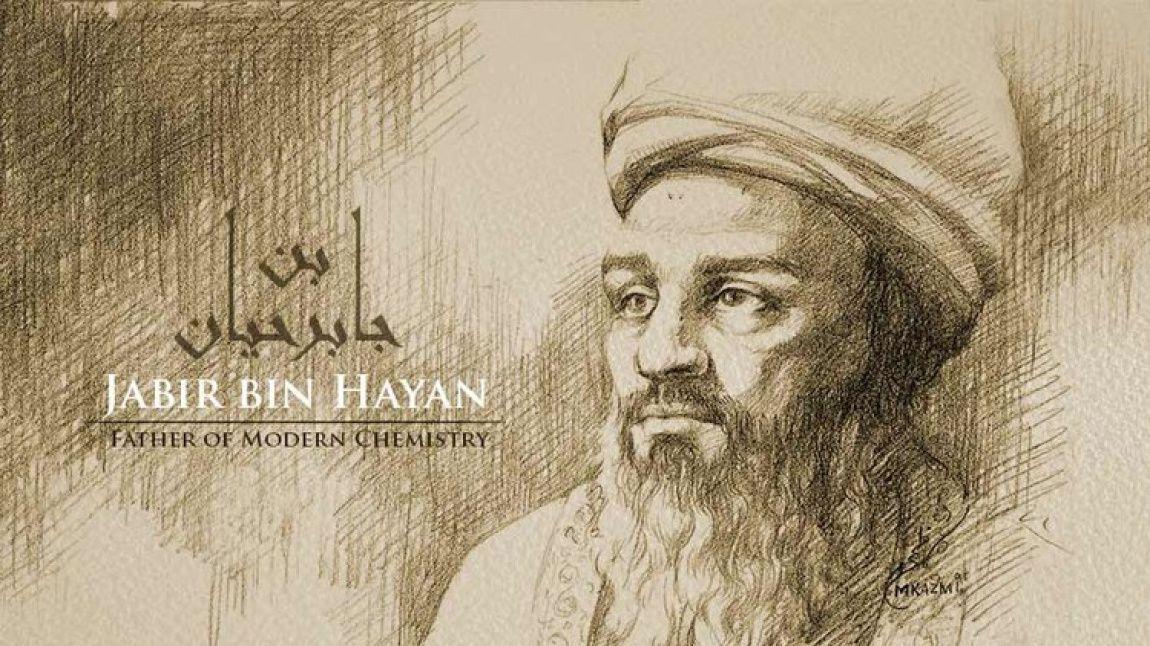



Jabir ibn Hayyan
Jābir ibn Hayyān was a Muslim scientist who lived in the 8th century. There is debate about his place of birth: was it Khurasan or Kufa? But one thing we are certain of is that he transformed chemistry from alchemy into a science.

(Generated by artificial intelligence.)
The First Hero of the Laboratory
Jābir knew that chemistry could not advance without experimentation. He became one of the first people to establish a laboratory and conduct experiments.
- Glass flasks, alembics, retorts—all came to life in his hands.
- Curious about how gold was formed, he studied mixtures of mercury and sulfur and developed the theory that metals have a “mother and father.”
- He never believed anything without testing it: “See first, then write!”

(Generated by artificial intelligence.)
What Did He Discover?
Jābir’s discoveries were anything but ordinary. Here are a few examples:
- He produced acids such as sulfuric acid, nitric acid, and hydrochloric acid.
- He discovered a mixture he called aqua regia, which could even dissolve gold!
- He developed the alembic, a distillation apparatus still used today in everything from perfumery to pharmaceuticals.
- He systematized methods such as vaporization, sublimation, and crystallization.
Books and Influence
Jābir wrote hundreds of books. So many, in fact, that some believed “no single person could have authored so many.”
In Europe, he was known as “Geber.” (His name in the Latin world.) His works were translated into Latin and studied for centuries.
- Roger Bacon called him “the master of masters.”
- Historians of chemistry place him on the same level as Boyle, Priestley, and Lavoisier.

(Generated by artificial intelligence.)
His Legacy in the World of Science
Jābir’s importance lies not only in chemistry but in his development of the scientific method.
- He asserted that knowledge cannot exist without experimentation.
- He argued that numbers and measurement are key to understanding the order of nature.
- By suggesting that atoms could be broken apart, he winked at the future centuries ahead!