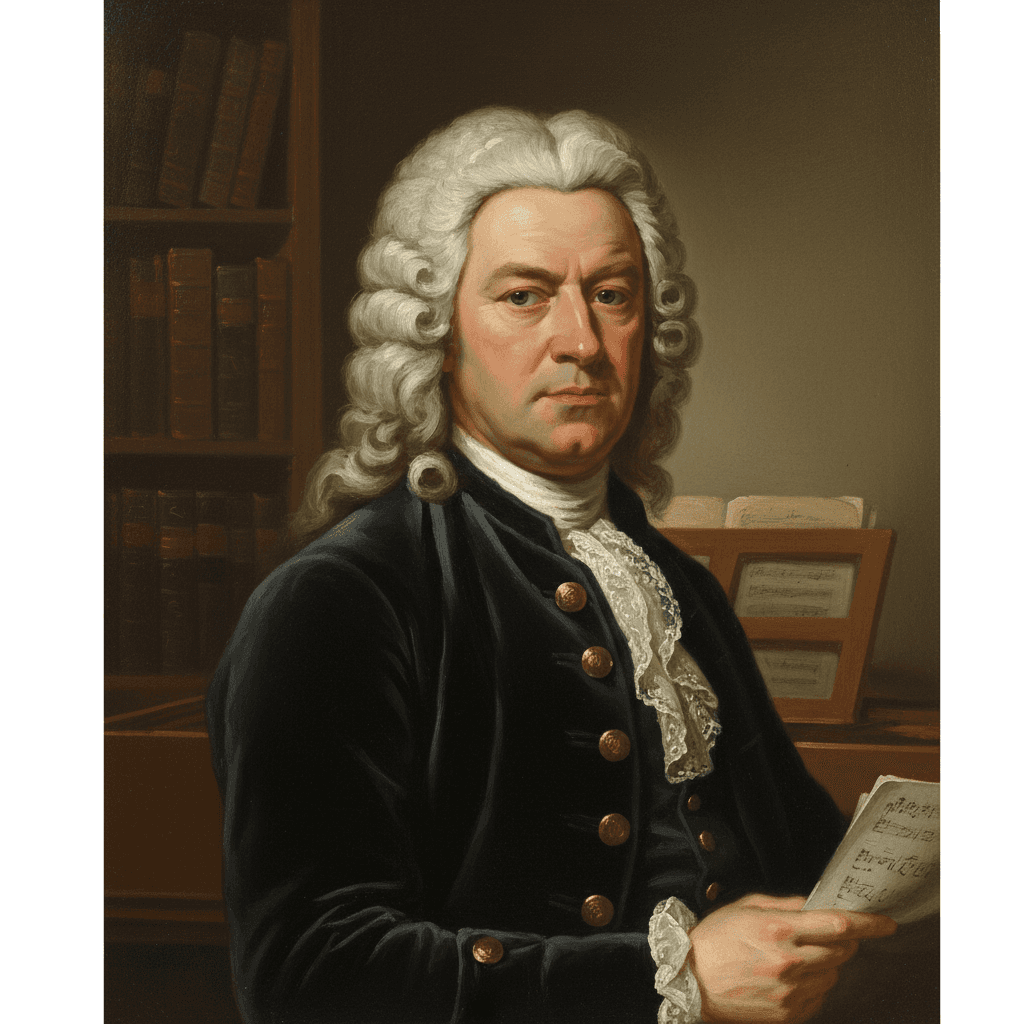




Johann Sebastian Bach
Do you ever feel your heartbeat syncing with the rhythm of music as you listen? 🎶 Johann Sebastian Bach was precisely the kind of composer who transformed this very feeling into notes! Bach is renowned in music history as one of the brightest stars of the Baroque period. How did this great composer grow up, and which works left an enduring mark on the world? Let’s explore together!
👨🏻👩🏻👦🏻Birth and Childhood
Johann Sebastian Bach was born in 1685 in the German town of Eisenach. His family was deeply immersed in music; nearly every member played an instrument! Young Johann grew up surrounded by the melodies of his home.

Young Bach listening to his father and uncle (Image generated by artificial intelligence).
He learned to play the violin and keyboard from his father, and his uncle introduced him to the enchanting sounds of the organ. Unfortunately, he lost both his mother and father when he was only ten years old. Nevertheless, his passion for music never faded. He continued his musical studies under the guidance of his older brother.
🎼His Interest in Music and Education
At a young age, Bach realized that music was not only an expression of emotion but also a discipline grounded in knowledge. He established a connection between the scientific thinking of his time and musical composition.

Young Bach playing the violin professionally (Image generated by artificial intelligence).
To him, music, like science, could be measured, learned, and refined. This perspective made him one of the most innovative composers of the Baroque period.
🎹Composition and Instruments
Bach was not only a composer but also a virtuoso—he could write music and perform it with exceptional skill. He particularly loved playing the organ, harpsichord, and violin, and masterfully exploited the rich tonal qualities of these instruments in his compositions.

Organ, harpsichord and violin, from left to right (Image generated by artificial intelligence).
In his works, structure, rhythm and emotion are seamlessly united. According to sources, Bach viewed music as an art that operated with the precision of mathematics yet emanated from the heart.
🎵His Works and Famous Compositions
Bach’s compositions are still performed across the world today. Among the hundreds of works he wrote, notable masterpieces include the Brandenburg Concertos, the St Matthew Passion, and the Toccata and Fugue in D minor. These pieces convey profound emotion while demonstrating extraordinary technical mastery. Moreover, his arrangements for church choirs brought a fresh vitality to the religious music of his era.
🎧You Can Experience Bach’s Brandenburg Concertos by Listening!
Bach - Brandenburg Concertos (YouTube)