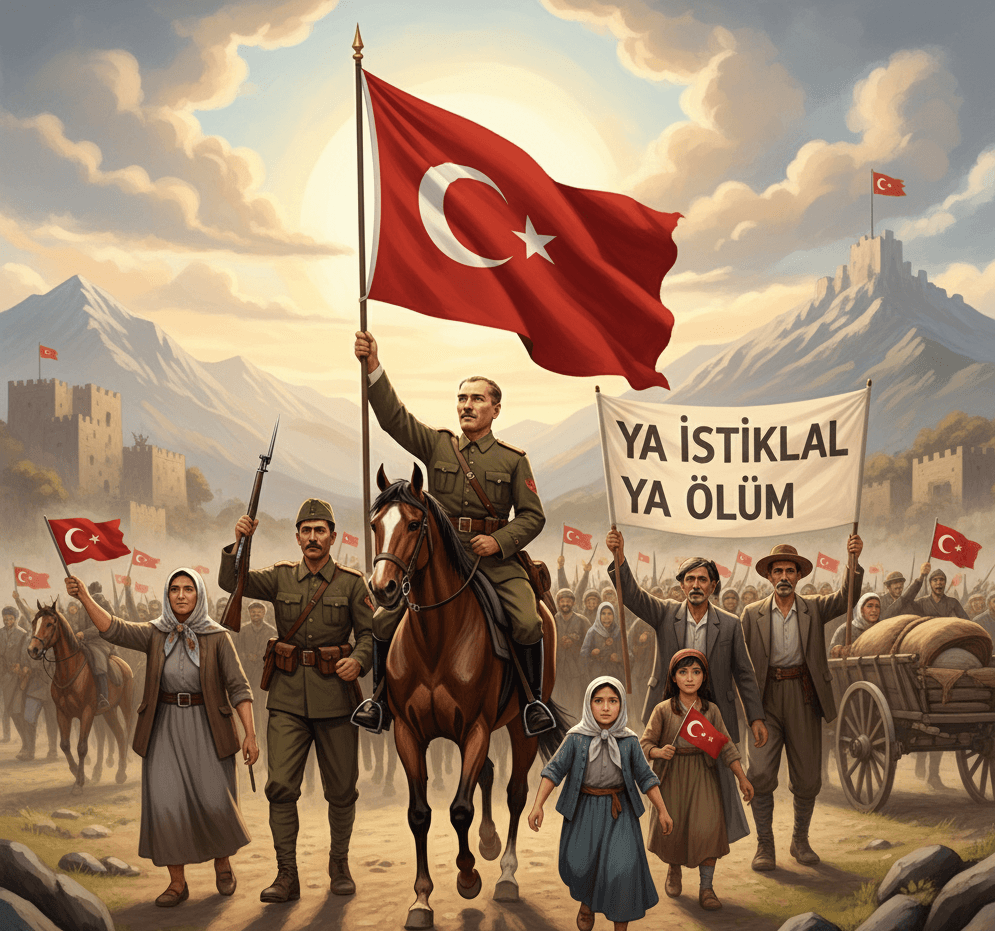


Journey to Independence: The National Struggle Period
The National Struggle was a great war fought from 1919 to 1923 to reclaim the right of a nation to live freely on its own soil. This war emerged after the Ottoman Empire began to be occupied following its defeat in the First World War. The War of Independence was not merely a war; it was also a journey toward establishing a modern state governed by its own people.
Let us closely examine how a nation united and fought for its independence.
🌍 What Happened After the World War?
When the First World War ended the Ottoman State was considered defeated. The Treaty of Mudros, signed on 30 October 1918, led to the disbandment of the army and left key areas of the country undefended.
Article 7 of this treaty was critically significant: the Allied Powers (the victorious nations) gained the right to occupy any territory they deemed a threat to their security. This article provided a pretext for the occupation of Anatolian lands.
The Ottoman government in Istanbul was unable to mount strong resistance against these occupations. The government sought to preserve the sultanate by yielding to the demands of the occupying powers. This situation sparked among the people the idea that “We must determine our own destiny.”

Visual representing the partition of territories after the Treaty of Mudros (generated by artificial intelligence).
🛡️ The First Spark: Resistance in the South
After the occupations began, occupying forces in the southern regions began to exert pressure on the local population. In particular, after France took control of the region it attempted to suppress the people through collaboration with certain groups.
In response to these hostile actions the people felt the need to defend themselves. An armed resistance began. For example the Sütçü İmam incident in Maraş became a symbol of this local resistance. This event marked the transition from passive sorrow to active defense.
These local acts of heroism were not sufficient on their own. To succeed these scattered forces needed to be transformed into a unified national army under centralized command.

Visual representing the Sütçü İmam incident (generated by artificial intelligence).
🧭 Mustafa Kemal Paşa Enters the Scene
The War of Independence officially began on 19 May 1919 when the great leader Mustafa Kemal Atatürk landed in Samsun. He traveled across Anatolia organizing the people.
He issued a declaration known as the Amasya Circular (June 1919). In this declaration a crucial point was stated: “The nation’s independence will be restored by the determination and resolve of the nation itself.” This was the first sign that the country would no longer be governed by the sultan but by the people. The will of the people was now established as the new source of sovereignty.

Visual representing Mustafa Kemal Paşa’s arrival in Samsun (generated by artificial intelligence).
🏛️ Establishment of the National Assembly: TBMM
The principle of popular sovereignty declared in Amasya became reality with the opening of the Turkey Grand National Assembly (TBMM) in Ankara on 23 April 1920. The opening of the Assembly meant that the authority to govern the country was transferred from the sultan directly to the people’s representatives. The entire nation needed to make collective decisions and manage the resistance from a single center. Responding to Mustafa Kemal Paşa’s call delegates came from every corner of the homeland to Ankara. This Assembly signified the people governing themselves and became the center of the National Struggle. The Assembly not only made war decisions but also laid the foundations of a new state.
With the establishment of the TBMM a strong alternative government emerged in opposition to the weak Istanbul government representing the will of the people.

📜 The Erzurum and Sivas Congresses
Erzurum Congress (July–August 1919)
The congress convened in Erzurum defined the rules and principles of the War of Independence. While laying the foundations of the independence struggle it also established key principles for the future state. Among these principles were the foundations of secularism—the idea that state governance would be based on reason and science rather than religious rules. The goal was not only to liberate the land but also to establish a modern state.
Sivas Congress (September 1919)
The Sivas Congress brought together all scattered local defense associations under a single umbrella organization: the Society for the Defense of the Rights of Anatolia and Rumelia. This meant uniting disparate forces under one national strategy. Decisions made in Sivas accelerated the national struggle by ensuring that the nearest military units would support local resistance efforts.

Visual representing the Erzurum and Sivas Congresses (generated by artificial intelligence).
🔪 Threats from Within and Without
As the TBMM was established and grew stronger the Ottoman government in Istanbul and the occupying powers reacted against it.
Time Travel: A Harsh Treaty
In 1920 approximately 105 years ago a very harsh treaty known as the Treaty of Sèvres was signed between the occupying powers and Ottoman representatives.
This treaty aimed to partition Turkish territory and completely expel Turks from Anatolia. Mustafa Kemal Atatürk described this treaty as a “great assassination” planned against the Turkish people.
However the Treaty of Sèvres was declared invalid because it was not ratified by the TBMM the only legitimate representative of the country. This treaty became the most important document proving the justice of the people’s struggle.
Internal Rebellions
The Istanbul government sought to halt the National Struggle by exploiting the people’s loyalty to religion and the sultan. To this end a religious leader (Sheikh ul-Islam) issued a fatwa declaring Mustafa Kemal Paşa and his companions rebels.
This triggered some internal uprisings. Yet in the long term it enabled the people to see that the sultanate regime was collaborating with foreign powers. The National Struggle was understood not as a war against religion but as a struggle between those who loved the homeland and those who submitted to imperialism.
🎖️ The Regular Army
The key to the success of the War of Independence was the transition from the disorganized local forces known as the Kuvayı Milliye to a disciplined and centralized Regular Army capable of defeating the enemy.
The popular resistance on the Southern Front (in Maraş Antep and Urfa) was organized by officers sent from Ankara. The local population fought so determinedly against French occupation that the French forces were forced to withdraw due to the rising cost of maintaining their presence.
This victory secured the southern border and allowed the army to concentrate all its strength on the Western Front where the decisive battles would take place.

Visual representing the Regular Army (generated by artificial intelligence).
Great Victories and Outcomes 🏆
The Regular Army fought major battles on the Western Front. Some of these were the First Battle of İnönü the Second Battle of İnönü and the Battle of the Sakarya River.
Finally the Great Offensive beginning on 26 August 1922 and the Commander-in-Chief Battle resulted in the complete defeat and expulsion of the occupying armies from our homeland. On 24 July 1923 the Treaty of Lausanne was signed formally recognizing the independence of the new state. Thus the National Struggle concluded with the establishment of a fully independent state.