


This article was automatically translated from the original Turkish version.
+2 More
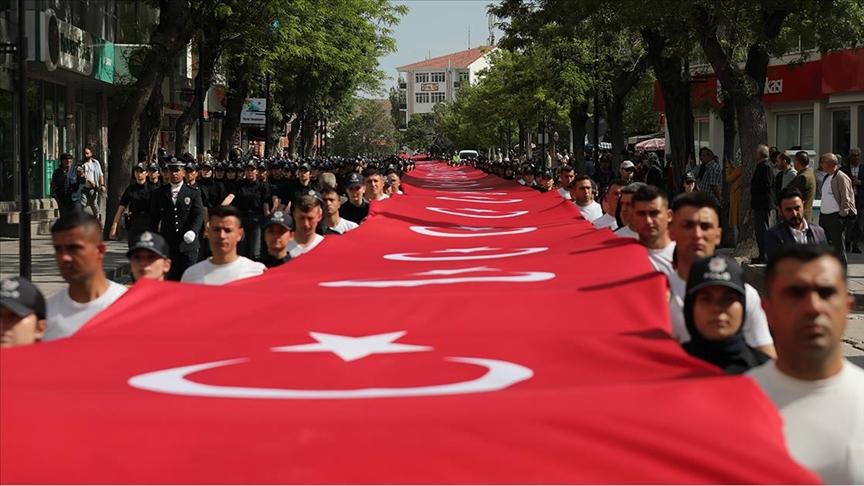
An Image from the May 19 Events
History | 19 May 1919 | ||||||||
|---|---|---|---|---|---|---|---|---|---|
Country | Türkiye | ||||||||
Holiday Type | Official National Holiday | ||||||||
Start Process | 1981: Current name 'Commemoration of Atatürk Youth and Sports Holiday' 1938: Officially established as 'Youth and Sports Holiday' 1935: Expanded celebrations as 'Atatürk Day' 1926: First local celebrations in Samsun under the name 'Gazi Day' | ||||||||
Frequency of Occurrence | Celebrated annually on 19 May | ||||||||
19 May Atatürk Commemoration, Youth and Sports Day is a national holiday that symbolizes the day Mustafa Kemal Paşa began the National Struggle by arriving in Samsun on 19 May 1919 and has been celebrated since 1938 as “Atatürk Commemoration, Youth and Sports Day” in honor of Turkish youth.
The date of 19 May 1919 is one of the turning points in the process that began with Mustafa Kemal Paşa’s appointment as Inspector of the 9th Army. His departure from Istanbul on 16 May and arrival in Samsun on the morning of 19 May marked a significant development at the outset of the National Struggle. The process initiated by Mustafa Kemal Paşa’s arrival in Samsun took shape alongside local defense initiatives organized under various names in Anatolia and growing societal resistance against occupations.
In 1938, Interior Minister Şükrü Kaya declared that 19 May had been dedicated by Mustafa Kemal to Turkish youth and athletes. Since then, annual sporting exhibitions and official ceremonies involving youth participation have been held throughout Türkiye. For many years celebrated as “Youth and Sports Day,” the holiday was renamed “Atatürk Commemoration, Youth and Sports Day” in 1981, during the year declared as Atatürk Year, by a decree issued by then President Kenan Evren.
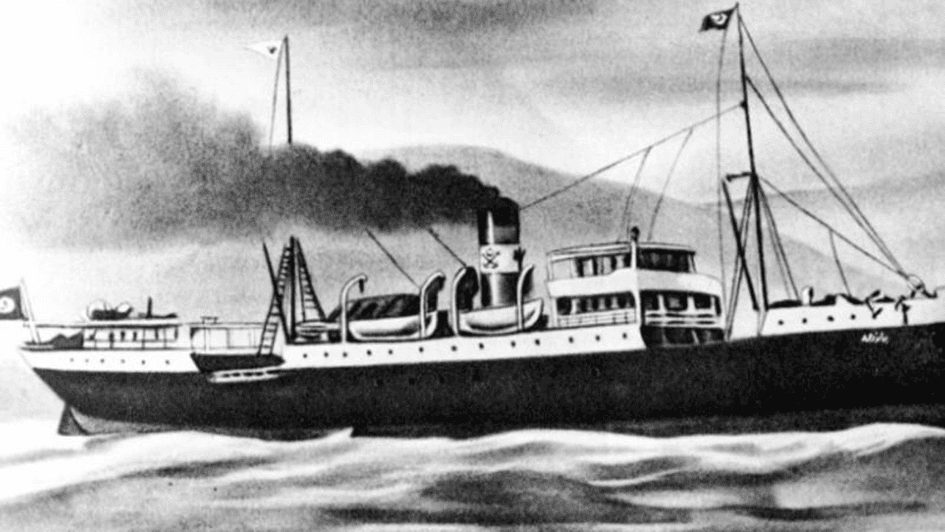
Representative Image of Mustafa Kemal Paşa and the Bandırma Ship That Carried Him (TRT News)
The Armistice of Mudros, signed on 30 October 1918, served as a document certifying the de facto end of the Ottoman State and, although not legally binding, practically legitimized the Allied Powers’ control over Anatolia. According to the armistice terms, the Ottoman army was to be disbanded and ports and transportation routes were to be opened to Allied control. These provisions were applied arbitrarily by the Allied Powers and quickly created conditions for occupations across various regions of Anatolia.
The British occupation of Mosul on 5 November 1918 and the anchoring of the Allied fleet off Istanbul on 13 November 1918 culminated in the formal occupation of Istanbul on 16 March 1920. During this period, the Sultan and the central Ottoman government were unable to take any meaningful action beyond urging the public to remain calm. While the existing political structure remained passive under pressure from the Allied Powers, a new organizational foundation began to emerge in Anatolia.【1】
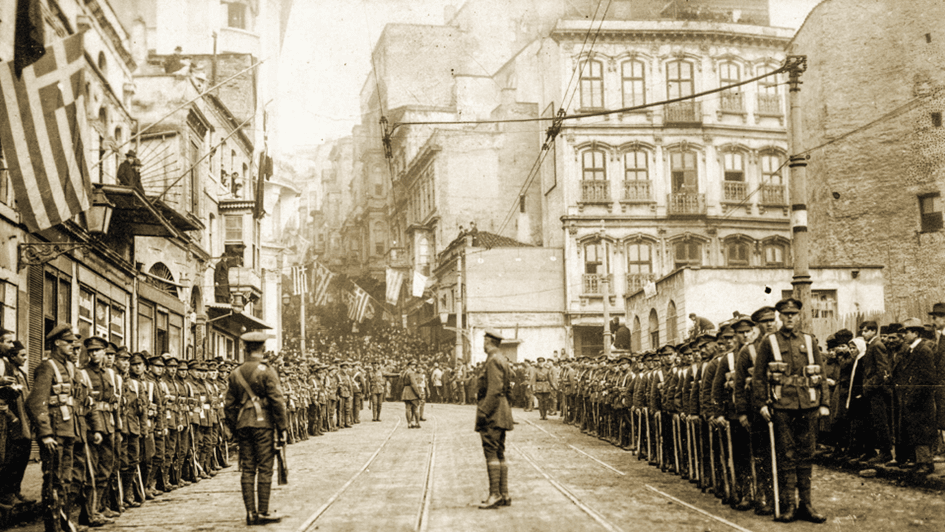
Days of the Occupation of Istanbul (Turkish Historical Society)
İzmir was occupied by Greek forces on 15 May 1919. This occupation was an extension of promises made by the Allied Powers to Greece at the Paris Conference. Carried out under the protection of the British navy, this operation provoked widespread outrage across Anatolia. The local population in İzmir and its surroundings took up armed resistance.
The occupation of İzmir triggered a rise in national consciousness throughout Anatolia and accelerated the organization of local resistance movements. Kuvâ-yi Milliye units were established in Balıkesir, Aydın, Manisa and surrounding areas, while the influence of the Defense of Rights Associations grew steadily. This event became one of the key reasons for Mustafa Kemal Paşa’s decision to leave Istanbul and actively move into Anatolia. The occupation of İzmir acted not merely as a local provocation but as a catalyst for a national awakening and expanded the popular base of the National Struggle.
In the post-armistice period, populations in various regions of Anatolia began organizing around independent associations in response to local occupations and the breakdown of public order. Among these, the most prominent were the Defense of Rights Associations. These organizations not only safeguarded the lives and property of the people but also played a crucial role in the formation of national unity.
Initially regional in character, these associations were unified under a single national framework following the Erzurum and Sivas Congresses in the summer of 1919. As a result of the Sivas Congress held on 7–8 September 1919, they were consolidated into a single organization under the name “Association for the Defense of the Rights of Anatolia and Rumelia.”
These associations formed not only the structural basis for armed resistance but also for political representation. Although their resolutions were grounded in local legitimacy, they effectively functioned as an alternative central government. Through the Representative Committee, coordination of Kuvâ-yi Milliye units, particularly in Western Anatolia, was carried out via these structures. The authority gained by the Representative Committee after the Erzurum and Sivas Congresses laid the foundation for the Grand National Assembly of Türkiye, which opened in Ankara in 1920.【2】
The appointment of Mustafa Kemal Paşa as Inspector of the 9th Army was initiated by the Ottoman State’s high-level administrative mechanisms. The assignment was formally confirmed through correspondence between the Ministry of War, the Grand Vizierate and the Sultan.【3】
Two primary objectives underlay this appointment. The first was to prevent potential conflicts between Turkish and Greek populations in the Eastern Black Sea region. Article 7 of the Armistice of Mudros granted the Allied Powers the right to occupy Ottoman territories in the event of any situation threatening security. Therefore, preempting foreign military intervention under the pretext of unrest in Samsun and its surroundings became a top security priority for the Ottoman administration.【4】
The second reason was the Ottoman government’s desire to strengthen its position in the upcoming peace conferences.【5】
Upon his appointment as Inspector General of the 9th Army, Mustafa Kemal Pasha was granted extensive administrative and military authority. The directive dated 6 May 1919 specified the operational area as the provinces of Samsun, Sivas, and Erzurum, and the districts of Trabzon, Canik, and Erzincan; it clearly defined his powers as ensuring public order, collecting weapons and ammunition, bringing the army under discipline, and directing the civil administration when necessary.
Mustafa Kemal Pasha was responsible not only for military units but also for civil administration. The provisions of the directive explicitly stated that the Pasha could issue direct orders to governors and district officers, exercise oversight over security forces, and report on any disorder in the region. Furthermore, he was authorized to command and manage all military units within his jurisdiction. This placed him in an extraordinary position of authority, endowed with exceptional powers both militarily and administratively.
After his formal appointment as Inspector General of the 9th Army, Mustafa Kemal Pasha began preparations for his journey to Samsun at both military and administrative levels. On 9 May 1919, he sent a telegram to the commander of the units in Sivas, ordering them to meet him in Samsun and remain ready.
At that time, the Black Sea coast was effectively under British occupation, and any military or official delegation departing from Istanbul required a visa from the British occupation authorities. On 14 May 1919, the Ministry of War formally applied to the occupation authorities for a visa. The application requested travel permission for Mustafa Kemal Pasha, along with a total of 23 officers, 25 enlisted men, and six saddle horses. The British approved this request on 15 May. On the same day, the Bandırma Steamship was prepared and equipped to transport the delegation.【6】
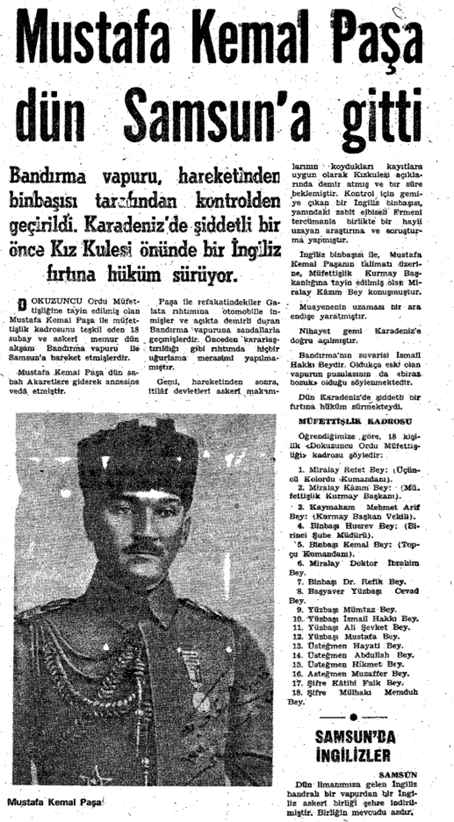
A Newspaper Clipping from the Period (İstiklal Harbi Gazetesi
Before departing for Samsun, Mustafa Kemal Pasha made a series of farewell visits in Istanbul. During this time, he met with the Ministry of War, the Grand Vizierate, and various military and civil authorities. The most notable of these visits was his meeting with Sultan Vahdettin at Yıldız Palace on 15 May 1919.
Detailed accounts of this meeting have reached us through narratives Mustafa Kemal Pasha later recounted to Falih Rıfkı Atay. According to these accounts, Sultan Vahdettin said during the meeting: “Pasha! You have served the country until now. All of that has been recorded in books. The service you are about to perform may be the most crucial of all: you may save the state.”【7】 This conversation between Mustafa Kemal Pasha and Sultan Vahdettin carried symbolic significance for the political balance of the era.
Immediately after arriving in Samsun on the morning of 19 May 1919, Mustafa Kemal Pasha telegraphed the Grand Vizierate to report on the security situation in the region and the public reaction to the occupation of İzmir.【8】
Under British pressure, the Istanbul government recalled Mustafa Kemal; however, he refused to comply. On 23 June, a decision was issued to remove him from his post. During this period, while attending the Erzurum Congress, the Pasha was officially relieved of his duties on 8 July and resigned from military service. Thus, he resolved to continue his struggle as a civilian leader.【9】
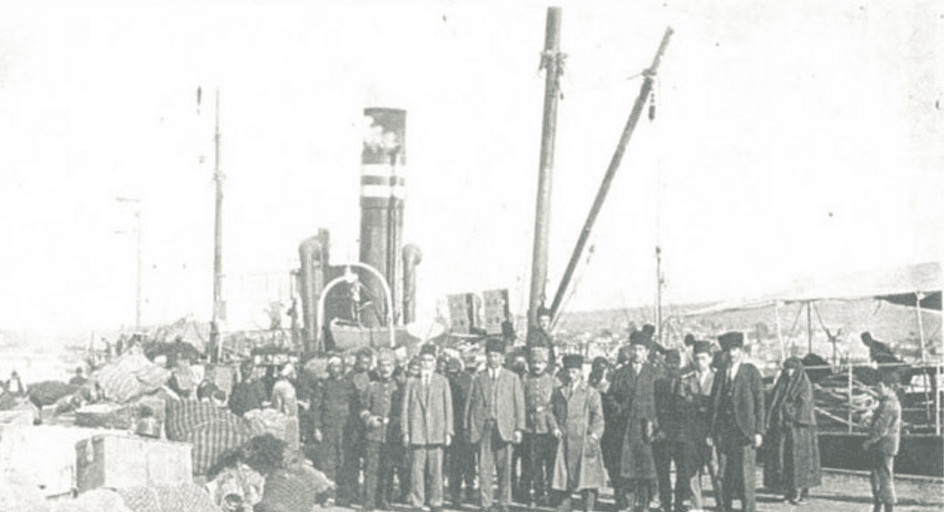
Mustafa Kemal Pasha and His Nature in Samsun (
Mustafa Kemal Pasha’s arrival in Samsun on 19 May 1919 gained significance during the Republican era, but the date was not officially recognized as a national holiday for many years. The first local commemorative events began in Samsun in 1926 under the name “Gazi Day”; in 1933, celebrations organized by the people of Samsun and a telegram sent to Atatürk led him to express his gratitude.【10】
One of the most significant developments in the process of embedding 19 May in public memory occurred in 1935. That year, wreaths were laid at Atatürk’s statue in Taksim, and sports clubs organized various events. A bicycle race was held between Taksim and Bentler, sailing and rowing competitions took place in Bebek, Fenerbahçe and Galatasaray clubs played a match at Taksim Stadium, and other matches at Karagümrük Stadium followed a parade. These events marked the first comprehensive organized celebrations that effectively established 19 May as a day commemorated primarily through youth and sports activities.【11】
In 1936 and 1937, newspapers continued to refer to 19 May as “Atatürk Day” or “Youth Day”; despite its lack of official status, it was widely perceived by society as a holiday. In 1938, during ceremonies held at Ankara Stadium, Interior Minister Şükrü Kaya announced that Mustafa Kemal had dedicated 19 May to Turkish youth and athletes. This declaration constituted the first official recognition of the historical date as dedicated to youth.【12】
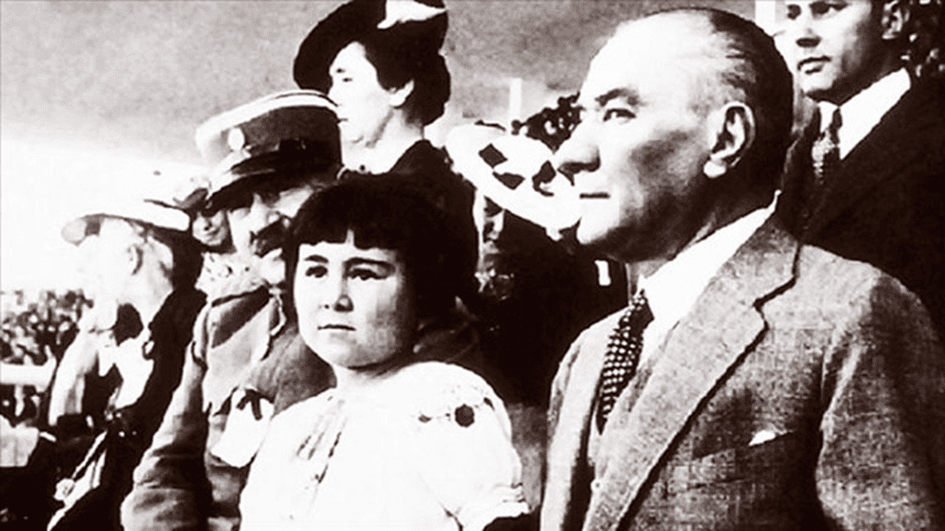
An Image from the 19 May Celebrations Attended by Atatürk in 1938 (AA)
Following this declaration, Law No. 3466 dated 20 June 1938 officially proclaimed 19 May as “Youth and Sports Day” and included it in the list of official public holidays. Thus, the local commemorations that began in the 1920s had, by the 1930s, become mass events centered on sports and youth activities, and in 1938, they acquired a legal foundation and national holiday status.
Following the military coup of 1980, national holidays were reorganized within the framework of the state’s ideological orientation. In 1981, the “Law on National Holidays and General Holidays” officially established May 19 as the “Commemoration of Atatürk, Youth and Sports Day”.
May 19, the Commemoration of Atatürk, Youth and Sports Day, is observed annually across Türkiye with various ceremonies and events involving participation from state institutions, universities, local administrations, and youth organizations. The day begins with official commemorative ceremonies at Anıtkabir led by state officials, followed by the laying of wreaths at Atatürk monuments, a moment of silence, and official programs accompanied by the National Anthem. Throughout the day, activities include stadium performances, youth parades, sports competitions, concerts, cultural presentations, and folk dances.【13】
A Scene from the May 19 Celebrations AA)
The Commemoration of Atatürk, Youth and Sports Day on May 19 is regularly observed in many countries outside Türkiye through Turkish diplomatic missions, educational institutions, and civil society organizations. These observances demonstrate the global continuation of Türkiye’s historical memory and its emphasis on youth.
Overseas events are typically organized under the patronage of Turkish embassies and consulates, with participation from Turkish schools, universities, local associations, and students in those countries. Programs include a moment of silence and the recitation of the National Anthem, followed by poetry readings, orations, folk dances, sports demonstrations, and student performances. In some locations, lantern parades, marches, exhibitions, and cultural promotion activities are also held.
Attendees usually include the Turkish ambassador to the host country, education advisors, Turkish teachers, students, and local guests. Speeches highlighting the significance of the day are delivered, and Atatürk’s address to the youth is recited.
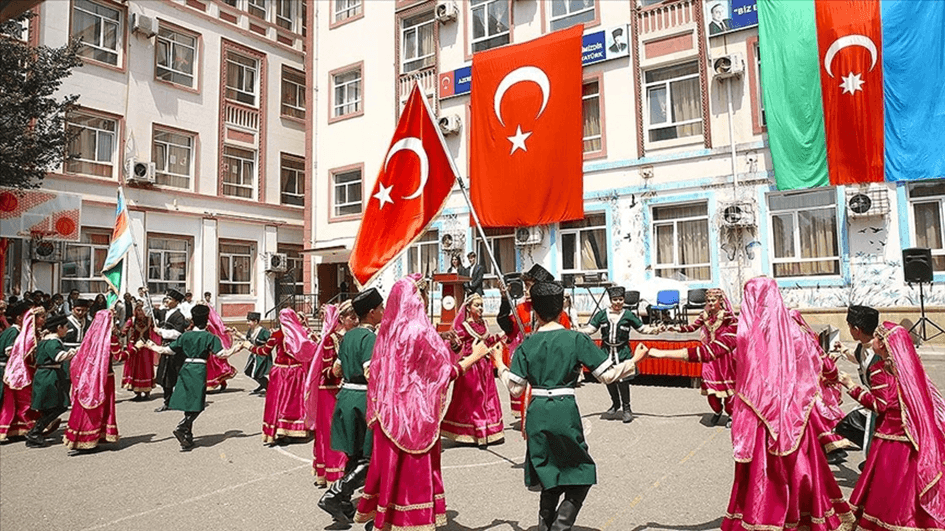
A Scene from the May 19 Celebrations in Azerbaijan – AA
These commemorations provide a framework for sustaining Turkish cultural identity and historical awareness, particularly in Azerbaijan, the Turkish Republic of Northern Cyprus, Balkan countries, Central Asian republics, and several European capitals. Observances abroad also reinforce the international symbolic resonance of the historical role assigned to youth and the ideal of independence.【14】
"Anadolu ve Rumeli Müdâfaa-i Hukuk Cemiyeti." Türkiye Diyanet Vakfı İslâm Ansiklopedisi, c. 3. İstanbul: Türkiye Diyanet Vakfı Yayınları, 1991, 44–46.
Anadolu Ajansı. Photo. "19 Mayıs Atatürk'ü Anma, Gençlik ve Spor Bayramı."
Anadolu Ajansı. “Atatürk’ün Katıldığı Son 19 Mayıs Kutlaması AA Arşivinde.” *AA*, May 19, 2024. https://www.aa.com.tr/tr/kultur/ataturkun-katildigi-son-19-mayis-kutlamasi-aa-arsivinde/3223015.
Anadolu Ajansı. “Dünyada 19 Mayıs Atatürk’ü Anma, Gençlik ve Spor Bayramı Kutlamaları.” *AA*, May 19, 2023. https://www.aa.com.tr/tr/dunya/dunyada-19-mayis-ataturku-anma-genclik-ve-spor-bayrami-kutlamalari/2901121.
Bardakçı, Murat. Bir Devlet Operasyonu: 19 Mayıs. İstanbul: Türkiye İş Bankası Kültür Yayınları, 2021.
Bardakçı, Murat. Şahbaba: Osmanoğulları’nın Sürgün ve Miras Öyküsü. İstanbul: Pan Yayıncılık, 2004.
Bardakçı, Murat. “Bir Devlet Operasyonu: 19 Mayıs 1919.” Habertürk, May 19, 2017. https://www.haberturk.com/yazarlar/murat-bardakci/1499934-bir-devlet-operasyonu-19-mayis-1919.
Bardakçı, Murat. “İşte Mustafa Kemal Paşa’ya Verilen Samsun Talimatının Sultan Vahideddin İmzalı Orijinal Nüshası.” Habertürk, May 19, 2018. https://www.haberturk.com/yazarlar/murat-bardakci/1974048-iste-mustafa-kemal-pasaya-verilen-samsun-talimatinin-sultan-vahideddin-imzali-orijinal-nushasi.
Cevdet Küçük. "Millî Mücadele." Türkiye Diyanet Vakfı İslâm Ansiklopedisi, c. 30. İstanbul: Türkiye Diyanet Vakfı Yayınları, 2005, 37–50.
Ekrem Buğra Ekinci, “19 Mayıs 1919 Neyin Başlangıcıdır?,” *ekrembugraekinci.com*, Accessed May 19, 2025. https://www.ekrembugraekinci.com/article/?ID=700&19-mayis-1919-neyin-ba%C5%9Flangicidir-.
Falih Rıfkı Atay, Çankaya, Pozitif Yayınları, 1999
T.C. Samsun Valiliği. "Atatürk ve Samsun." samsun.gov.tr. Accessed May 15, 2025. http://www.samsun.gov.tr/ataturk-ve-samsun2.
TRT Avaz. “Atatürk’ün Katıldığı Son 19 Mayıs Kutlaması Arşivlerde.” TRT Avaz, May 19, 2024. https://www.trtavaz.com.tr/haber/tur/avrasyadan/ataturkun-katildigi-son-19-mayis-kutlamasi-arsivlerde/66499d959849c1e85fd0b79d.
Turan, Şerafettin, Hasan Eren, and Hakkı Dursun Yıldız. “Mustafa Kemal Atatürk.” *Türkiye Diyanet Vakfı İslâm Ansiklopedisi*, Volume 31, Ankara, 2020, pp. 310–341. Accessed May 15, 2025. https://islamansiklopedisi.org.tr/mustafa-kemal-ataturk
Özüçetin, Yaşar. “Millî Mücadele İçerisinde ‘19 Mayıs 1919’.” Ahi Evran Üniversitesi Kırşehir Eğitim Fakültesi Dergisi 12, no. 1 (2004): 245–254. https://dergipark.org.tr/en/pub/kefad/issue/57226/808282.
[1]
Cevdet Küçük, “Millî Mücadele,” TDV İslâm Ansiklopedisi, vol. 30 (İstanbul: Türkiye Diyanet Vakfı Yayınları, 2005), 37–50.
[2]
Anadolu ve Rumeli Müdâfaa-i Hukuk Cemiyeti,” TDV İslâm Ansiklopedisi, vol. 3 (Istanbul: Türkiye Diyanet Vakfı Yayınları, 1991), 44–46.
[3]
Murat Bardakçı, Bir Devlet Operasyonu: 19 Mayıs (İstanbul: Türkiye İş Bankası Kültür Yayınları, 2021)
[4]
Özüçetin, Yaşar. “‘19 May 1919’ Within the National Struggle.” Ahi Evran University Kırşehir Faculty of Education Journal 12, no. 1 (2004): 245–254.
[5]
Ekrem Buğra Ekinci, “What Is the Beginning of May 19, 1919?,” ekrembugraekinci.com, accessed May 15, 2025,
[6]
Murat Bardakçı, “A State Operation: May 19, 1919,” Habertürk, May 19, 2017.
[7]
Falih Rıfkı Atay, _Çankaya_, İstanbul: Pozitif Yayınları, 1999, pp. 201-203
[8]
Government of Samsun, Türkiye. “Atatürk and Samsun.” samsun.gov.tr. Accessed 15 May 2025.
[9]
Turan, Şerafettin, Hasa Eren, and Hakkı Dursun Yıldız. “Mustafa Kemal Atatürk.” Türkiye Diyanet Vakfı İslâm Ansiklopedisi. Accessed 15 May 2025.
[10]
TRT Avaz,
[11]
Anadolu Agency, “The Last May 19 Celebration Attended by Atatürk in AA Archives,” AA, 19 May 2024,
[12]
Bardakçı, Murat. Bir Devlet Operasyonu: 19 Mayıs. İstanbul: Türkiye İş Bankası Kültür Yayınları, 2021.
[13]
【13】
In Ankara, the celebrations commence with a visit to Anıtkabir and continue with ceremonies attended by youth from all 81 provinces under the leadership of the Minister of Youth and Sports. In Samsun, a symbolic ceremony is held at the Tütün Pier, where Atatürk landed on May 19, 1919; the Turkish flag is raised ashore, commemorating the beginning of the National Struggle. Similar events—sports activities, youth gatherings, musical performances, and various displays—are organized in many cities across Türkiye. Universities and municipalities support programs through concerts, lectures, marches, and outdoor events designed to encourage youth participation.
[14]
Anadolu Agency, “Commemorations of May 19 Atatürk, Youth and Sports Day Around the World,” AA, 19 May 2023,


An Image from the May 19 Events
History | 19 May 1919 | ||||||||
|---|---|---|---|---|---|---|---|---|---|
Country | Türkiye | ||||||||
Holiday Type | Official National Holiday | ||||||||
Start Process | 1981: Current name 'Commemoration of Atatürk Youth and Sports Holiday' 1938: Officially established as 'Youth and Sports Holiday' 1935: Expanded celebrations as 'Atatürk Day' 1926: First local celebrations in Samsun under the name 'Gazi Day' | ||||||||
Frequency of Occurrence | Celebrated annually on 19 May | ||||||||
No Discussion Added Yet
Start discussion for "May 19 Commemoration of Atatürk, Youth and Sports Day" article
Period After the First World War
Signing of the Armistice of Mudros and the De Facto Occupation of Istanbul
Occupation of İzmir (15 May 1919)
Anatolian Defense of Rights Associations
The Process of Mustafa Kemal Paşa’s Assignment to Samsun
Appointment as Inspector of the 9th Army
His Powers, Nature, and Final Days in Istanbul
Powers and Mission Definition
Nature and Headquarters
His Final Days in Istanbul
Events After His Arrival in Samsun
Proclamation of 19 May as Youth and Sports Day
May 19 Celebrations Today
Observances Abroad