




Kelkit (District)
Have you ever imagined a place that is covered in snow during winter and glows with fertile soil in summer? Kelkit is a historic district of Gümüşhane, renowned for its plains and rivers, rich with stories. Let us explore this place steeped in history and nature together!
Where Does the Name Kelkit Come From?
The name Kelkit has several intriguing origins. Some researchers suggest that in ancient times, the Kelkit River was known in Greek as “Lykos,” meaning “wolf.” Over time, this name evolved into its current form. According to another legend, the area was once called “Kilki Bey’s Farm” in antiquity.
Nature and Lush Green Plains
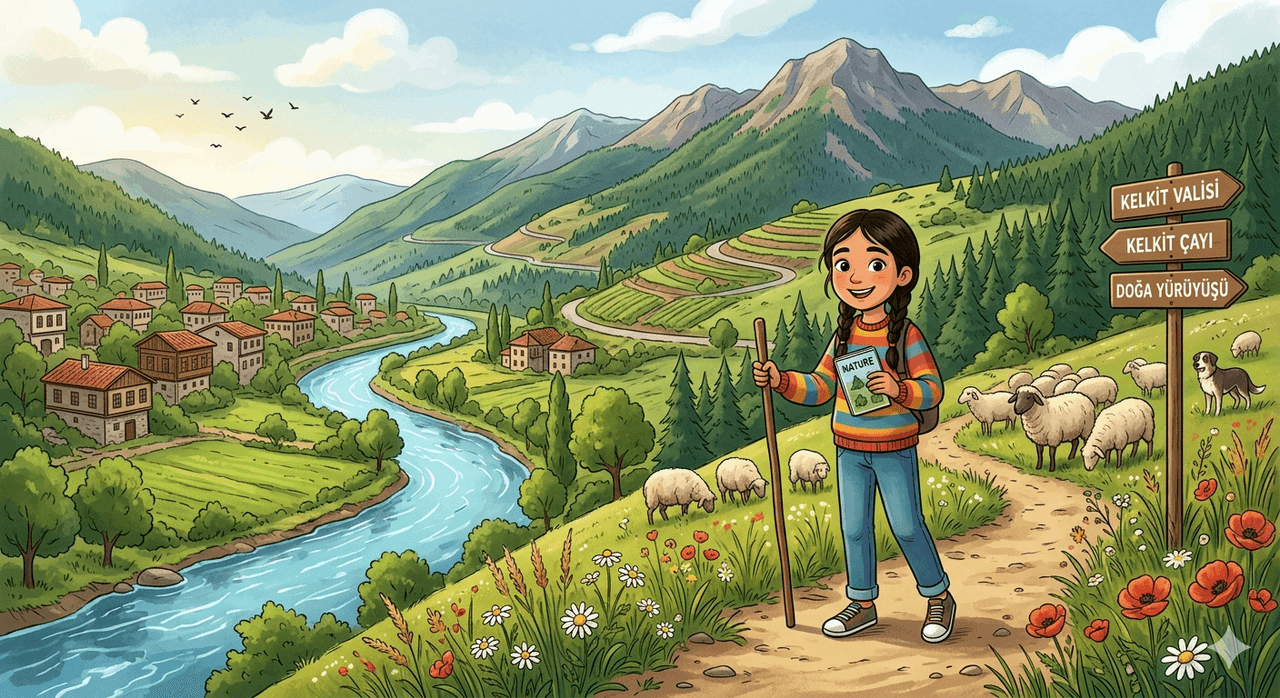
Kelkit is located at a considerable elevation above sea level, approximately 1412 meters high.【1】 Although surrounded by mountains, the district itself is generally a flat plain. The massive Kelkit River originates from the Çimen Mountains and is one of the largest tributaries feeding into the Yeşilırmak.
While summers here are dry, abundant rain and snow fall during winter and spring. This climate allows crops such as barley, wheat, and rye to thrive in the fields.

Visual representing Kelkit (generated by artificial intelligence).
A Journey Through Time: From the Hittites to Today
Kelkit’s history extends back thousands of years, to around 5000 years ago.【2】 In ancient times, the Hittites, Urartians, and Persians inhabited this region.
In 1058, Ibrahim Yinal Bey, brother of Seljuk Sultan Tugrul Bey, conquered these lands.【3】 From that time onward, Kelkit became a new home for Turkmen tribes.
During the Ottoman Empire, Kelkit remained an important center and was officially established as a district (kaza) in 1840.【4】
In 1918, thanks to our heroic soldiers, Kelkit was liberated from enemy occupation and attained the peaceful present it enjoys today.【5】
Famous Zilli Kilims
One of the most colorful things associated with Kelkit is the "Zilli Kilim." The origins of these kilims reach back to Central Asia. With their distinctive patterns and vibrant colors, they have become a symbol of Kelkit. Once woven only as prayer rugs or saddlebags, today they are also made as wall decorations and souvenirs.
Citations
[1]
T.C. Gümüşhane Valiliği, “Kelkit,” accessed 31 March 2026, https://www.gumushane.gov.tr/kelkit.
[2]
Kelkit Belediyesi, “Sayfa,” accessed 31 March 2026, https://www.kelkit.bel.tr/sayfalar/sayfa/369.
[3]
Kelkit Belediyesi, “Sayfa,” accessed 31 March 2026, https://www.kelkit.bel.tr/sayfalar/sayfa/369.
[4]
Kelkit Belediyesi, “Sayfa,” accessed 31 March 2026, https://www.kelkit.bel.tr/sayfalar/sayfa/369.
[5]
Kelkit Belediyesi, “Sayfa,” accessed 31 March 2026, https://www.kelkit.bel.tr/sayfalar/sayfa/369.