KURE Kids Header Line
badge icon

This content was originally written in Turkish for children and is automatically translated into English using artificial intelligence.

article-image

Lebdeğmez (Lip-Not-Touched) Tradition

Last Updated: 06.04.2026

Have you ever tried speaking without letting your lips touch each other or biting your lower lip? Have you ever wondered how you would say words like “Baba” or “Meyve,” which contain the letters “B” or “M,” without moving your lips at all? Isn’t that quite difficult? For centuries, our folk poets in Anatolia and neighboring regions have mastered this challenge. The tradition of poets competing by reciting poetry to each other without using the labial consonants "b, p, m, v, f" is known as lebdeğmez or dudakdeğmez.

Representative Visual of the Lebdeğmez Tradition (Image Generated by Artificial Intelligence)

How Is the Lebdeğmez Game Played? 🎸

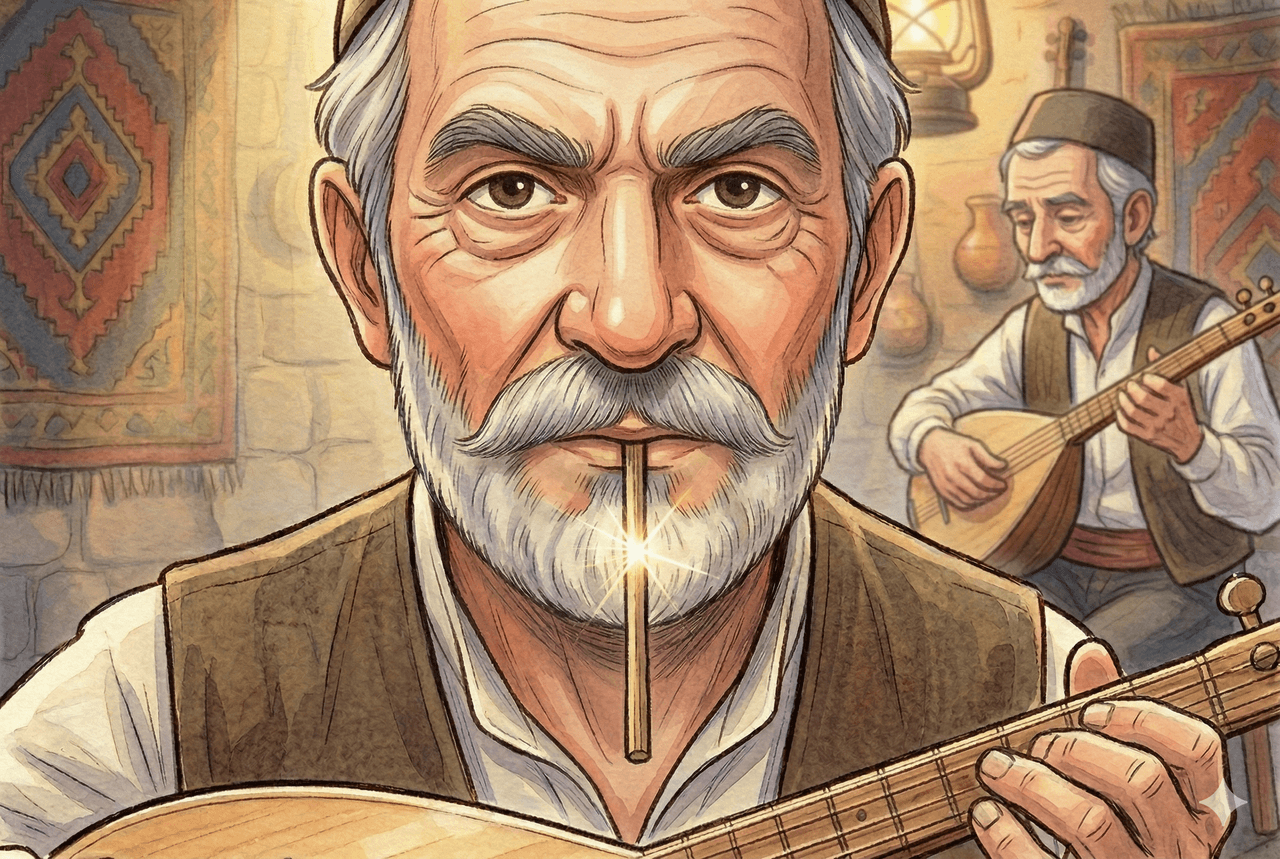
Folk poets, known as aşıks, place a sharp needle or a toothpick between their lips during these contests. They then take up their saz instruments and begin reciting poetry back and forth.


The rule is simple but demands great precision: If during the contest one poet accidentally uses a word containing any of the letters b, p, m, v, or f, their lips will naturally come together. At the moment the lips close, the needle or toothpick between them will gently pierce the lip or fall out. The poet who breaks this rule loses the competition.

Why Do Poets Use Such a Demanding Method? 🧠

You may have wondered, “Why do they put themselves through such difficulty?” The art of lebdeğmez is a display of skill meant to demonstrate the poets’ vast vocabulary and remarkable intelligence.


It is also deeply thrilling for the audience. The poets select each word like a puzzle piece, using sharp wit and speed to craft verses that challenge and confuse their opponents.

Poets Competing in the Lebdeğmez Tradition (Image Generated by Artificial Intelligence)

⏳ A Journey Through Time

This unique lebdeğmez art within the aşıklık tradition is an ancient heritage that has endured for centuries. Around 300 to 400 years ago, in the 17th century, renowned masters such as Âşık Hasta Kasım and Âşık Hekim Telim Han demonstrated this skill by placing needles between their lips. Today, the tradition is still kept alive in cities such as Erzurum.

Don't Forget to Look at These!
Science and Technology
cat img
Natural Sciences
cat img
Art and Literature
cat img
image
Most Read
Thomas Edison
arrow
image
Last Added
Kişisel Verileri Koruma Günü
arrow
ilham-notu-bg
INSPIRATION NOTE FOR CURIOUS KIDS!

You can also play a small "lebdeğmez" game with your friends or family! Try describing your favorite cartoon or book for one minute without using any words containing the letters B, P, M, V, or F. Let's see how long you can speak without your lips touching!

Who Wrote?
Kids Writing
AuthorEsra Nur BulutApril 6, 2026
bottom-bg-effect-bottom
bottom-bg-effect-top

The lebdeğmez tradition is a highly entertaining and thrilling word game played within the world of language. This custom, preserved by our poets for centuries, demonstrates the richness of our Turkish vocabulary and creates a unique work of art by pushing the boundaries of our language.

Bibliographies

Balkaya, Adem. "Âşıklık Geleneğinde Bilinmeyen Bir Söyleme Tarzı: Dil Oynamaz/Dil Dönmez." *Folklor Akademi Dergisi* 7, no. 3 (2024): 1004-1011. Accessed March 28, 2026. https://dergipark.org.tr/tr/download/article-file/4017799

Kayaokay, İlyas. "Divan Edebiyatında Leb-Değmez Sanatıyla Yazılan Gazeller." *Millî Kültür Araştırmaları Dergisi (MİKAD)* 1, no. 2 (December 2017): 95–107. Accessed March 28, 2026. https://dergipark.org.tr/tr/download/article-file/386373

Özdemir, Fırat. "Aşıklık geleneği 'dudakdeğmez'i yaşatıyorlar." Anadolu Ajansı. Date Published January 22, 2020. Accessed March 28, 2026. https://www.aa.com.tr/tr/kultur-sanat/asiklik-gelenegi-dudakdegmezi-yasatiyorlar/1710002

Salahi, Ahmad. "İran Âşıklarında Dudak Değmez." *TÜRÜK Uluslararası Dil, Edebiyat ve Halkbilimi Araştırmaları Dergisi* 11, no. 32 (2023): 199–207. Accessed March 28, 2026. http://www.turukdergisi.com/Makaleler/1115019195_22.A.Salahi%20199-207.pdf

ilham-notu-bg
ilham-notu-bg
ilham-notu-bg
HEYY!
Did You Know?
These?
Lamb
Lamb
Ask to Küre