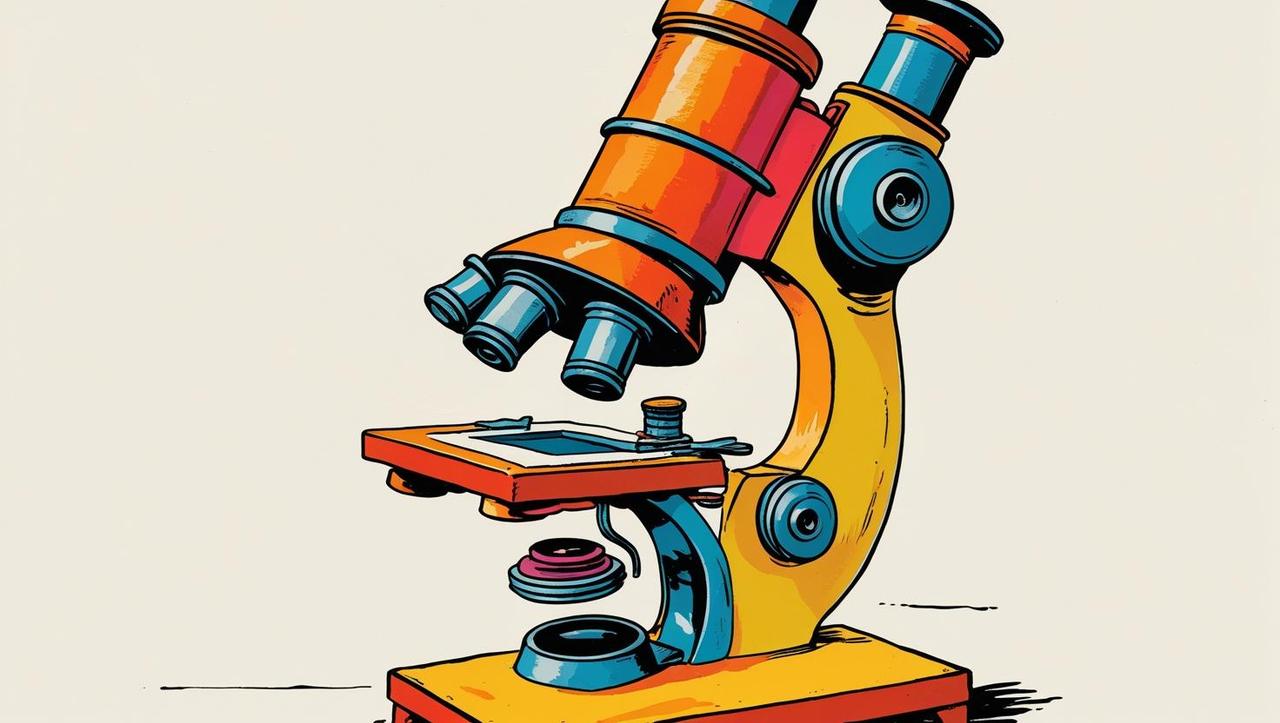




Microscope
Microscope
When viewed through a microscope, worlds invisible to the naked eye are revealed!
What Is a Microscope?
A microscope is an instrument that magnifies objects too small to be seen with the naked eye. For example, a grain of dust, an ant’s leg, or cells become visible when viewed through a microscope.
Many microscopic organisms—those too small to be seen—exist around us in daily life. Thanks to the microscope, we can examine these organisms in detail.

(Generated by artificial intelligence)
How Does It Work?
Microscopes contain special lenses that bend light to enlarge the image. As a result, a tiny object appears as if it has become enormous.
Some microscopes have a light source that illuminates the object from below, producing a clearer and more detailed image.
Where Is It Used?
- In schools: To examine cells and living organisms in science classes
- In hospitals: To analyze blood samples or pathogens
- In laboratories: Scientists use microscopes during experiments
Archaeologists may even use microscopes to study tiny traces on historical artifacts.
What Can Be Seen Through a Microscope?
- Plant cells
- Blood cells
- Bacteria and microbes
- Fibers of fabric
- Details of insects
Even within a tiny leaf, a remarkable order can be observed through a microscope!

(Generated by artificial intelligence)
Time Travel
The First Microscope Was Made Over 400 Years Ago!
The microscope was first developed in the 1600s in the Netherlands. Scientist Antonie van Leeuwenhoek was the first person to observe microscopic organisms living in a drop of water!